
Beyond Chips and Tariffs: Inside the US–China Rare Earth War
“China’s rare earth export restrictions mark a new chapter in the US-China trade war. As Trump revives tariff battles, Beijing strikes back by weaponizing semiconductors and rare earths.”

Paromita Das
New Delhi, 14th October: In the 21st century, the power to dominate no longer rests on nuclear warheads or troop strength alone—it lies in the invisible realm of chips, data, and rare minerals that fuel global technology. As Donald Trump storms back into the White House, promising to reassert American dominance, the world braces for a new kind of war—one fought not on battlefields, but across supply chains, semiconductor fabs, and rare earth mines.
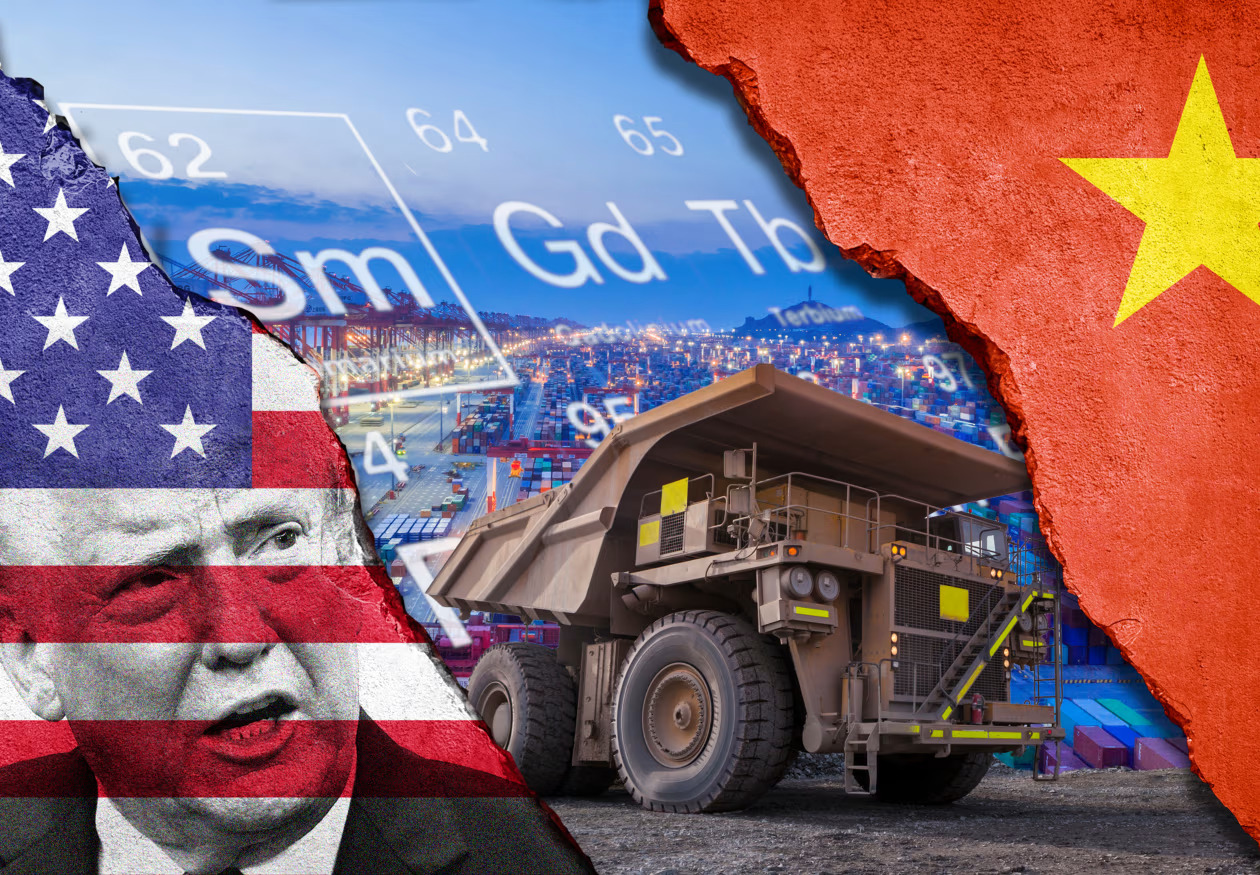
On October 9, 2025, China’s Ministry of Commerce (MOFCOM) announced sweeping new export restrictions on rare earth elements (REEs)—a move that immediately shook global markets and sent shockwaves through Washington. Beijing’s decision isn’t merely economic; it’s a declaration of strategic defiance, a signal that China will no longer be a passive participant in America’s trade games.
Beijing’s Metallic Counterstrike
Under MOFCOM’s Announcement No. 61, China expanded its export control list to include 12 additional rare earths—such as Holmium, Europium, and Ytterbium—used in semiconductors, military radar systems, and electric vehicle magnets. Even products containing trace Chinese inputs, as little as 0.1%, are now subject to licensing. This extension effectively pulls global supply chains into Beijing’s jurisdiction, giving China unprecedented leverage over any nation dependent on its rare earth refining technologies.
To grasp the scale of this move, one must understand that China refines over 90% of the world’s rare earths. While these minerals exist in other regions—from Australia to the US—their extraction and purification are environmentally taxing, capital-intensive, and technologically demanding. China mastered this art decades ago, combining cheap labor, lax environmental regulations, and state-driven investment.
In one stroke, Beijing has turned its technological dependency into a geopolitical weapon.
Weaponizing the Elements of Modern Civilization
By tightening control over rare earth exports, China isn’t merely retaliating—it’s redefining the rules of engagement. The new controls directly link REEs to the semiconductor and artificial intelligence sectors, both central to Washington’s ambitions. Any material tied to chips smaller than 14 nanometers or AI systems with potential military applications now falls under “case-by-case” scrutiny by Beijing.
The result? A precarious rebalancing of global supply chains. Factories in Vietnam, Malaysia, and Thailand—which rely on Chinese-designed magnet and refining equipment—now face uncertainty. For companies like Intel, Tesla, and Boeing, this is more than an inconvenience; it’s a strategic crisis. The message from Beijing is crystal clear: if the US restricts China’s access to chips, China will restrict America’s access to what makes chips possible.
Trump’s High-Stakes Trade Game
President Donald Trump’s return has reignited his signature strategy—tariffs and trade threats. His administration’s insistence on reinstating high tariffs, especially the 57.6% duty on Chinese goods, has worsened tensions. Washington recently added 16 Chinese tech firms to its Unreliable Entity List, accusing them of aiding hostile groups and supplying dual-use components. In response, China retaliated by blacklisting 14 American firms, accusing them of meddling in Taiwan and aiding military applications against Beijing.
Trump’s economic nationalism may play well to his domestic base, but it is increasingly boomeranging on the US economy. American automakers like Ford have already faced production halts due to magnet shortages, and farmers are reeling from retaliatory tariffs on soybeans. What began as an effort to bring manufacturing “home” has turned into an expensive cycle of mutual retaliation, with both sides bleeding in the process.
China’s Calm, Calculated Response
Unlike Washington’s erratic approach, Beijing’s moves appear measured, strategic, and confident. The CCP leadership understands that while the world depends on the dollar, it equally depends on Chinese minerals, magnets, and microchips. Even Trump’s threats to ban Chinese airlines from Russian airspace or sanction Chinese refineries have done little to unnerve Beijing. China’s rare earth monopoly—controlling 90% of refining—remains its most powerful deterrent.
This monopoly now extends even to trace elements in finished products, effectively placing a “Made with China” stamp on countless Western goods. It’s a masterstroke of policy warfare—turning economic interdependence into strategic dominance.
Ripple Effects on Bharat and the Global South
Bharat, though not directly involved in the US-China trade war, finds itself walking a tightrope. Nearly all of Bharat’s rare earth magnets for EVs and defence systems come from China. With Beijing tightening its grip again, New Delhi faces supply vulnerabilities that could slow its EV adoption target of 30% by 2030 and complicate defence modernisation plans.
However, the Modi government is responding proactively. Bharat’s ₹7,350 crore incentive scheme aims to promote domestic production of sintered rare-earth permanent magnets, creating an indigenous supply chain for materials like neodymium and praseodymium oxide. The initiative envisions five manufacturing hubs capable of producing up to 6,000 tonnes annually, reducing dependence on Beijing over the next decade.
Diplomatically, Bharat has managed to carve out a mutually cautious understanding with China. After the August 2025 SCO Summit, where Modi and Xi met, Beijing resumed light REE exports to Bharat, provided New Delhi guarantees against re-exporting to the US. It’s a delicate dance of pragmatism amid rivalry—proof that Bharat can balance national interests without bowing to great power pressures.
A Battle Beyond Economics
The escalating tech-mineral war between the US and China is more than an economic spat—it’s a struggle over the architecture of global power. Trump’s brand of economic coercion represents the old unipolar mindset, where Washington dictates and others comply. China’s response, however, mirrors the emerging multipolar order—one that seeks parity, not submission.
In this sense, Beijing’s REE policy is both a defensive maneuver and a declaration: the age of unilateral dominance is over. The world’s industrial backbone—its chips, magnets, and metals—is no longer controlled by one power. The future belongs to those who can adapt, diversify, and innovate beyond political tantrums.
The Metallic Future of Multipolarity
The global order is shifting, not through treaties or wars, but through supply chains and circuitry. As the US and China trade economic blows, the rest of the world watches and adapts. Beijing’s latest export controls may be a tactical escalation, but strategically, they mark the dawn of resource-based geopolitics—where rare earths are the new oil, and technological independence is the ultimate weapon.
Trump may try to tariff his way back to dominance, but in the mineral and semiconductor age, control lies with those who own the process, not just the product. For now, that edge belongs to China—and the rest of the world is learning to live, and compete, within that new reality.
