
Between Ally and Equilibrium: Bharat’s Quiet Diplomacy in the Israel-Gaza Conflict

Paromita Das
New Delhi, 16th June: The historic relationship between Bharat and Israel is rooted in both pragmatism and evolving geopolitics. While formal diplomatic ties were only established in 1992, the collaboration between the two countries predates that—with Bharat extending quiet support during Israel’s formative years, and Israel reciprocating with arms supplies during the 1962 and 1971 wars. But for decades, Bharat’s public alignment leaned toward the Palestinian cause, rooted in its post-colonial foreign policy and commitment to non-alignment. That approach has gradually transformed into a delicate balancing act, and in the current Israel-Gaza crisis, Bharat’s careful positioning is more strategic than ever.
When Prime Minister Narendra Modi recently tweeted about his conversation with Israeli Prime Minister Benjamin Netanyahu amid the ongoing conflict in Gaza, the message was clear in what it included—and perhaps even clearer in what it didn’t. There was sympathy for Israel’s losses and concern over regional instability, but no mention of the dire humanitarian crisis unfolding in Gaza, no call for a ceasefire, and conspicuously, no reference to Iran. This silence speaks volumes.
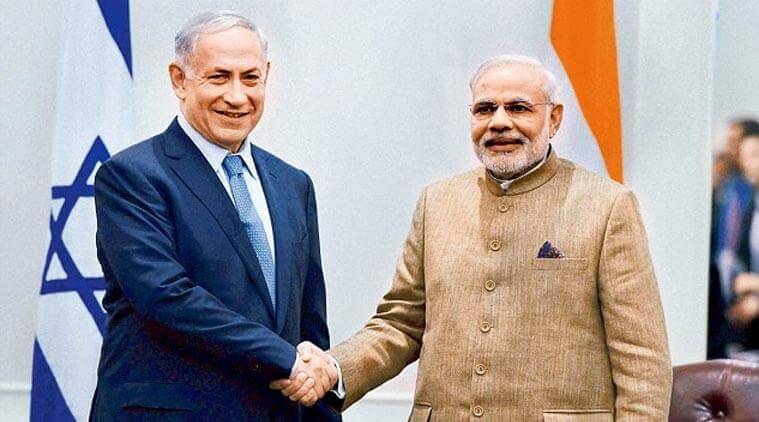
Modi and Netanyahu: A New Chapter in Bharat-Israel Relations
Under Modi’s leadership, Bharat’s ties with Israel have become increasingly open and unapologetic. Gone are the days of covert defense collaboration alone; now, the friendship encompasses a wide array of sectors—from advanced weaponry and drone technology to water management and agricultural innovation. Modi’s visit to Israel in 2017—the first by an Bharatiya Prime Minister—was a diplomatic milestone, signaling Bharat’s readiness to treat Israel as a visible and strategic ally.
This close alignment, especially in the face of global criticism over Israel’s military actions in Gaza, signals a shift in Bharat’s foreign policy language—from non-alignment to nuanced alignment. Bharat supports Israel’s right to self-defense and continues to condemn terrorism. These are positions that align comfortably with its own national security narrative, particularly when dealing with cross-border terrorism in Kashmir or threats from extremist groups.
Iran and the Art of Strategic Silence
Yet even as Modi affirms solidarity with Israel, Bharat’s refusal to mention Iran is no coincidence. Iran remains a sensitive partner for Bharat—not necessarily a friend, but certainly not a foe. Bharat’s infrastructure investment in Iran’s Chabahar Port is pivotal to accessing Central Asia and sidestepping its complex relationship with Pakistan. Iran also lies at the heart of Bharat’s extended neighborhood policy, playing a crucial role in energy security and regional connectivity.
The problem is that Israel and Iran are on a collision course. From covert assassinations to drone strikes, tensions have escalated beyond proxy battles. For Bharat, any appearance of choosing one side over the other could come at a significant cost—politically, economically, and diplomatically. Hence, Bharat’s response has been calculatedly cautious. It is diplomacy in its most muted form—avoiding unnecessary noise while preserving essential ties.
The Arab World and the Domestic Balancing Act
Bharat’s engagement with the Arab world adds another layer of complexity. Gulf nations like the UAE, Saudi Arabia, and Qatar are not just vital energy suppliers—they are home to over eight million Bharatiya expatriates who send billions in remittances annually. These countries also maintain strong cultural and religious ties with the broader Muslim world, including Palestine. Any overt support for Israel during active conflict risks jeopardizing those relationships.
On the home front, the government is aware that its core voter base leans towards a nationalistic view of foreign policy. Aligning with Israel’s security-first stance—while avoiding overt critique of Palestinian suffering—plays well with constituents who admire Israel’s military resolve and counterterrorism strategies. It’s a domestic calculation layered over a geopolitical one.
Realism Over Rhetoric
Bharat’s response, though frustratingly vague to some observers, reflects a broader shift toward realism in foreign policy. Idealism—the kind that once drove Bharat to champion Palestinian statehood—has gradually given way to strategic pragmatism. New Delhi now prioritizes alliances that serve tangible national interests over moral posturing.
But realism doesn’t have to mean indifference. A more balanced stance—acknowledging civilian casualties while condemning terrorism—would project Bharat as a truly global leader with the moral authority to mediate, not just maneuver. Silence may preserve relationships, but empathy can earn respect.
Diplomacy by Design, Not Default
In one tweet, Prime Minister Modi said little. But in that silence lies a roadmap of Bharat’s foreign policy in the 21st century: cautious, calculated, and increasingly centered on strategic interests rather than historical positions. Bharat’s relationships with Israel and Iran, with the Arab world and its own diverse population, demand this intricate balance.
The current Israel-Gaza war has placed the region—and the world—on edge. While major powers take bold stands, Bharat continues to tread lightly, trying to avoid the cracks in the geopolitical pavement. It’s a risky game of balance, but one that reflects the country’s evolving priorities.
In diplomacy, sometimes saying less isn’t weakness—it’s a strategy. And in the Middle East, where every word can carry the weight of war, Bharat has chosen, at least for now, to whisper rather than shout.
