
Bengal’s Tourism Boom: The Rise Mamata Can’t Claim Alone
“Bharat’s nationwide tourism reforms—not state-level politics—are driving Bengal’s sudden surge in foreign visitors.”

Paromita Das
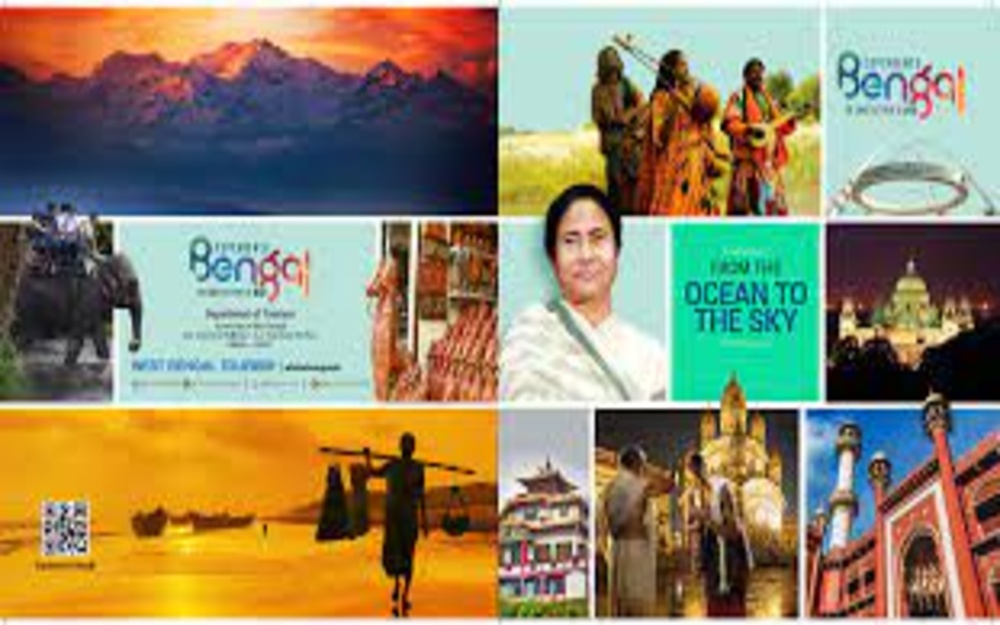
New Delhi,1st December: Tourism numbers seldom become political talking points, yet West Bengal’s sudden rise in Bharat’s tourism rankings has sparked exactly that. For the first time, the state has climbed to the second position in foreign tourist arrivals in 2025, up from third place in 2023–24. On the surface, it is a moment of pride for both Bengal and Bharat. But instead of celebrating a collective achievement, Chief Minister Mamata Banerjee has taken to social media to congratulate herself—without acknowledging the larger national push that made this surge possible.
This storyline is not unusual in Bharatiya politics, where development statistics are often reshaped into personal victories. But tourism is a sector that does not grow in isolation. It thrives on policy consistency, global branding, strong infrastructure, and ease of entry—factors driven overwhelmingly by the central government over the past decade. Bengal’s improved ranking, then, is not the outcome of sudden state-level innovation, but a reflection of Bharat’s broader tourism transformation under Prime Minister Narendra Modi.
The Rise of Bengal: A National Effort in the Background
The numbers tell a compelling story. According to the Bharat Tourism Data Compendium 2025, West Bengal recorded 3.12 million foreign tourists, placing it just behind Maharashtra. In doing so, it surpassed Rajasthan and Delhi—two long-established tourism giants.
Yet Bengal’s tourism infrastructure has not undergone any dramatic transformation since 2011, when the TMC came to power. Roads remain inconsistent, tourist safety measures have not significantly evolved, and the state’s international promotion remains modest. What changed instead was Bharat’s national tourism environment, revitalized through targeted policies that made travel to Bharat easier, safer, and more attractive.
The surge is real—but its roots extend far beyond Kolkata’s administrative boundaries.
How National Policies Powered Bengal’s Tourist Influx
UNESCO Recognition: Durga Puja’s Global Spotlight
The global acknowledgment of Kolkata’s Durga Puja as an “Intangible Cultural Heritage of Humanity” in 2021 was a turning point. UNESCO’s recognition did not arrive by chance; it was the result of coordinated diplomacy and cultural advocacy by Bharat’s central government. Once listed, the festival gained unprecedented visibility, becoming a magnet for international travelers and cultural researchers.
Durga Puja today is not just a religious celebration—it is a globally endorsed cultural phenomenon. That stamp of prestige alone has driven thousands of foreign visitors to Bengal every October.
E-Visa and Medical Visa: The Real Game Changers
The Modi government’s e-visa expansion, simplified visa application process, and medical visa reforms have dramatically boosted travel to Bharat. Bengal, due to its proximity to Bangladesh, has benefited the most.
Private hospitals in Kolkata now attract record numbers of Bangladeshi medical tourists, drawn not by Bengal’s governance but by Bharat’s streamlined visa systems and the “Heal in India” initiative. These visitors contribute significantly to the state’s hospitality, retail, and travel sectors.
This flow would not exist without the central government’s redesign of medical visa procedures.
Incredible Bharat 2.0 and Global Branding
One of Bharat’s most influential tourism drivers remains Incredible Bharat, first conceptualized under Atal Bihari Vajpayee and expanded aggressively by Modi. The campaign was re-launched in 2017 as Incredible Bharat 2.0, with targeted digital advertising, global events, and a fully integrated tourist portal.
The new system enables travelers to learn, plan, book, and navigate trips in Bharat with unprecedented ease. States like West Bengal, even without investing heavily in international visibility, enjoy the spillover benefits of this national platform.
Cruise Tourism: Bengal’s Silent Beneficiary
Kolkata’s tourism revival also owes much to Bharat’s push for cruise tourism, particularly along the Hooghly and through the Bay of Bengal. Initiatives like the Bengal Ganga Cruise and the planned Bharat-ASEAN cruise corridor have placed Bengal on the map for premium travelers, a demographic that previously had limited engagement with the state.
Again, the vision and investment for these projects came largely from Delhi.
Mamata Banerjee’s shameless “proud milestone” for Bengal tourism?
A blatant CREDIT THEFT from the tourism revolution unleashed under Prime Minister Narendra Modi, while the only “international visitors” she seems most invested in facilitating are those who conveniently bolster… https://t.co/oeR8OeZQ7h
— Amit Malviya (@amitmalviya) November 26, 2025
The Missing Piece: Mamata’s 15 Years of Under-investment
While Mamata Banerjee has eagerly claimed credit for Bengal’s rising tourism rank, her administration’s own record tells a different story. Over nearly 15 years, the state has not delivered major tourism-driven infrastructure, global branding initiatives, or world-class facilities. Its famous cultural wealth—from Kalighat art to Baul traditions—remains under-marketed. Adventure tourism, beach infrastructure, and heritage restoration lag behind other Bharatiya states.
The contrast is stark: Bengal’s tourism success is growing despite the state government, not because of it.
Proud to share that West Bengal has emerged as one of the most favoured international tourist destinations in the country, and has achieved another great milestone!!
In the recently released India Tourism Data Compendium 2025 by Ministry of Tourism, Government of India , West…
— Mamata Banerjee (@MamataOfficial) November 26, 2025
Politics and Tourism: A Convenient Narrative Before Elections
With assembly elections approaching, it is unsurprising that the TMC seeks to present this achievement as a direct result of state leadership. BJP leaders, including Amit Malviya, have publicly questioned this narrative, pointing out that tourism has been a priority sector for the Modi government since 2014.
Tourism growth translates to income for local communities, higher informal sector earnings, and increased state revenue. Politically, it offers an attractive storyline. But facts remain stubborn: Bengal’s tourism infrastructure did not undergo sudden improvement. The rise is part of a pan-Bharat tourism boom, driven by central reforms.
A Victory for Bharat—Not an Individual
Bengal’s tourism leap to the second position is a matter of national pride. It reflects the vibrancy of Bharatiya culture, the strength of Bharat’s global branding, and the accessibility created through digital governance and streamlined visas. But it also highlights the dangers of political appropriation.
Tourism does not grow through isolated praise posts. It grows when national and state systems work in sync—something Bengal must still strive to achieve. For now, the credit belongs to Bharat’s collective push, not to any single leader. The numbers show it. The travelers reveal it. And soon, voters may see it too.
