
Bengal’s Data Bomb: How a Voter List Audit Sparked a Political Earthquake
“Bengal’s Electoral Earthquake: What the Voter List Data Reveals About Illegal Infiltration and the Political Storm Ahead.”

Paromita Das
New Delhi, 25th November: Sometimes, it is not political speeches or protests that change the course of national debate — it is cold, hard data. In West Bengal, the Special Intensive Revision (SIR) process of the Election Commission has turned into one such revelation. What began as a routine verification exercise to update voter rolls has now exposed what could be one of the largest demographic and electoral irregularities in Bharat’s democratic history.
As the Election Commission’s computerized voter data from 2003 was uploaded and cross-verified in late 2025, startling figures began to emerge. District after district, the numbers pointed to an abnormal surge in voter registration — a pattern concentrated along Bengal’s nine border districts adjoining Bangladesh. What was once political rhetoric about infiltration now stands reinforced by statistical evidence — and it raises difficult questions about governance, security, and the integrity of Bharat’s democracy.
A Disturbing Statistical Pattern
According to official SIR data, voter registration in Bengal’s border districts has increased by an astonishing 66% over the last 23 years — far beyond the natural rate of population growth. The most dramatic increases have been recorded in districts sharing direct boundaries with Bangladesh:
- Uttar Dinajpur: 105.49% increase
- Malda: 94.5%
- Murshidabad: 87.6%
- South 24 Parganas: 83.3%
- Jalpaiguri: 82.3%
- Cooch Behar: 76.5%
- North 24 Parganas: 72.1%
- Nadia: 71.46%
- Dakshin Dinajpur: 71%
- Birbhum: 73.4%
When the data was first computerised, the surge appeared inexplicable. Now, with digitized records revealing duplications, false entries, and irregular documentation, a worrying narrative has begun to unfold — one that aligns with long-standing allegations of large-scale illegal immigration from Bangladesh.
Infiltration, Identity, and Electoral Manipulation
For decades, illegal migration from Bangladesh has been both a humanitarian and political issue in Bengal. However, the latest data suggests it may also be an institutional issue — one that implicates local political ecosystems. Many of the alleged illegal entrants appear to have obtained Aadhaar, PAN, and voter ID cards, often through local networks and political patronage.
Those involved in the SIR process claim that local leaders and administrative workers facilitated the inclusion of illegal names for vote bank expansion, ensuring electoral advantages for certain parties. Political insiders allege that infiltration was not merely ignored but actively engineered to reshape Bengal’s demography and cement long-term political control.
This accusation, though politically charged, now finds empirical backing. The SIR data from the Election Commission is not based on speculation but on cross-verification of voter records spanning two decades.
The Political Battle Over SIR
While the revelations have sent shockwaves through political circles, the response from parties has been sharply divided. The Bharatiya Janata Party (BJP) has long maintained that Bengal’s voter rolls are tainted by mass inclusion of illegal immigrants. BJP leaders such as Suvendu Adhikari have demanded immediate verification and removal of fraudulent entries, arguing that “illegal voters undermine national security and distort democracy.”
In contrast, the Trinamool Congress (TMC) government, led by Chief Minister Mamata Banerjee, has repeatedly questioned the SIR process, calling it “politically motivated” and “administratively flawed.” The TMC has argued that the exercise could disenfranchise genuine citizens, warning that it might be used selectively to target minority communities.
Yet, the intensity of TMC’s resistance — letters to the Election Commission, appeals to the Supreme Court, and political protests — has itself raised eyebrows. Critics point out that if the data is genuine, halting the SIR only serves to shield irregularities, not democracy.
Institutional Challenges and Risks
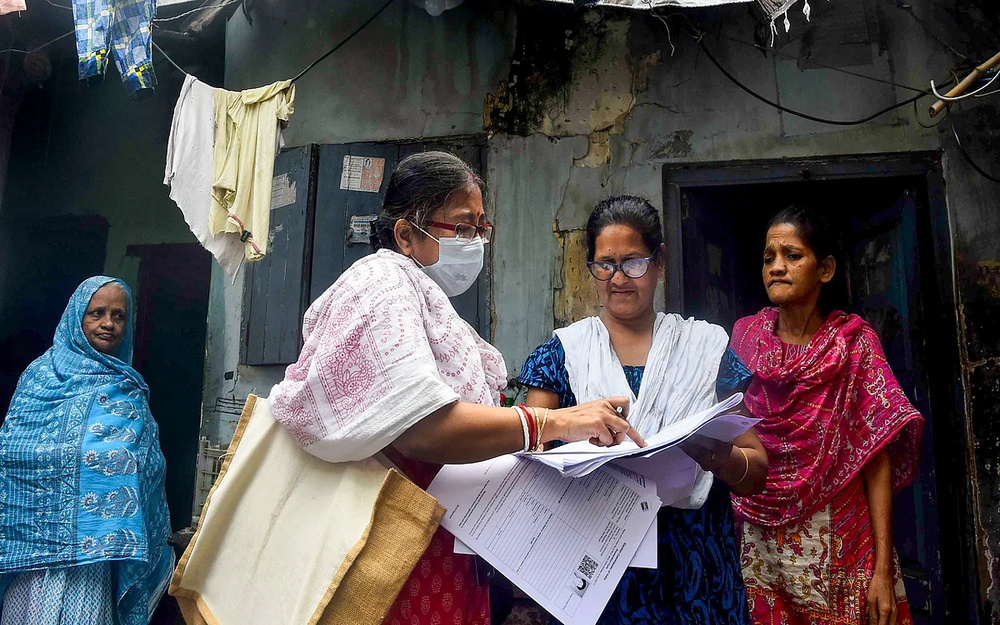
The SIR process has also exposed the pressures faced by Booth Level Officers (BLOs) and election officials in Bengal. Reports suggest that many are working under threats and political coercion, making it difficult to conduct impartial verification. In some instances, officials have even faced intimidation from local groups while trying to remove false entries.
Observers argue that the Election Commission may need to deploy central staff or inter-state teams — similar to how central security forces are deployed during elections — to ensure the integrity of the ongoing process. Relying solely on local personnel in politically charged districts risks compromising accuracy and transparency.
A Question for the Judiciary and the Nation
As the controversy deepens, petitions challenging the SIR process have once again reached the Supreme Court, with new appeals filed even after earlier judgments had upheld the legitimacy of the revision. Many legal experts question why the Court continues to re-examine a settled matter when the Election Commission’s data-backed evidence speaks for itself.
The larger question now is not just administrative — it is existential. If individuals whose parents are absent from the 2003 voter rolls are now registered voters, how did this demographic transformation occur? What does it mean for Bharat’s electoral purity and for the very definition of citizenship?
Politics Over Patriotism
The SIR revelations are not merely about numbers; they are about national integrity. When political parties choose short-term electoral gains over the country’s long-term security and demographic balance, democracy itself becomes vulnerable. It is concerning that, apart from the BJP, no major party has openly acknowledged infiltration as a national threat.
This silence — whether born of political calculation or ideological appeasement — risks normalizing a problem that could one day alter Bharat’s social and cultural fabric irreversibly.
The Numbers Don’t Lie
The ongoing revelations from the SIR in Bengal mark more than just an electoral audit — they represent a moment of reckoning. A 66% rise in voter registration along the border is not a statistical quirk; it is a signal that national borders have blurred not only geographically but electorally.
For Bharat, this is not merely about who votes, but who belongs. The Election Commission’s persistence, despite political resistance, must be seen as a defense of democratic integrity. Whether the system can withstand the combined pressure of politics, populism, and fear will define the credibility of Bharat’s democracy in the years ahead.
