

Poonam Sharma
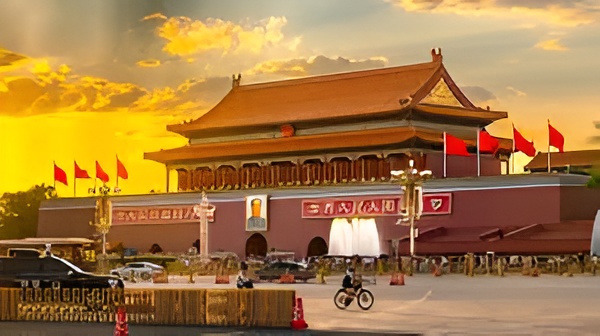
Beijing still stands. The glass towers remain to glisten in the smog-filmed sun, the propaganda posters still clutter the boulevards, and Tiananmen Square continues to capture the eye of cameras. But take a stroll through the streets, and you will hear a sound which never fit the world’s second-largest economy: the echo of your own footsteps.
After being the pulse of China’s ascendance—fashion capital, banking center, cultural hub, and political cockpit—Beijing now resembles a city on life support. Restaurant earnings plummeted 88% in the last year. Tourists have disappeared. Expats and young professionals are gone. The individuals who used to crowd Beijing’s alleys, clubs, and boardrooms have departed, have been forced out, or simply quit. What is left is not decline, but decay—slow, grinding, and self-inflicted.
From Cosmopolitan Engine to Ghost City
2010s Beijing was China’s reply to Paris and New York in one package. Models, venture capitalists, expats, and movie stars occupied smoky bars and rooftop lounges. Foreigners injected money, connections, and cosmopolitan drive. Nowadays? A fifth-tier vegetable market on a Saturday night is more vibrant.
Sanlitun, Beijing’s nightlife hub, now looks like a movie set when the actors have all left home—lights off, clubs closed, hawkers gone. Even the city’s legendary late-night barbecue stalls, smoky havens for dreamers and deal-breakers, have been muzzled.
The Six Legs of an Economy—Four Already Broken
Beijing’s economy previously rested on six legs: tech, finance, education, culture, foreign investment, and tourism. Four are already broken.
Tech: What was once China’s Silicon Valley has seen its innovation culture asphyxiated by censorship and rectification campaigns. Baidu and ByteDance office spaces are ghosts of their former selves, manned by risk-averse bureaucrats rather than hungry engineers.
Finance: Chaoyang’s finance center is a graveyard of deals killed by overregulation. Even regulators cut 30–50% salaries. Old six-figure financiers now have cheap dinner at home rather than driving luxury stores and restaurants.
Education: The 2021 private tutoring crackdown exploded Haidian’s billion-dollar industry in an instant. New Oriental giants let go of 60,000 employees and shed 80% of revenue. Middle-class steps crumbled with it.
Culture: Independent cinema, tiny theatres, and music bars have shriveled up under censorship. The soft power rhythm of Beijing pulses a barely perceptible beat.
Foreign investment and tourism—the last two pillars—are buckling fast. Multinationals quietly shift to Singapore and Bangkok. International visitors to China plunged from 32 million in 2019 to just 14 million in 2023. Beijing’s slice of that smaller pie keeps shrinking, as tourists increasingly prefer Tokyo, Kyoto, or even Harbin.
The Human Exodus
Beijing’s actual collapse is demographic. The city’s population reached its peak in 2016 and has since dwindled. Worse, it is not only retirees who are moving out but the young, educated working citizens that infuse a metropolis.
Two political decisions hastened this freefall:
The “low-end population purge” in 2017: Overnight, tens of thousands of migrant workers—delivery riders, cooks, shopkeepers—were expelled, branded “low-end.” Bulldozers demolished their neighborhoods, tearing out the circulatory system of the city.
The Xiong’an New Area experiment: Factories and workers were moved 100 km out, abandoning an aging capital. Now, 20% of Beijing’s residents are aged over 60, weighing down economic dynamism.
Throw in lost foreign talent and widescale layoffs in tech and education, and the streets of Beijing are surprisingly quiet.
Tourism Wrecked, Spirit Broken
Beijing must be a tourism giant. It is a surveillance state instead, where the Great Wall and Forbidden City appear as checkpoints under watchful eyes. Harsh Covid regulations murdered spontaneity; stricter security laws frightened off foreigners. Japanese and American business leaders held without reason? Word spread quickly. The consequence: a tourism downturn that even Chinese tourists shun, opting for Harbin’s ice festivals or Chengdu’s barbecue.
In the meantime, official statistics hide the slowdown. State-owned Beijing-based companies record revenues made elsewhere, exaggerating the capital’s GDP. In theory, the city remains robust. In reality, small enterprises choke. The atmosphere is hoarding and fear, not expansion.
A Broken Social Contract
Beijingers endured decades of smog, traffic, and filthwater because the city paid dividends to ambition. You could reinvent yourself, cut deals, or find opportunities that transformed your life. That tacit bargain is shattered.
Today, Beijing provides only surveillance, censorship, and quiet. A city once full of life has turned into an homage to what it once was.
Epilogue: A Capital in Name Only
Beijing is not rubble just yet; the lights remain. But without its inhabitants and soul, it is no longer a capital—simply an accident of history. You can fence off Tiananmen, you can plaster propaganda, but you cannot disguise the emptiness of closed-up shops, deserted bars, and empty streets.
The golden age of Beijing is gone. And while the rest of the globe keeps going forward, the great city lingers in time, holding its breath for someone to flip the switch on the way out.
