
Behind the Beat: Congress’s Playbook to Fake Gen Z Outrage
"What looked like Gen Z’s fiery protest anthem turns out to be a carefully curated Congress campaign blending music, politics, and manipulation."

Paromita Das
New Delhi, 18th October: It began like any other viral moment.
A young, struggling rapper drops a fiery track calling out the Modi government — lyrics laced with anger, rhythm pulsing with defiance. Within hours, the song floods social media timelines. Congress supporters share it with zeal, influencers tag it “India’s Gen Z awakening,” and the video racks up thousands of views.
But as the digital applause grows louder, something doesn’t add up. The same video, promoted heavily by Congress’s IT cell, carries a familiar tone — one that feels rehearsed rather than raw. It’s the kind of outrage that seems less like rebellion and more like a campaign wearing a hoodie.
Soon, questions emerge: Who created this song? Who promoted it? And is it truly the voice of Bharat’s youth — or just another political project disguised as one?
Behind the Bars of Propaganda
The rapper’s video, promoted by several Congress-aligned accounts, carried a caption that sounded revolutionary. One of the first to share it was X user Ankit Mayank, who proudly calls himself Rahul Gandhi’s “Babbar Sher.” His post declared, “Gen Z is using music to expose the fascist regime. Fiery rap — must share.”
So GenZ in India is now using music to expose & speak against the fascist regime
Fiery rap song, must share. Interesting times ahead 🔥 pic.twitter.com/RDdi4L6eCt
— Ankit Mayank (@mr_mayank) October 12, 2025
But behind the bold words lies a different truth. Investigations into the viral track revealed that the Congress party has been actively hiring rap songwriters, influencers, and meme creators for months. The so-called “organic rebellion” was part of a paid digital strategy.

A LinkedIn trail led straight to Tekendra Sharma, who had posted multiple job openings for the Congress party — specifically looking for “rap songwriters,” “cartoonists,” and “social media influencers.” When contacted, Sharma confirmed that he had indeed posted the vacancies for the Congress, though he described himself as an “independent recruiter.” His role, he admitted, was to shortlist candidates and forward them to the party.

In simpler terms, Congress was recruiting creative professionals to craft anti-government content — and passing it off as the genuine frustration of Bharat’s youth.
The Rap, the Rhetoric, and the Reality

This revelation changes the context entirely. What seemed like a spontaneous protest song now appears to be a premeditated political tool, part of a wider digital campaign designed to seed anti-government sentiment.
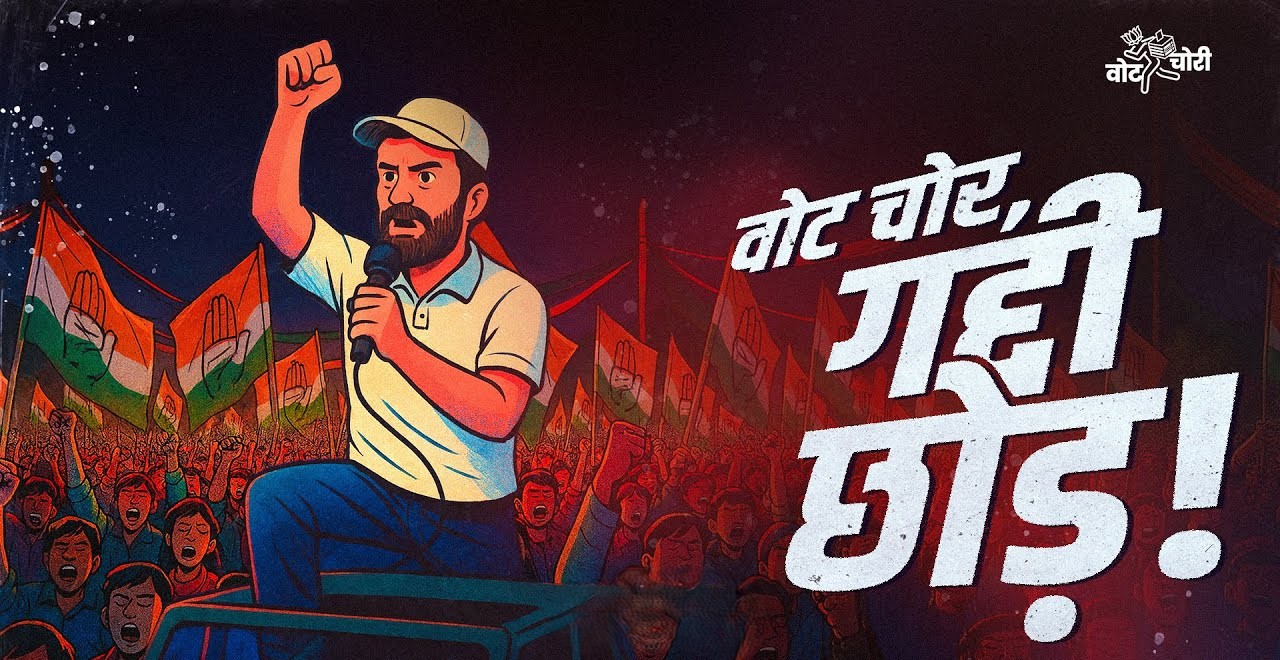
A second rap, titled “वोट चोर, गद्दी छोड़” (Vote Thief, Leave the Throne), soon surfaced on Congress’s own YouTube channel. The lyrics portrayed Rahul Gandhi as an incorruptible hero, accused the Election Commission of bias, and echoed the same “vote theft” narrative Congress had been pushing online for weeks.
Interestingly, around the same time, Congress-linked content creators began releasing short Reels and memes echoing the same themes — many of which were later exposed as part of a paid influencer campaign, costing between ₹20,000 and ₹30,000 per creator.
The pattern is unmistakable: manufacture digital outrage, brand it as “Gen Z anger,” and use it to energize anti-government sentiment.
Borrowed Beats from Across the Border

Congress’s strategy appears to draw inspiration from Nepal’s Gen Z protests, which toppled the KP Oli government after months of online activism. Rahul Gandhi, whose political messaging has increasingly focused on youth empowerment and social media outreach, seems to be attempting a similar playbook in Bharat.
Over the past year, his digital ecosystem has evolved rapidly — from rap songs to meme-driven attacks, influencer collaborations, and orchestrated “viral moments.” It’s politics, but not as usual. It’s politics in 4K — catchy, emotional, and algorithm-ready.
Yet the core question persists: Can a movement be authentic if it’s manufactured?
When Politics Turns Pop Culture

There’s nothing inherently wrong with using art to express dissent. Music, after all, has always been a mirror to society’s conscience — from protest songs in America’s civil rights era to anti-establishment rock in the 1970s.
But what’s happening now is different. Here, music isn’t being used to challenge power — it’s being commissioned to imitate rebellion.
Congress’s approach reflects a broader crisis in political communication: the belief that viral equals valid. Instead of nurturing organic movements, parties now assemble them, treating outrage as a product. When dissent is scripted, its power diminishes — and so does public trust.
Moreover, Bharat’s Gen Z — highly connected, skeptical, and digitally literate — can tell the difference between genuine conviction and paid performance. Trying to “influence the influencers” may work once or twice, but in the long run, it risks alienating the very demographic Congress hopes to win.
A Deafening Silence from Congress

Emails sent to Congress media chief Jairam Ramesh and spokesperson Pawan Khera seeking clarification about the recruitment drive remain unanswered. No official statement has been issued on the authenticity of the viral rap or the hiring process.
Meanwhile, the rapper behind the viral track has vanished from public view — no interviews, no updates, no acknowledgement. The silence speaks volumes.
On YouTube, Congress’s official handle continues to post more rap videos, meme edits, and music-driven jabs at the Modi government. The pattern of digital warfare is clear: weaponize pop culture to capture the attention economy.
The Manufactured Sound of Anger
The viral rap song marketed as Gen Z’s rebellion against the Modi government wasn’t a spontaneous act of courage — it was a carefully orchestrated campaign, built in boardrooms and branded as grassroots.
This isn’t just about one song or one party. It’s about the transformation of political discourse into performance art — where authenticity is optional, and virality is the goal.
For Bharat’s youth, the lesson is crucial: don’t let algorithms define your activism. Genuine change is built on conviction, not choreography.
In the end, every beat that claims to speak for Gen Z must answer one question — is it rebellion or recruitment?
