
When Politics Entered the Bench: The Baharul Islam Episode
India’s Institutional Paradox

Poonam Sharma
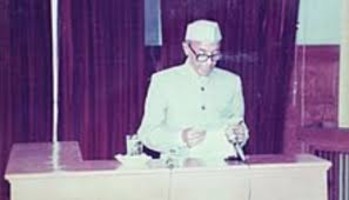
In contemporary political discourse, allegations of “institutional capture” dominate debates around India’s democracy. Opposition leaders repeatedly accuse the ruling establishment of weakening constitutional bodies by placing “their people” in positions of authority. Yet history, when revisited carefully, often unsettles convenient narratives. The career trajectory of Baharul Islam—an advocate from Assam who moved seamlessly between the Congress party, Parliament, High Courts, and even the Supreme Court—offers a telling case study of how deeply politics and institutions were intertwined in the early decades of post-Independence India.
A Forgotten Name, A Revealing Story
Baharul Islam is not a household name today. Yet his journey reflects an extraordinary convergence of political patronage and judicial elevation that would be unthinkable under today’s scrutiny. Originating from Kamrup district in Assam, Islam began his professional life as an ordinary advocate at the then Assam–Nagaland High Court (now Gauhati High Court) in the early 1950s. At that stage, his career gave no hint of the exceptional path ahead.
The turning point came in 1956, when Islam formally joined the Indian National Congress. This political alignment would prove decisive. By 1958, he had enrolled as an advocate of the Supreme Court. Four years later, in 1962, the Congress nominated him to the Rajya Sabha. A second term followed in 1968, allowing him to remain a Member of Parliament until 1972.
From Parliament to the High Court
What followed marked a constitutional oddity. In 1972, directly from the Rajya Sabha, Baharul Islam was elevated as a judge of the Gauhati High Court. The transition from active party politician to constitutional adjudicator raised eyebrows even then, but the political climate of the time permitted such moves. Judicial appointments were entirely under executive control; the collegium system did not yet exist.
Islam assumed office as a High Court judge on January 20, 1972. Within a few years, his ascent continued. On March 11, 1979, he took oath as the Chief Justice of the Gauhati High Court. A former Congress MP now headed a constitutional court tasked with adjudicating disputes involving the state and the citizen—an overlap that exposed the blurred lines between political loyalty and judicial independence in that era.
Retirement, Return, and the Supreme Court
Islam retired from the High Court in March 1980, as per service rules. But retirement did not mark an exit from public power. That same year, Indira Gandhi returned to office after defeating the Janata Party government led by Morarji Desai. Within months, on December 4, 1980, the Congress government appointed Baharul Islam as a judge of the Supreme Court of India.
The appointment sparked controversy. Critics questioned the propriety of elevating a recently retired Chief Justice with a clear political background to the apex court. Unlike today, there was no institutional buffer—no collegium, no consultative checks. Judicial appointments were an extension of executive discretion.
The controversy intensified in January 1983, when Islam resigned from the Supreme Court following sustained criticism. Yet what happened next was perhaps the most revealing moment of all.
From the Bench Back to the Party Office
Immediately after resigning as a Supreme Court judge, Baharul Islam walked straight back into Congress politics. He rejoined the party without pause or hesitation. The Congress even considered fielding him from the Barpeta Lok Sabha constituency in Assam. Amidst the charged atmosphere of the Assam Movement, Islam reportedly chose not to contest. Instead, Indira Gandhi once again accommodated him—this time through a Rajya Sabha nomination.
The sequence was extraordinary: advocate to MP, MP to High Court judge, judge to Chief Justice, Chief Justice to Supreme Court judge, Supreme Court judge to Congress leader, and once again MP. Such a circular movement between politics and the judiciary remains rare, even by global standards.
The Larger Constitutional Question
The Baharul Islam episode forces a deeper reflection on India’s constitutional evolution. Today’s debates around judicial independence, neutrality of institutions, and executive overreach often assume that such problems are new. History suggests otherwise. In the Nehru–Indira era, institutional control was often overt, unapologetic, and structurally embedded.
Several of Islam’s judgments were later criticised for alleged bias, including rulings perceived as favourable to Congress-led governments. Whether those judgments were legally flawed or merely politically suspect is a matter of interpretation. But the perception of partisanship itself damaged the credibility of institutions meant to stand above politics.
Then and Now: A Question of Memory
Ironically, it is the Congress that today raises the loudest alarms over alleged institutional erosion. Leaders like Rahul Gandhi accuse the BJP and RSS of “placing their people” across constitutional bodies. Yet the Congress’s own history reveals a period when political loyalty and constitutional authority coexisted with little resistance.
The presence of retired officials, judges, and commissioners—appointed during Congress rule—who later took overt political positions further complicates claims of moral high ground. The system that Congress built allowed such crossovers. Baharul Islam was not an anomaly; he was a product of his time.
An Uncomfortable Legacy
The story of Baharul Islam is not merely about one individual. It is about an institutional culture that blurred boundaries between party and state, ideology and adjudication. As India debates judicial appointments and institutional trust today, this forgotten chapter serves as a reminder: the crisis of neutrality did not begin in the present. It was inherited.
Selective amnesia may serve political rhetoric, but constitutional integrity demands historical honesty. Without it, claims of defending democracy risk sounding hollow—echoes unanchored from the very past that shaped India’s institutions.
