

GG News Bureau
Ayodhya, 9th Jan.
Ayodhya Ram Mandir Marks A Watershed Moment in Bharat’s Cultural History
As we usher in 2024, Bharat is on the brink of a cultural renaissance. The consecration of the Ram statue at Ayodhya’s freshly constructed Ram Janmabhoomi mandir should not be viewed solely as a religious occasion. Yes, we Hindus worship Ram. However, much as the Ramayana and Mahabharata are Bharat’s national epics, Ram is our national hero. Within every one of us, we see Ram.
The Ram Mandir in Ayodhya marks a watershed moment in Bharat’s cultural history. A society that is constantly subjected to injustice and horrors committed by aggressors will eventually be liberated. This temple represents our ability to protect our self-respect. The revival of the Ram mandir in 2024 is only comparable to the resurrection of the Somnath mandir in the 1950s.
What is being built at Ayodhya is more than a brick-and-mortar temple; it is a monument to Bharat’s civilizational journey.
This energy manifests itself majestically in the mandir, which is currently being completed. On August 5, 2020, Bharat’s Prime Minister, Narendra Modi, laid the ceremonial foundation stone for a new mandir at what is considered to be the birthplace of the god Ram. “Navya Ayodhya,” a new city near the Faizabad-Gorakhpur motorway, will be built on a 500-acre tract and will include luxury hotels and housing complexes.
The inauguration of the Ram Mandir is scheduled for January 22, 2024. PM Modi has rightly called on citizens to light a lamp on this day so that the eternally relevant message of Ram’s life and goal reaches everyone.
Ayodhya, located on the banks of the Sarayu River, formerly known as Saketa, boasts a rich history dating back to the fifth or sixth century BC. The magnificence of the Ayodhya Ram Mandir stands tall in the historic city of Ayodhya, a monument to the continuing spirit of a people passionately connected to their cultural and religious past. Ayodhya draws pilgrims, historians, and visitors who are drawn by its mythological and historical roots.
Today, the growing Ram Mandir is a majestic symbol of endurance, dedication, and cultural resurgence, ushering forth a new era in Ayodhya and Bharat’s history.
Let’s delve into every facet of Ayodhya, from its ancient origins to the majesty of its mandir, while unearthing some lesser-known truths that add to its richness.
Timeline of Ayodhya
Ayodhya is a significant place not only for Hindus but also for Jainism, as the Jain text states that five Tirthankars, including the founder of Jainism and the first Tirthankar, Shri Rishabh Dev, lived there. For Buddhists, Ayodhya is particularly significant as a Buddhist centre under the Mauryan Empire (322–185 B.C.E.). Ashoka the prominent was a prominent advocate of Buddhism, expanding the Mauryan Empire to encompass nearly all of modern-day Bharat. At the height of his empire-building, Ashoka renounced battle and converted to Buddhism, declaring Buddhism the official religion of the empire and establishing Buddhist mandirs throughout. During his rule, Ayodhya rose to prominence as a Buddhist centre.
Shravasti served as the kingdom’s capital during Buddhist times, between the sixth and fifth centuries BCE. Some scholars believe that Ayodhya is the same as Saketa, where Buddha is claimed to have lived for a while. Ayodhya also became an important Buddhist centre under the Maurya and Gupta kingdoms, with Buddhist temples and stupas being built over the centuries.
The Significance of Ayodhya
Ayodhya, one of the most ancient, largest, and most majestic of Bharatiya towns, covered an area of 250 km2. The city was the capital of the Hindu kingdom of Kosala, and it housed the court of the great king Dasaratha, the 63rd monarch of the Solar dynasty descended from Vivaswan, or the Sun God. Vivaswan’s son, “Viavswat Manu,” established the city of Ayodhya. The first chapters of the Ramayana describe the splendour of the city, the glories of the ruler, and the virtues, wealth, and allegiance of his subjects. Rama’s father, Dasaratha, was the Seventh Avatar of Vishnu.
The legendary monarchs of Kosaldesh’s capital city included Ikshvaku, Prithu, Mandhata, Harishchandra, Sagar, Bhagirath, Raghu, Dileep, Dashrath, and Ram. Ayodhya is mentioned as another name for Saketa in many works beginning in the fourth century, including Kalidasa’s Raghuvamsha. The later Jain canonical source Jambudvipa-Pannati describes Lord Rishabhanatha’s birthplace as Viniya and associates it with Bharata Chakravartin; the Kalpa-Sutra describes Rishabhadev’s birthplace as Ikkhagabhumi.
According to another idea, the fabled Ayodhya is a fictitious city, and the name “Ayodhya” was first used for Saketa in the fourth century, when a Gupta monarch relocated his capital to Saketa and called it Ayodhya after the legendary city.
Ayodhya’s local oral tradition, first documented in writing by Robert Montgomery Martin in 1838, mentions that the city was abandoned following the death of Rama’s descendant, Brihadbala. The city remained uninhabited until King Vikrama of Ujjain came looking for it and rebuilt it. He cleared the woods that had buried the old ruins, built the Ramgar fort, and constructed 360 temples.
Hans Bakker hypotheses that the transfer to Ayodhya was spurred by the flooding of the Ganges at Pataliputra, the necessity to halt the Huna march from the west, and Skandagupta’s wish to compare himself to Rama.
Mughal and British periods
The Babri mosque in Ayodhya was built during the reign of the Mughals. Following Aurangzeb’s death in 1707 AD, the central Muslim rule collapsed, and Awadh gained practical independence, with Ayodhya as its capital. However, the kings became more reliant on the local Hindu nobles, and authority over temples and pilgrimage sites was relinquished.
In the 1850s, a group of Hindus stormed the Babri mosque, claiming that it was built on the birthplace of the Hindu deity Ram. To avoid further clashes, British rulers divided the mosque grounds between Hindus and Muslims. The British annexed Ayodhya in 1856. Awadh’s rulers were Shia, and Sunni organisations had already criticised the previous government’s lax policies. The British intervened, crushing the Sunni resistance. In 1857, the British seized Oudh (Awadh) and later reorganised it as the United Provinces of Agra and Oudh.
Ayodhya in an independent Bharat
The Vishva Hindu Parishad party initiated a push in 1984 to recapture the Babri mosque for a Rama mandir. In 1992, a right-wing Hindu nationalist protest degenerated into a riot, resulting in the destruction of the Babri mosque. A temporary shrine at Ram Janmabhoomi was built for Ram Lalla. Under Bharatiya government orders, no one was permitted inside 200 yards of the location, and the gate was sealed from the outside. However, Hindu visitors began entering through a side door to worship.
In 2003, the Archaeological Survey of India (ASI) excavated the mosque site to discover whether it was built on the ruins of a mandir. On September 30, 2010, the Allahabad High Court’s Lucknow bench ordered that one-third of the disputed land should be granted to the Uttar Pradesh Sunni Central Waqf Board, one-third to the Nirmohi Akhara, and one-third to the Hindu party for the shrine of “Ram Lalla.” The court further directed that the area containing the Ram idols be granted to Hindus in the final decision, while the remainder of the land is divided evenly by metes and bounds among the three parties.
The judgement, along with evidence supplied by the Archaeological Survey of India, upheld that the Babri Masjid was erected after demolishing the Hindu Mandir where Rama was born and that the mosque was not built in accordance with Islamic principles. The Supreme Court’s final decision in the case determined the disputed land in favour of Hindus for the construction of the Ram Mandir and ordered that an alternative piece of land be provided to the Muslim community for the construction of the mosque.
On November 9, 2019, a five-judge bench of India’s Supreme Court handed over the site to the government to form a trust for the temple building. The court ordered the government to allocate a 5-acre plot of land in Ayodhya to the Uttar Pradesh Sunni Central Waqf Board for the construction of a mosque or masjid.
Architecture of the Ram Mandir in Ayodhya
The Sompura family of Ahmedabad originally designed Ram Mandir in 1988. However, it underwent several adjustments in 2020, specifically in reference to the Vastu and Shilpa shastras. For at least 15 generations, the Sompuras have helped design more than 100 temples around the world, including the Somnath mandir.
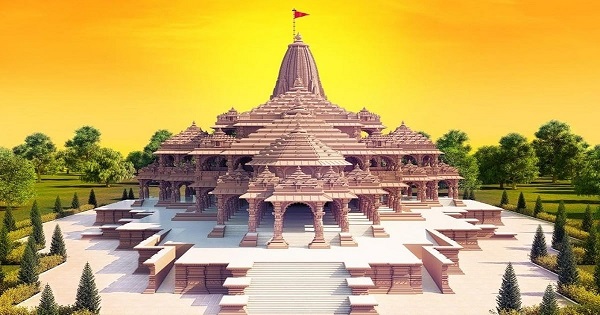
The Ayodhya Ram Mandir is a large mandir created in the Nagara style of temple construction, distinguished by its tall spires, or shikharas. The mandir is constructed of pink sandstone and covers an area of 2.77 acres. The mandir is encircled by a huge courtyard and features several smaller shrines devoted to different Hindu deities. The mandir’s most outstanding feature is the huge Shaligram stone, a black stone believed to represent Lord Ram that was taken from Nepal’s Gandaki River.
The mandir is 161 feet tall and has three stories, each serving a particular purpose. The first floor is dedicated to Lord Ram, the second to Lord Hanuman, and the third is a museum highlighting Ayodhya’s history and culture.
The mandir complex also includes a yajnashala, or hall for performing Hindu fire rituals, a community kitchen, and a medical facility. The mandir complex spans 67 acres and is anticipated to become a significant cultural and religious hub, drawing millions of devotees from all over the world. The Shri Ram Janmabhoomi Teerth Kshetra Trust is in charge of the construction of the Shri Ram Janmabhoomi mandir. In addition, the mandir’s construction is expected to cost between ₹ 1,400 crore and ₹ 1,800 crore, according to estimates.
Pictures taken this morning at Shri Ram Janmabhoomi Mandir site.
श्री राम जन्मभूमि मंदिर परिसर में आज प्रातः काल लिए गए चित्र pic.twitter.com/MOaDIiS91Y
— Shri Ram Janmbhoomi Teerth Kshetra (@ShriRamTeerth) December 24, 2023
The building will have three stories, with a 20-foot ceiling on each floor. There will be 44 gates and 392 pillars throughout the entire mandir. A small statue of Lord Shri Ram will be kept in the main sanctum, while Shri Ram Darbar will be located on the first level. The mandir can be accessed by ascending 32 steps from Singhdwar on the east side.
श्री राम जन्मभूमि मंदिर का भव्य सिंहद्वार
The Magnificent Sinh Dwar of Shri Ram Janmbhoomi Mandir.
📍Ayodhya pic.twitter.com/1BhjPpJh2N
— Shri Ram Janmbhoomi Teerth Kshetra (@ShriRamTeerth) January 4, 2024
Perkota is used to secure the mandir both inside and outside. The plan for Ram Mandir is to expand gradually over the next 50 years.
Special three-tiered tree planting to shield the mandir and its surroundings from storms and seasonal dust. Dedicated security facility to prevent any untoward events. Astrological constellations are used to design a flower garden and plantation.
The mandir has watchtowers on each of its four corners. Huge monuments to honour the martyrs. Four temples honouring the Sun God, Goddess Bhagwati, Lord Ganesha, and Lord Shiva surround the main temple in Ayodhya. There will be a mythical Sitakoop close to the mandir. Maharishi Valmiki, Maharishi Vashishtha, Maharishi Vishwamitra, Maharishi Agastya, Nishadraj, Mata Shabari, and Rishipatni would all have their own proposed mandirs on the property.
Places to explore
Ayodhya is also the location of Hanuman Garhi, a mandir devoted to Lord Hanuman, and Sita ki Rasoi, a location thought to be where Goddess Sita prepared meals while she was visiting the city. The city’s spiritual and cultural vitality are on display during the yearly Deepotsav celebration, which is marked by thousands of diyas.
There are several attractions in the city, including Ramkot, Tulsi Smarak Bhawan, Dashrath Bhawan, Mani Parbat, Kanak Bhawan, and Shri Nageshwarnath Mandir.
The history of Ayodhya is a tapestry woven with religious significance, cultural evolution, and mythology. Ayodhya is a city that remains a tribute to the enduring spirit of faith, drawing pilgrims and tourists alike.
The Hindu has come a long way from Vaikom to Ayodhya. In stipulating the Ayodhya Dham Airport after Maharishi Valmiki and urging the adherents of the Valmiki and Ravi Das mandirs to be present at the consecration ceremony scheduled for January 22,.
Millions of Bharatiya have been enthralled by the centuries-old ideal materialised in the form of the Ram Mandir in Ayodhya. This is a strong message that social assimilation, justice, and peace are no longer valued; this aligns with the philosophy of Babasaheb Ambedkar.
