
Know Your MP : Ashok Kumar Yadav
The Madhubani Voice in Parliament

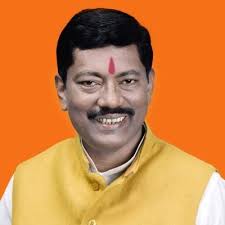
Poonam Sharma
Ashok’s political life has its roots in Bihar soil. Born on June 21, 1970, he inherited not only the resilience of a rural family but also the political acumen of his father, Hukumdev Narayan Yadav, one of Bihar’s most honored BJP veterans. Trained at Lalit Narayan Mithila University and Delhi University, Ashok gained an unobtrusive wisdom as to how politics is done—not as a passive observer, but as a person who was destined to make it happen.
His political career began not at the grand stage of Delhi, but in the dusty assembly constituencies of Keoti in Bihar. Elected thrice as MLA—February 2005, October 2005, and 2010—Ashok learned the politics of potholes and promises at the grassroots level. By the time he contested the 2019 Lok Sabha elections from Madhubani, he was no stranger to the pulse of his people.
A Seat with a Story
Madhubani is not any constituency. It’s the land of art, culture, and folk wisdom, and it has traditionally experienced infrastructure deficits, bad roads, poor rail connectivity, and weak rural healthcare. It’s a place where politics is close to home. Here, an MP doesn’t get assessed only by speeches in Parliament—but by the roads constructed, schools maintained, hospitals improved, and promises fulfilled.
Ashok Yadav entered national politics with this burden on his shoulders.
The MPLADS Mandate: Power to Construct
All Members of Parliament are provided with funds under the MPLADS (Members of Parliament Local Area Development Scheme)—a chance to convert political will into material development. For Ashok Kumar Yadav, this was not only a line in the budget; it was a means to reach out to the remotest villages that hardly find any mention in national news.
During the initial months of his stay, Ashok emphasized the fundamentals. Rural connectivity—the very lifeline of Bihar—was made a topmost priority. Via MPLADS releases, road repairs at the panchayat level, and small culvert works were taken up in a number of blocks of Madhubani. Most of them weren’t high-profile projects but essential ones: the brief kutcha stretches that link a village with its closest market, or a bridge that reduces hours of travel to a hospital.
Local leaders remember how his team would insist on faster clearances so that MPLADS works weren’t merely approved on paper but were finished before the monsoon would destroy the foundations. In a Jhanjharpur sub-division panchayat, money was sent to fix a three-year-old leaky school roof. In another, a tube well installation project provided more than 300 families with year-round water security.
The Railway Dream 
But most ambitious of all Ashok Yadav’s plans has been the Sitamarhi–Jaynagar–Nirmali railway line, which he campaigned so ardently before the Railway Ministry. It is not a rail route but a lifeline for the Mithila region, cutting through some of Bihar’s least connected pockets.
In several letters to the Railway Minister, Ashok put forth a powerful argument: “This project isn’t just about speed—it’s about dignity for those who travel every day to earn a living.” To this, the Union government has promised accelerated work, and the foundation is underway. If finished on schedule, this railway line will reduce journey time by half for thousands of Madhubani people who now rely on potholed roads and packed buses.
The COVID Years
The leadership test came not through elections, but the pandemic. The dark months of 2020 and 2021 saw Ashok Yadav’s office serving as a local coordination center—dispatching masks, coordinating oxygen concentrators, and arranging transport for stranded migrants. Though much of that work was not making headlines, it gained him silent goodwill throughout villages.
Some of his MPLADS funds were diverted—as the government permitted during the pandemic—to medical equipment, ambulances, and community health centers. At the Madhubani district hospital, an oxygen pipeline system was augmented through these funds, decreasing the dependence on cylinders in times of emergency rushes.
Education, Culture and the Soft Touch
Unlike many MPs who focus solely on big-ticket infrastructure, Ashok Yadav has also made smaller but visible investments in cultural and educational spaces. Madhubani’s folk painting tradition—a world heritage—found renewed support through community centres built or renovated with MPLADS recommendations.
Several primary schools were equipped with smart classroom gadgets with MPLADS funding, transforming mud-floor classrooms into half-digital classrooms. These investments, small as they were, indicated that the MP’s office did not view education only as policy, but as pride.
Transparency and Gaps
But as with any politician’s record, the tale has some shadows. Public MPLADS dashboards show limited granular information on the precise utilisation of his money year by year. In contrast with some MPs releasing detailed reports, Ashok Yadav’s office has not released a complete year-end statement of fund utilisation, which makes outside assessment more difficult.
Progress in Bihar’s rural constituencies is similarly glacial—due to delays in tendering, monsoon losses, and bureaucratic hold-ups. Some activists contend that some projects approved in 2020–21 remain pending. The discrepancy between recommendation and action continues to be an issue.
The 2024 Reaffirmation
In spite of these challenges, when the 2024 Lok Sabha elections were held, Ashok Yadav again emerged a winner from Madhubani—beating RJD’s Ali Ashraf Fatmi by a huge margin. For the voters, it was a reassertion of faith, not based on gaudy oratory but seeable work on the streets.
As one of the older voters in Pandaul explained in a local media interview, “Hamra gaon mein sadak ab pakki hai… MP babu kaam kar raha hai (Our village road is now paved… the MP is working).”
The Road Ahead
As of 2025, Ashok Kumar Yadav begins his second term as MP with larger expectations on his shoulders. The completion of the railway project, rural health expansion, water infrastructure development, and digital connectivity are the grand promises he’s on a mission to fulfill.
He’s also conscious that Madhubani is not the sort of place where people forget. Development here is recalled in kilometers of road, in hours gained by rail, and in roofs that no longer leak.
For Ashok Yadav, the MPLADS amount is not a figure—it’s a political currency. Each road constructed is a line in his unfolding political narrative. Each classroom colored is a signature on the history his father started.
And when trains finally run on the Sitamarhi–Jaynagar–Nirmali track, they’ll be carrying passengers. They’ll be carrying the responsibility of a constituency’s trust in its MP.
Summary of Key MPLADS Contributions & Focus Areas (2019–2025):
