

Poonam Sharma
The resonance of heavy silence in the Oval Office is usually a precursor to a storm. President Donald Trump sat across from German Chancellor Friedrich Merz, the air wasn’t just thick with the usual diplomatic tension—it was clouded by a strategy that many, even within his own inner circle, are calling “Operation Epic Confusion.”
We’ve reached a surreal tipping point in the Middle East. For weeks, the world watched as a new war ignited, threatening to swallow the region whole. But the latest twist hasn’t come from a missile battery; it came from a podium in Tehran. Iran has done the unthinkable: they apologized. This sudden pivot toward contrition has left the Trump administration, and the American public, in a state of cognitive dissonance.
A House Divided: The Criticism from Within
In Washington, the narrative of a “united front” is crumbling. While the President’s public rhetoric remains as expansive and shifting as ever, the whispers from the hallways of the West Wing have turned into open dissent.
Trump is increasingly being criticized by “his own people”—long-time GOP hawks and intelligence officials who feel the administration’s goals in Iran are not just moving targets, but potentially impossible ones. The recent ouster of Kristi Noem as Homeland Security chief is a glaring symptom of this internal friction. Sources suggest the friction stems from a fundamental disagreement over what “victory” actually looks like. Is it regime change? Is it a new nuclear deal? Or is it simply a chaotic display of “America First” muscle?
The lack of a coherent endgame has alienated the very strategists tasked with executing the mission. For the first time in this term, the “Donroe Doctrine”—a messy blend of isolationism and sudden, aggressive intervention—is being questioned by those who were once its loudest cheerleaders.
The American Mindset: A Nation in Limbo
Outside the Beltway, the American public is experiencing a collective “wait, what?” moment. The average citizen is profoundly confused by Iran’s way of retaliation—or rather, the lack thereof.
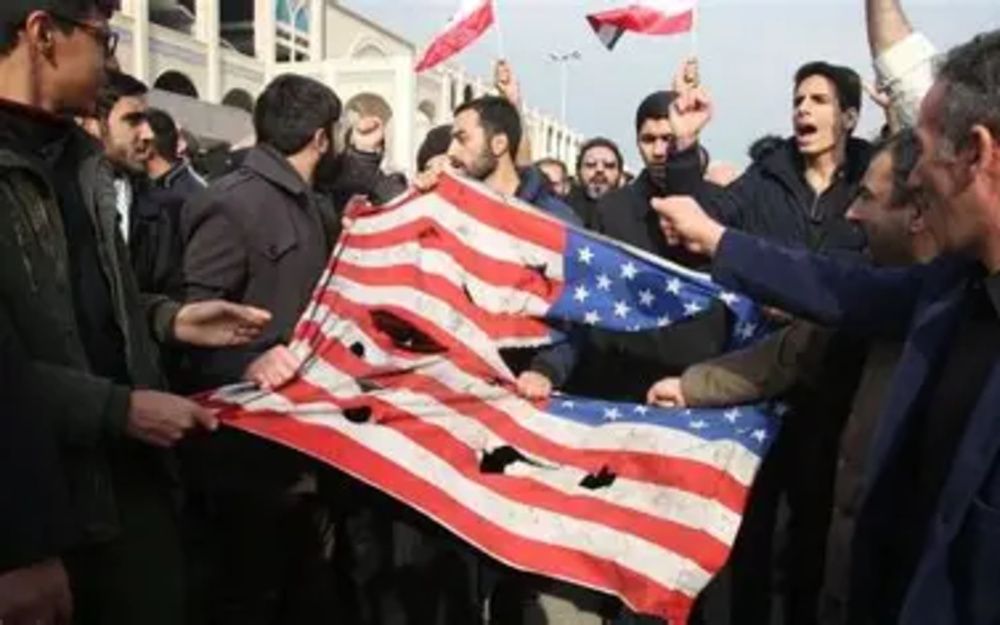
For decades, the American psyche has been conditioned to expect a specific script from Tehran: “Death to America” slogans followed by proxy strikes. Instead, we are witnessing a version of Iran that seems to be playing a much more sophisticated, perhaps desperate, game of PR. The apology from Tehran has thrown a wrench into the gears of the American war machine’s justification.
How do you sell a war against an enemy that is saying “sorry”?
This has created a bizarre atmosphere across the U.S. Some view the apology as a sign of weakness brought on by Trump’s “maximum pressure,” while others see it as a brilliant tactical retreat designed to make the U.S. look like the aggressor. The result is a nation that is neither fully behind a war nor fully convinced of a peace.
The Neighborhood Watch: Changing Tides in the Gulf
It’s not just Washington and the American suburbs feeling the whiplash. Iran’s neighbors—the UAE, Saudi Arabia, and Kuwait—are recalibrating in real-time.
Historically, these nations have looked to the U.S. as the ultimate security guarantor against Iranian hegemony. However, as Trump’s goals shift and Iran adopts a more apologetic, diplomatic tone, the “attitude” of the neighborhood is shifting.
De-escalation over Confrontation: Seeing the internal chaos in the U.S. government, Gulf leaders are beginning to wonder if a direct line to Tehran might be more reliable than a direct line to a distracted White House.
Economic Realism: The region cannot afford a prolonged disruption of the Strait of Hormuz. If Iran is offering an olive branch, the neighbors are likely to take a sniff, even if they don’t fully trust the source.
The Merz Factor: The presence of Friedrich Merz in D.C. signals that Europe is also pushing for a more measured approach, further isolating the “hawks” who want to see the conflict escalate.
The “Epic” Mismatch
The tragedy of “Operation Epic Confusion” is the mismatch between the stakes and the strategy. We are looking at a region where air defenses are dwindling and the clock is racing for everyone involved. Iran is trying to drag out the timeline, hoping the internal political divisions in the U.S. will eventually force a withdrawal or a stalemate.
Trump’s staring matches in the Oval Office may play well for his base, but they don’t provide a roadmap for a region on fire. As the apology from Iran settles into the global consciousness, the burden of proof has shifted. The world is no longer asking what Iran will do next—they are asking if the United States knows what it is doing.
In the end, you can’t fight a war—or build a peace—on a foundation of shifting sand. Whether it’s the ouster of key cabinet members or the scathing critiques from his own party, the message is clear: the current path is unsustainable. If the goal was to keep the world guessing, Trump has succeeded. But in the world of high-stakes geopolitics, confusion is rarely a winning strategy
