
Apparel Exports Key to Viksit Bharat: VP Radhakrishnan
Vice President lauds exporters, calls for modernisation and market diversification

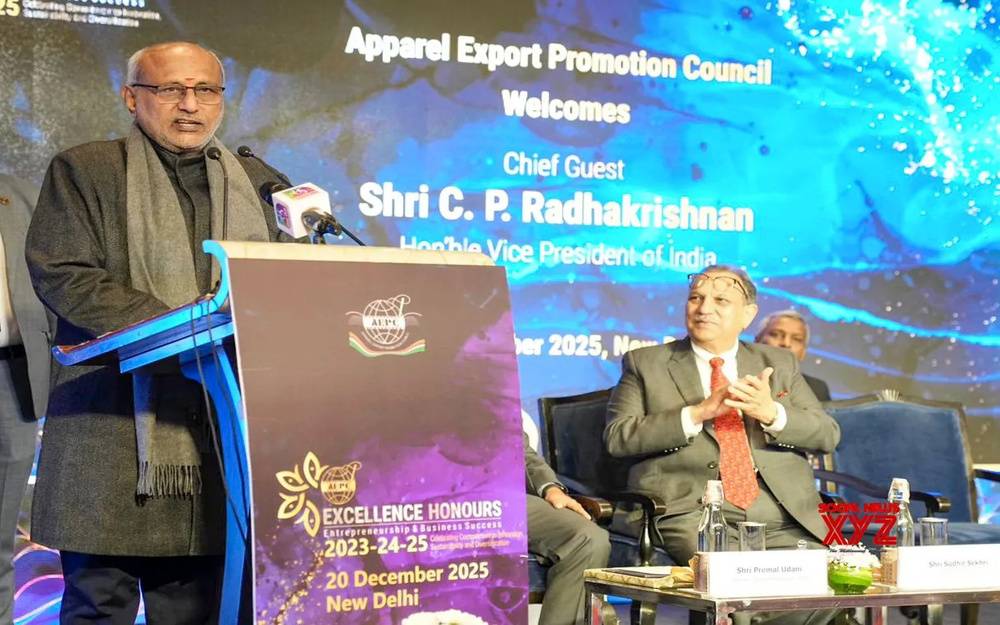
- Vice-President highlights apparel sector’s role in jobs and GDP
- Lauds exporters’ resilience amid global challenges
- Urges value addition, innovation and new markets
- Stresses labour welfare and sustainable exports
GG News Bureau
New Delhi, 20th Dec: Vice-President of India C. P. Radhakrishnan on Saturday said that apparel exports are vital to India’s economic growth and central to achieving the vision of a Viksit and Aatma Nirbhar Bharat. He was addressing the Annual Awards Function of the Apparel Export Promotion Council (AEPC) in New Delhi.
Congratulating the awardees, the Vice-President said the apparel and textile sector remains a core pillar of the Indian economy, providing direct employment to over 45 million people and supporting more than 100 million livelihoods indirectly. He noted that the sector contributes about 2 per cent to the country’s GDP and nearly 11 per cent to manufacturing Gross Value Added (GVA).
Highlighting government support under the leadership of Narendra Modi, Radhakrishnan referred to initiatives such as PM MITRA Parks and the SAMARTH Skill Development Programme, and said the Prime Minister’s Vision 2030 aims to transform India’s textile and apparel sector into a global powerhouse. He underlined that policy initiatives achieve real impact only when matched by industry-led innovation and determination.
Commending the industry’s performance amid global headwinds, the Vice-President said Indian apparel exporters have shown resilience and steady progress despite international challenges. He added that the government is actively engaging with stakeholders to address sectoral concerns, including through ongoing Free Trade Agreement (FTA) negotiations.
Calling for a future-ready approach, Radhakrishnan urged exporters to explore new markets in Asia, Africa and Latin America, while focusing on value addition, diversification of the export basket, reduced import dependence, and greater emphasis on research, innovation and sustainable practices.
Noting that textiles are the second-largest source of employment after agriculture, the Vice-President stressed the importance of ensuring labour welfare across the industry. He said exports in the sector are expected to double in the coming years, creating substantial new employment opportunities, and expressed confidence that the apparel industry would play a leading role in India’s development journey.
Sharing his personal connection with the sector, Radhakrishnan said he hails from Tiruppur, India’s hosiery and knitwear hub, and has closely witnessed the industry’s evolution. He also recalled his role as a Member of Parliament and Co-Chairman of the Sub-Committee on Textiles under the Parliamentary Standing Committee on Commerce, which allowed him to study industry challenges and contribute to policy recommendations.
He appreciated AEPC’s role as a vital link between the government and industry and released its coffee table book “Threads of Time: Story of India’s Textiles”. The event was attended by Manjinder Singh Sirsa, AEPC Chairman Sudhir Sekhri, Vice Chairman A. Sakthivel, and other senior figures from the textile and apparel sector.
