
Airborne Deterrence: Inside the Strategy of Operation Trishul
“From the deserts of Rajasthan to the Bay of Bengal, Bharat’s 12-day tri-forces exercise is more than military muscle-flexing—it’s a silent declaration of deterrence, signaling that the era of reactive defense is over.”

Paromita Das
New Delhi, 3rd November: For the first time in independent Bharat’s history, the entire sky has gone tactical. Civilian airspace that once echoed with airline traffic has fallen silent under layers of military secrecy. The message is clear, though unspoken: the game has shifted. As national air corridors go dark and radar grids hum with encrypted signals, Operation Trishul marks a new phase in Bharat’s defense doctrine—a phase where anticipation replaces retaliation.
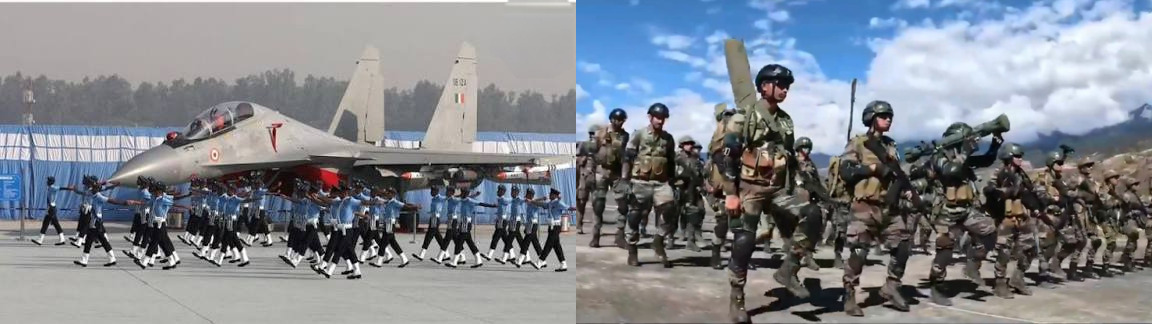
On October 30, Trishul began as a 12-day tri-service military exercise stretching from the sands of Rajasthan to the waters of the Bay of Bengal. It follows Operation Sindoor by just six months, suggesting a new rhythm in national preparedness. The scale is staggering—special forces commandos, missile regiments, nuclear-capable submarines, and the Indian Air Force’s top-tier Rafale and Sukhoi Su-30 fighters operating in seamless coordination. The exercises simulate offensive strikes deep into southern Pakistan, testing the nation’s readiness for a multi-front conflict.
This is no ordinary drill. It’s a rehearsal for deterrence—a message etched not in words, but in the exhaust trails of fighters cutting across a restricted sky.
The Pakistan Reaction and the Regional Ripples

Across the border, Islamabad’s anxiety is visible. In an unusually swift response, Pakistan issued NOTAMs restricting its own southern and central airspace. Its aviation authority, typically slow on civilian notices, moved decisively to clear critical sectors, a sign of how seriously it reads Bharat’s messaging.
The rhetoric from Pakistan’s ministers has meanwhile turned dangerously loose—threats of “decisive response” and “unprovoked aggression” flood social media even as civil-military balance in Islamabad frays once more. More worryingly, early signals from Dhaka indicate renewed ISI activity across Bangladesh, where a regime transition has left power vacuums ripe for exploitation. This triangulation—Pakistan’s defensiveness, China’s quiet watchfulness, and Bangladesh’s instability—creates exactly the strategic cocktail Trishul seems designed to preempt.
Bharat’s airspace lockdown running across four cardinal sectors—west near Pakistan, east near China and Bangladesh, the Arabian Sea, and even segments over central Bharat—is unprecedented. It suggests not just preparedness for confrontation but practice for coordinated, multi-domain dominance.
Beyond the Drill: The Real Agenda of Operation Trishul

The true purpose of Operation Trishul extends far beyond the horizon of visible maneuvers. Strategically, it appears to serve four converging objectives:
First, it recalibrates Bharat’s deterrence architecture from a reactionary stance to a proactive doctrine. New Delhi’s position is no longer to wait for provocation but to prepare for rapid escalation control and swift response.
Second, it sends an unmistakable message to both adversaries and allies: Bharat’s readiness is no longer seasonal or symbolic. This tri-service synchronization reflects a matured defense posture capable of sustaining war or deterrence across domains simultaneously.
Third, it tests the interoperability of forces under real conflict simulation. Seamless integration of land, air, and naval command systems is critical if Bharat is to maintain parity in a two-front scenario involving both China and Pakistan.
Fourth—and perhaps most importantly—it reaffirms Bharat’s posture in an increasingly unstable neighborhood. The subcontinent sits at an inflection point where traditional threats merge with asymmetric warfare—cyber intrusions, proxy terrorism, and narrative manipulation. Operation Trishul projects power across all these spectrums, including psychological deterrence.
This isn’t only military preparedness; it’s information warfare signaling in the digital age.
The Doctrine of Decisive Deterrence

At the heart of Trishul lies a doctrine that breaks from decades of strategic hesitation. Delhi’s recent stance—any terror attack on Bharatiya soil will be treated as an act of war—marks a historic evolution from defensive diplomacy to assertive deterrence.
This shift was seeded after successive provocations that exposed the cost of restraint. From Kargil to Pulwama, Bharat built a slow but irreversible awareness that global empathy rarely translates into security. Every nation, especially one targeted by parallel adversaries, must define its own red lines. Trishul is that definition written with radar sweeps, air sorties, and missile drills.
By turning NOTAMs into instruments of geopolitical messaging, Bharat has inverted the signaling chain. Silence has become strategy. Absence of civilian chatter becomes presence of intent.
Power, Perception, and Preparedness

The argument that Bharat’s military drills are mere showmanship misses the deeper evolution of statecraft underway. Trishul represents a recalibration of deterrence psychology. Unlike the Cold War-era display parades, today’s war games are designed for ambiguity—sending layered cues to multiple audiences. To Beijing, it signals readiness. To Islamabad, it warns restraint. To internal audiences, it reassures control.
Geopolitically, it ties into a larger pattern—countries asserting autonomy amid shifting global alignments. Bharat’s refusal to be pulled into military blocs or proxy confrontations has often invited skepticism. Trishul, however, redefines that neutrality. It’s active non-alignment reinforced by strength, not passivity.
The real brilliance of Trishul lies in its timing—just as the digital world is aflame with misinformation and perception warfare, Bharat chooses kinetic signaling rooted in clarity.
A Message Written in the Skies
Operation Trishul is more than a war game—it is a declaration of strategic maturity. As fighter jets replace passenger planes, and NOTAMs replace press notes, Bharat is making its stance unmistakable: deterrence now begins before provocation.
Every blackout across the national sky is a chapter in a new strategic doctrine—one that defines Bharat not as a reactive democracy but as a prepared power. The world can read the radar, interpret the silence, and see the shift. Because this time, Bharat isn’t waiting to respond—it is preparing to command.
