
AI Can Drive Women’s Economic Power: Vijaya Rahatkar
Calls for women to lead as creators, not just users, at AI Impact Summit

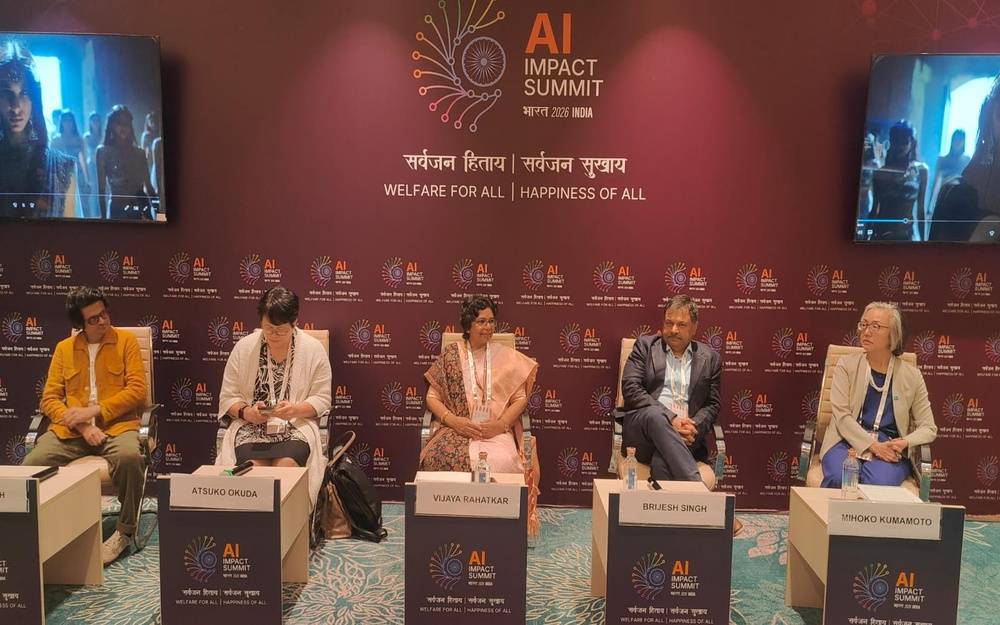
- AI can accelerate women’s economic empowerment, says Vijaya Rahatkar
- Special session held at India AI Impact Summit in Delhi
- Focus on AI literacy, safety, and global opportunities for women
- Experts highlight digital inclusion and protection from deepfakes
GG News Bureau
New Delhi, 17th Feb: Artificial Intelligence can become a key driver of women’s economic empowerment and sustainable development, Vijaya Rahatkar said at a special session during the India AI Impact Summit at Bharat Mandapam in New Delhi.
She said AI is no longer just a technological tool but has become central to education, governance, and industry. With AI expected to transform employment patterns, women should move beyond being mere users of technology and become researchers and creators who lead the change.
Rahatkar expressed confidence that linking women’s economic empowerment with AI would make sustainable development possible.
The session, titled “AI and Economic Power – A Framework for Women-Led Prosperity,” was organised jointly by the National Commission for Women, the International Telecommunication Union, and the United Nations Institute for Training and Research.
She said the discussion was not just a dialogue but a movement, noting that Indian women have always led change and will not remain behind in new technologies like AI. She stressed the need for proper training and a supportive ecosystem so that women can take ownership of technology.
Highlighting the importance of AI literacy, she said it must include awareness about data protection, digital ethics, and cybersecurity. She also called for concrete action instead of mere announcements and urged efforts to connect micro and small enterprises run by women to global supply chains.
Information and Public Relations Principal Secretary and Director General Brijesh Singh highlighted digital threats, noting that many AI systems are built on male-dominated datasets, leading to concerns about fairness and sensitivity. He said 91 percent of deepfake victims are women, calling it a serious issue.
He stressed the need to hold social media platforms accountable and said that under India’s 2021 rules, victims can file complaints with designated nodal officers, with companies required to remove objectionable content within a fixed timeframe. He also called for mandatory watermarking of AI-generated images.
UNITAR Director Mihoko Kumamoto emphasised capacity building and international cooperation to help women benefit from global AI opportunities. She said joint programmes with Indian institutions could strengthen women’s economic empowerment and serve as a model for other countries.
ITU Regional Director Atsuko Okuda highlighted the need to improve digital inclusion in smaller cities and reduce the digital divide. She said India should develop a practical roadmap to convert AI innovation into real economic empowerment for women.
AI music producer Kartik Shah spoke about growing opportunities for women in the creative and digital economy. The session began with a short film on women’s empowerment through AI.
