
Ahmedabad Crash Exposes Bharat’s Weak Link: Time to Build Aerospace at Home

Paromita Das
New Delhi, 18th June: Over the past decade, Bharat has made remarkable strides toward self-reliance in defense, evolving from one of the world’s largest arms importers to a promising exporter of missiles, drones, radars, and advanced combat systems. With indigenous projects like the Tejas fighter jet, the BrahMos missile, and INS Vikrant, the nation has shown that when vision meets commitment, self-sufficiency is achievable. But the tragic Air India Dreamliner crash in Ahmedabad on June 12, 2025, which claimed over 250 lives, has cast a harsh spotlight on a glaring gap in Bharat’s technological ecosystem — its continued dependence on foreign aerospace giants. If defense can be “Made in India,” why not aviation? The Ahmedabad crash must serve as a painful but necessary wake-up call: the time has come for Bharat to extend its Atmanirbhar Bharat vision to the aerospace sector.
A Catastrophe That Demands More Than Mourning
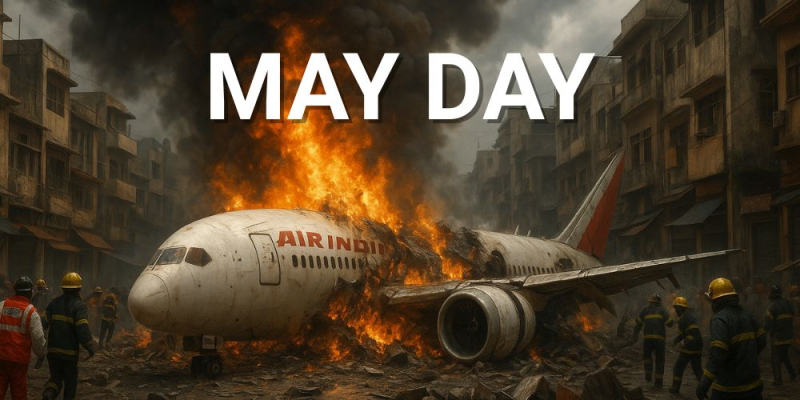
On the morning of June 12, 2025, the city of Ahmedabad witnessed a tragedy that shook the nation to its core. An Air India Boeing 787 Dreamliner, barely airborne for a minute, crashed with devastating impact, claiming over 250 lives, including several on the ground. It wasn’t just an accident—it became a national wake-up call.
While the cause remains under investigation, with theories ranging from engine failure to a bird strike, one fact is beyond dispute: Bharat’s heavy reliance on foreign aerospace companies like Boeing and Airbus has once again come under scrutiny. This isn’t the first incident, but it must be the last before serious change begins.
The Trail of Technical Dependence
Bharat’s aviation sector is bursting with potential, yet it is chained to foreign suppliers. The Dreamliner involved in the Ahmedabad crash was a product of Boeing, a company increasingly associated with safety lapses—most notoriously with its 737 Max line.
Boeing’s internal problems are not new. Whistleblowers have long raised concerns about their manufacturing practices. A former employee even claimed that faulty Dreamliner were delivered to Air India, which, if proven true, will reflect a shocking disregard for safety standards. The ongoing investigations may take months, but history already offers enough warnings.
We’ve seen this pattern before. In 2023, Go First Airlines was forced to shut down, primarily because of persistent technical issues with engines supplied by Pratt & Whitney, a division of the Airbus ecosystem. Repeated pleas for timely engine replacements were ignored. The fallout? Planes grounded, losses mounting, and yet again, an Bharatiya enterprise fell victim to foreign indifference.
The Cost of Looking West
At present, over 130 aircraft in Bharat are grounded, mostly due to foreign technical glitches. That’s about 16% of the country’s passenger airline capacity, leading to surging airfares, reduced connectivity, and customer frustration. When over a billion Bharatiya rely on aviation for business and personal travel, this capacity crunch hits not just airlines but the economy at large.
What’s most striking is that Bharat has placed orders for over 1,500 aircraft, all with either Boeing or Airbus. This will funnel lakhs of crores of rupees into the economies of the USA, France, Germany, and Britain, rather than being reinvested in Bharat’s own manufacturing.
The military sphere is no better. The Indian Air Force’s dependence on Russian IL-76 transport aircraft has long been a bottleneck. Aging technology, poor maintenance support, and lack of readiness continue to plague these machines. Meanwhile, Tejas, Bharat’s indigenous light combat aircraft, is still dependent on American-made GE engines, with deliveries running a year behind schedule. As of now, less than 10 engines have been supplied out of the 100 promised, halting production and frustrating the armed forces.
Self-Reliance Is No Longer a Choice — It’s a Necessity
One might argue that Bharat isn’t technically prepared to build complex commercial jets or high-thrust engines. True. But the same was said when Bharat first embarked on building nuclear submarines, ballistic missiles, or even space exploration missions. And yet, we succeeded.
Bharat’s success with Tejas, BrahMos, and ISRO’s space missions proves that with determination, investment, and political will, self-reliance isn’t a far-off dream—it’s an attainable reality. The key is to begin, not wait for perfection. Delaying the effort only deepens our dependence.
Moreover, aerospace is not just about defense or transport—it’s a strategic industry. It influences foreign policy, economic stability, and national security. When critical systems are controlled by foreign suppliers, a nation’s sovereignty is quietly compromised.
Learning From Pain, Building with Purpose
The Ahmedabad crash must be more than a statistic in aviation history. It must be a defining turning point.
If Bharat had been producing its own aircraft, we might have had better insights into maintenance, design flaws, and operational readiness. If we built our own engines, we wouldn’t be held hostage by international supply chains. Most importantly, if we developed end-to-end aerospace capabilities, we’d also be in a position to export them, just as we now do with missiles, tanks, and advanced radar systems.
The Modi government has made significant progress in defense exports and local defense production, moving from import dependency to becoming a net exporter. It is time this vision expands to include civil aviation and aerospace.
The market is ready, the talent is abundant, and the urgency has never been greater.
Now Is the Time
The tragic loss in Ahmedabad was a moment of deep sorrow, but also a piercing reminder: reliance on foreign aerospace giants comes with a cost—sometimes one too heavy to bear.
Bharat must channel its grief into building indigenous aerospace capacity. From manufacturing commercial jets to producing our own engines, the journey may be long, but it is vital. We owe it to the lives lost, and to the generations ahead, to never be at the mercy of foreign failures again.
The writing is on the wall. Now is the time for Bharat to soar on its own wings.
