
Against All Odds: Maria Corina Machado Wins Nobel for Peace
“Venezuela’s opposition leader, long silenced by authoritarian rule, is honored globally for her fearless fight to restore democracy and hope in a nation torn by repression.”

Paromita Das
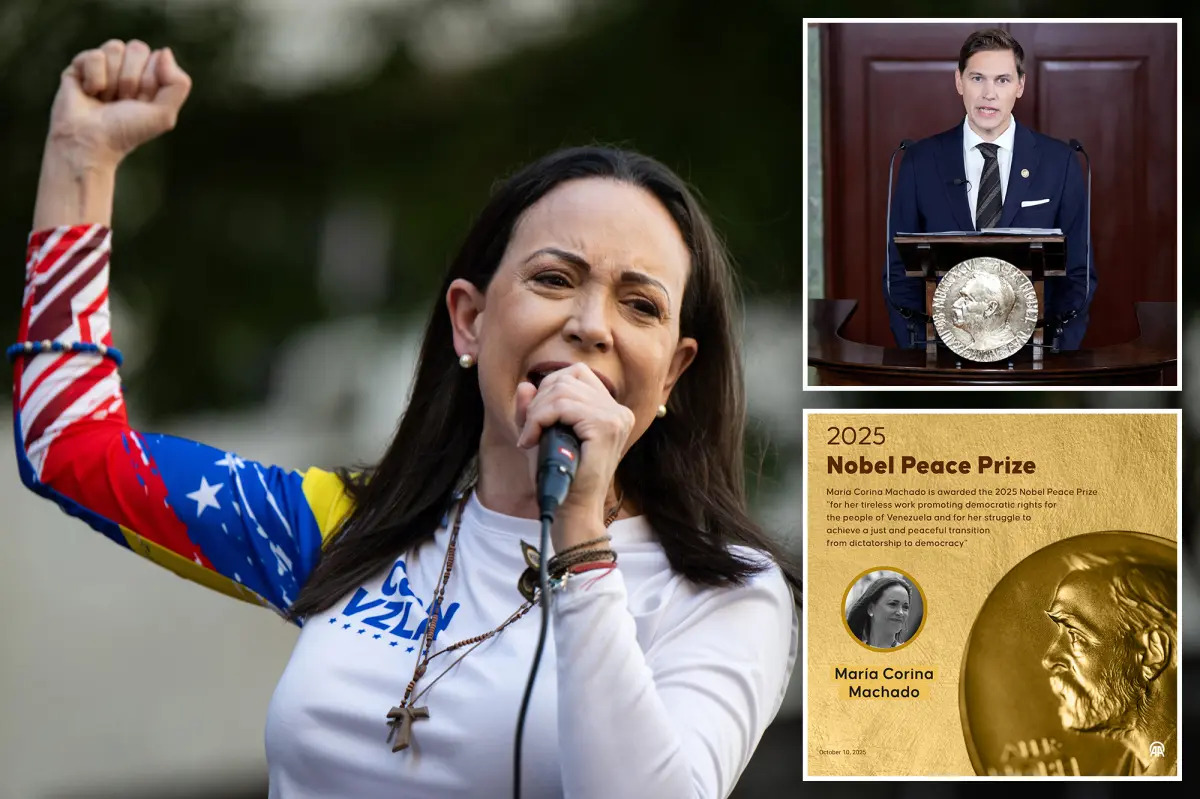
New Delhi, 15th October: In a world increasingly shadowed by authoritarianism, one woman’s voice has pierced through the darkness — Maria Corina Machado, Venezuela’s unyielding opposition leader and newly minted Nobel Peace Prize laureate. Her story isn’t merely about political dissent; it’s a saga of resilience, conviction, and a relentless pursuit of democratic integrity in a nation long suffocated by power’s excesses.
When the Nobel Committee announced her name in Oslo, calling her a “brave and committed champion of peace,” it wasn’t just Venezuela that cheered — it was the entire global community yearning for a reminder that peaceful defiance still matters.
A Symbol of Courage Amid Chaos

At 58, Machado’s recognition comes after decades of battling Venezuela’s autocratic machinery. Known at home as the Iron Lady, she has stood against political persecution, media smears, and personal threats — and yet refused to leave her homeland. The Nobel Committee lauded her not just for her political courage, but for keeping the flame of democracy alive amidst a growing darkness.
Her reaction, a simple “I’m in shock,” captured the disbelief of a woman who had faced imprisonment, exile threats, and bans from office — only to find her name etched alongside global icons of peace.
From Engineer to Political Revolutionary

Born in Caracas on October 7, 1967, Machado began as an industrial engineer with a master’s degree in finance. But destiny had other plans. In 2002, she co-founded Sumate, a civic organization dedicated to electoral transparency during Hugo Chávez’s presidency. Her activism led to a recall referendum against Chávez — an act of democratic defiance that came at a personal cost. Accused of treason, she sent her children abroad for safety as she became a symbol of Venezuela’s internal resistance.
Over time, Machado emerged as the leader of Vente Venezuela, pushing for liberal reforms, transparent governance, and the privatization of the state-run oil company, PDVSA. Yet, her fight has never been solely economic — it’s moral, driven by the belief that freedom and prosperity are inseparable.
Defiance in the Face of Dictatorship
When Venezuela’s opposition held its presidential primaries in 2023, Machado won decisively — proof of her magnetic appeal among citizens exhausted by authoritarian rule. But her victory was swiftly nullified by a court ban orchestrated under President Nicolás Maduro’s influence. Her alleged “crimes” included supporting U.S. sanctions and backing the opposition’s seizure of foreign assets.
Still, Machado refused to retreat. She threw her support behind Edmundo González Urrutia, her replacement candidate, campaigning from the shadows while her advisers were jailed or exiled. Even as she was forced into hiding following the disputed 2024 elections, her presence lingered in every street protest, every white-clad supporter chanting for change.
The Nobel Committee’s Message to the World

The Norwegian Nobel Committee’s decision to honor Machado wasn’t just about Venezuela — it was about democracy itself. Chair Jorgen Watne Frydnes said Machado “meets all the criteria” envisioned by Alfred Nobel: promoting fraternity among nations, reducing conflict, and advancing peace through moral courage.
In awarding her, the Committee sent a message that democracy is not a relic, but a living necessity. “Machado’s choice to remain in Venezuela, despite grave risks, has inspired millions,” the committee noted. It was a reminder that peace is not merely the absence of war — it is the presence of justice.
A Divided Reaction — and a Silent Trump

Interestingly, while global leaders and human rights organizations applauded the Nobel Committee’s decision, former U.S. President Donald Trump — who has often expressed his own desire for the Peace Prize — remained silent. His spokesperson accused the Committee of “placing politics over peace,” claiming Trump had “the heart of a humanitarian.”
The Nobel Committee, however, stood firm. “We base our decision only on the work and the will of Alfred Nobel,” Frydnes replied — a subtle rebuke to political vanity.
The Meaning of Machado’s Victory

Machado’s Nobel Peace Prize is more than symbolic — it’s catalytic. It acknowledges that nonviolent resistance still holds power in an age where dissent is criminalized. Her struggle reveals that courage is not about winning elections but standing firm when victory seems impossible.
In a time when democracies worldwide are weakening, Machado embodies the moral strength that many modern leaders lack. Her steadfast belief that ballots — not bullets — can change nations is a vision the world desperately needs to remember.
Yet, her recognition also raises a haunting question: Can global accolades protect those who challenge power from within oppressive regimes? While the Nobel Prize spotlights her heroism, it cannot shield her from Maduro’s retribution. And therein lies the fragility of our collective conscience — we celebrate the brave, but too often leave them to fend for themselves.
The Flame That Won’t Go Out
Maria Corina Machado’s story is one of luminous defiance. Barred, threatened, silenced — but never broken. Her Nobel Peace Prize doesn’t mark the end of her fight; it immortalizes it.
As Venezuela’s people continue their struggle for freedom, Machado’s name now stands as a universal emblem of resistance — proof that even in hiding, truth can still echo louder than tyranny.
Her journey reminds us that peace is not a prize to be won, but a promise to be kept. And through her courage, the promise of Venezuela’s rebirth feels a little less distant.
