
Congress Caught in the Crossfire as AAP, TMC, SP Boycott JPC
“A fragile INDI Alliance faces its toughest test yet as three major partners refuse to join the Joint Parliamentary Committee, exposing fault lines over the BJP-led government’s contentious new bills.”

Paromita Das
New Delhi, 26th August: On a heated August afternoon in Parliament, the Modi government introduced three contentious bills — the Constitution (130th Amendment) Bill, 2025, the Jammu & Kashmir Reorganisation (Amendment) Bill, 2025, and the Government of Union Territories (Amendment) Bill, 2025. Together, these bills proposed that any sitting minister, chief minister, or even the Prime Minister would be automatically removed from office if arrested and detained for 30 consecutive days for an offence carrying a minimum jail term of five years.
The move triggered uproar across opposition benches. Copies of the bills were torn, slogans filled the Lok Sabha, and several MPs even stormed towards Union Home Minister Amit Shah. Amidst the chaos, both Houses eventually resolved to refer the bills to a 31-member Joint Parliamentary Committee (JPC).
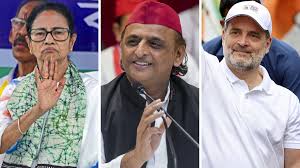
Yet, just days later, the carefully crafted façade of opposition unity crumbled. The Aam Aadmi Party (AAP), the All India Trinamool Congress (TMC), and the Samajwadi Party (SP) declared they would boycott the JPC, calling the entire exercise a “farce.”
AAP’s Stand: “An Unconstitutional Bill to Jail Opposition”
AAP was the first to opt out, branding the bills “unconstitutional” and politically motivated. Senior leader Sanjay Singh minced no words in his criticism.
“The Modi government is bringing a bill that is unconstitutional. The purpose of this bill is to put opposition leaders in jail and topple governments,” Singh declared.
मोदी सरकार एक ग़ैर संवैधानिक बिल लेकर आ रही है। इस बिल का मक़सद विपक्ष के नेताओं को जेल में डालना और विपक्षी दलों की सरकारें गिराना है। इस बिल का मकसद देश में लोकतंत्र को खत्म करने का है।
इस बिल के लिए सरकार द्वारा जो JPC बनाई जा रही है, उसमें आम आदमी पार्टी शामिल नहीं होगी। इस… pic.twitter.com/izg2A9MqDh
— AAP (@AamAadmiParty) August 24, 2025
For AAP, the bills are less about cleansing politics of criminality and more about disempowering elected leaders through central agencies like the CBI and ED. The party sees the legislation as a direct attempt to weaken state governments led by the opposition — a claim that resonates with AAP’s long-running tussles with the Centre.
TMC’s Argument: “A JPC Tilted in Favor of the Ruling Party”

If AAP’s objection was rooted in principle, the Trinamool Congress’ reasoning focused on procedure. Senior leader Derek O’Brien, writing in a blog post, dismissed the JPC as an “exercise in futility.”
According to him, three key issues plagued the process:
- The JPC chairperson and member composition inherently favor the ruling party.
- Amendments proposed by opposition members rarely survive the majority’s veto.
- Since 2014, JPCs have increasingly lost credibility, becoming political tools rather than platforms for consensus.
Party supremo Mamata Banerjee echoed these concerns, describing the bills as a “draconian step” and warning that they strike at the heart of federalism.
SP’s View: “A Flawed Idea That Can Be Misused”

Samajwadi Party chief Akhilesh Yadav aligned with Mamata Banerjee’s stance, calling the bills “deeply flawed.” Yadav argued that the legislation creates avenues for misuse, since anyone can be “falsely implicated” in criminal cases.
He also highlighted a practical loophole — state governments could withdraw criminal cases filed against their leaders, thereby bypassing the law entirely. In his words:
“CMs will be able to withdraw criminal cases filed against them in their states, and the Centre will have no control because law and order is a state subject.”
In effect, Yadav suggested, the law would neither eliminate corruption nor ensure accountability.
A Divided Opposition and Congress’ Dilemma

The refusal of three major INDI Alliance partners to join the JPC has left Congress in a tricky position. While the party initially supported referring the bills to the committee, it now faces a stark choice: uphold opposition unity or stick to its original plan of engaging in parliamentary scrutiny.
This internal tug-of-war exposes the deeper challenge facing the INDI Alliance — a lack of cohesion on strategy. While all parties oppose the bills, they disagree sharply on how to resist them.
Reform or Political Weapon?

At its core, the government’s proposal attempts to address a long-standing issue — the criminalization of politics. Bharat has long struggled with elected representatives facing serious criminal charges while continuing in office. In theory, the idea of disqualification after prolonged custody appears aligned with public sentiment for cleaner politics.
However, in practice, the opposition’s fears are not entirely misplaced. With central agencies often accused of selective targeting, such a law could become a political weapon. The refusal of AAP, TMC, and SP to participate in the JPC may appear obstructionist, but it also reflects their deep mistrust of parliamentary mechanisms under the BJP’s majority.
The government, for its part, must confront a credibility gap. Without broad consensus, even well-intentioned reforms risk being dismissed as partisan maneuvers.
Unity Tested, Democracy Questioned
The boycott of the JPC by three key INDI Alliance partners highlights not just a disagreement over bills, but the fragile state of opposition unity in Bharat today. While the government insists on its reformist agenda, opposition parties fear the weaponization of law against dissent.
As the JPC prepares to begin its work, the absence of AAP, TMC, and SP casts a shadow over its legitimacy. For Congress, the decision ahead will shape whether the INDI Alliance can present a united resistance or remain fractured by internal contradictions.
Ultimately, the larger question is not whether ministers should face consequences for criminal charges, but whether Bharat’s democratic institutions can implement such reforms without undermining trust. In the battle of law and politics, credibility may be the greatest casualty.
