
A Unified Stand: Quad’s Strong Message Against Terrorism After Pahalgam Attack

Paromita Das
New Delhi, 4th July: When the sun rose over the scenic valleys of Pahalgam on April 22, no one imagined that the serenity of this popular tourist spot would be shattered by a terror strike so brutal that it would echo far beyond Bharat’s borders. Twenty-six innocent lives, mostly tourists seeking respite in the cool Kashmir air, were lost to bullets and blasts. Yet, from this tragedy, a rare and potent diplomatic alignment emerged — a joint condemnation by the Quad nations, which has set the tone for a renewed global fight against terrorism.
A Gathering of Resolve in Washington
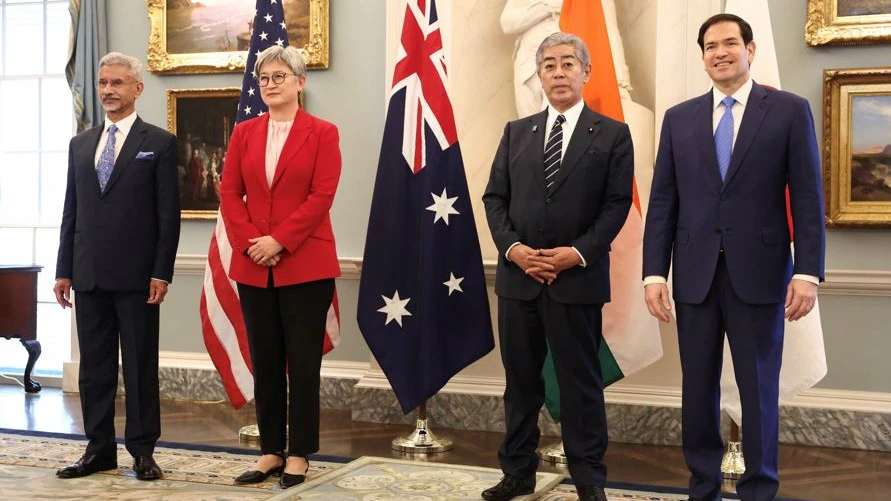
Thousands of miles from Pahalgam, the foreign ministers of Bharat, the United States, Japan, and Australia gathered in Washington D.C., the weight of their words carrying the hopes of many who demand that terrorism finds no sanctuary. In a world increasingly fractured by rivalries, their statement was strikingly unified. Without mincing words, they condemned the massacre and demanded that every conspirator, planner, and financier behind the bloodshed be brought to justice. The Quad, in its carefully chosen language, made it clear that the days of silently tolerating cross-border terrorism were over.
Jaishankar’s Candid Assertion
Amid the polished diplomacy, Bharat’s External Affairs Minister S. Jaishankar’s voice stood out — direct, resolute, and unyielding. He reminded the world that no sovereign nation can remain passive while its people are butchered in cold blood. “Victims and perpetrators must never be equated,” he said, dismissing any notion of restraint if the cost was more Bharatiya lives. His words weren’t just rhetoric; they were a clear endorsement of Bharat’s right to retaliate when terror knocks at its door.
This stance has found resonance among Bharat’s Quad partners, who now see New Delhi not just as a regional player but as an indispensable pillar of the Indo-Pacific security architecture.
Operation Sindoor: A Statement Beyond Words
Words alone do not silence guns across borders. Bharat’s swift and precise military answer, codenamed Operation Sindoor, sent a message deeper than any statement could. In less than two weeks after the Pahalgam horror, Bharatiya forces crossed the Line of Control with pinpoint operations that dismantled terror launchpads, training camps, and safehouses.
Unlike the shadowy conflicts of old, this operation was marked by modern precision. Drones mapped coordinates in real time; artillery units struck with surgical accuracy. By the time the guns fell silent, Bharat had left no doubt: it will no longer be the soft state that bleeds silently.
Pakistan: A Familiar Denial, A Shrinking Credibility
Predictably, Islamabad chose its well-worn playbook — deny, deflect, and declare innocence. But in a world that’s grown weary of half-hearted denials, the Quad’s pointed yet diplomatic language exposed Pakistan’s duplicity. For decades, global leaders looked the other way or issued routine condemnations that rang hollow. This time, however, the weight of four major Indo-Pacific democracies has boxed Pakistan into a diplomatic corner.
It’s no secret that Pakistan’s security establishment has long played a dangerous double game — hunting some terror groups while nurturing others. But with every new attack that traces its roots to safehouses across the border, its moral standing erodes a little more.
A New Doctrine Taking Shape
There was a time when Bharat’s policy towards terror was largely reactive — strong words, dossiers shared, and restrained responses dictated by fears of escalation. That time is gone. What we are witnessing is not just tactical retaliation but a strategic doctrine taking shape. Under the current leadership, Bharat has embraced a hard-nosed realism: to deter terrorism, you must make its cost unbearable for its sponsors.
This doctrine has found new allies. The Quad’s statement is not just solidarity — it is a tacit acceptance that peace in the Indo-Pacific cannot survive if terror factories are left untouched. By aligning with like-minded democracies, Bharat has broadened its fight from a bilateral feud with Pakistan to a global issue that demands accountability.
A Broader Impact: Strengthening the Global Anti-Terror Front
This unified condemnation also revitalizes the international conversation about state-sponsored terrorism — a topic too many countries tiptoe around. It calls upon the United Nations to uphold its own resolutions. The Quad’s clear ask that all member states must assist in bringing terrorists and their backers to justice renews hope that global bodies will no longer be safe havens for empty rhetoric.
For Bharat, this is a diplomatic leap forward. It underscores the maturity of its foreign policy — balancing decisive action with global consensus. It shows the world that Bharat will not shy away from using its military might but will also seek partners in its long battle against extremism.
No More Shadows to Hide
As Kashmir’s meadows heal from the blood spilled in Pahalgam, Bharat’s message is unmistakable — it will neither forgive nor forget. The Quad’s powerful backing amplifies this resolve. It holds a mirror to those who aid and abet terror, reminding them that their shadows are shrinking fast.
In an increasingly polarized world, this rare display of unity is not just about Bharat’s tragedy but about every nation’s right to live free of fear. By standing together, the Quad has not only endorsed Bharat’s counter-terrorism stance but has also redrawn the moral lines in the sand.
Terrorism survives in silence and divisions; it crumbles in the face of solidarity. And for now, the world seems ready to stand with Bharat and say — enough is enough.
