
A Leaderless Opposition and a Ruthlessly Ready NDA
“As BJP and NDA finalise their seat-sharing and candidates, Congress and Mamata Banerjee’s unresolved alliance issues weaken the INDIA bloc’s 2025 election prospects.”

Paromita Das
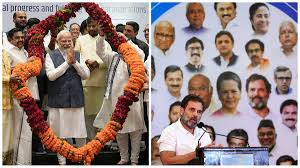
New Delhi, 15th October: In Bharat’s high-stakes democracy, strategy and unity often win elections — not slogans. Yet, the country’s Opposition bloc seems to be ignoring this golden rule. While the National Democratic Alliance (NDA), led by Prime Minister Narendra Modi’s BJP, moves ahead with calculated precision, the Opposition alliance appears lost in its own maze of egos, overconfidence, and conflicting ambitions.
From Mamata Banerjee’s unpredictable positioning to Rahul Gandhi’s strategic absence, the story of Bharat’s Opposition today is not one of resistance but of remarkable incoherence.
NDA’s Clarity vs. Opposition’s Confusion

The NDA’s message is clear: unity through strategy. Bihar BJP president Dilip Jaiswal confirmed that the alliance has already finalised its seat-sharing formula, ensuring that “all constituents will contest unitedly.” The BJP and JD(U) dominate the key battlegrounds, while smaller allies have been allotted seats proportional to their local strengths.
The picture on the other side is the opposite. The Mahagathbandhan (Grand Alliance) — composed of the RJD, Congress, and Left parties — remains stuck in internal squabbles. Seat-sharing talks have stalled, with Lalu Prasad Yadav and Tejashwi Yadav reportedly frustrated by Congress’s indecisiveness. The party, which managed to win only 19 of the 70 seats it contested in the 2020 Bihar elections, now faces the prospect of being further sidelined.
Even as the NDA fine-tunes its manifesto focusing on development, governance, and national security, the Opposition still debates basic arithmetic — who contests where, and under whose symbol.
Rahul Gandhi’s Absence and Congress’s Drift

Nothing underscores Congress’s crisis of leadership more than Rahul Gandhi’s prolonged absence from key alliance negotiations. While the party’s allies wait for clarity, Gandhi has been globe-trotting across South America, discussing caste politics and social justice with left-leaning governments.
Political observers see this as emblematic of his disconnect. As BJP spokesperson Amit Malviya quipped, “Rahul Gandhi spent nearly fifteen days in South America and participated in only a few public events. With just weeks left for crucial elections, he chose a foreign vacation over finalising alliances.”
The optics are damaging. At a time when strategy should be the focus, the Congress’s indecision and Rahul’s ideological experiments have only deepened perceptions of strategic fatigue and organizational inertia.
Mamata Banerjee: The Maverick Without a Map

If Congress struggles with inertia, Mamata Banerjee battles inconsistency. Once seen as a natural leader within the INDI alliance, Banerjee’s shifting positions have left both allies and observers guessing.
Her recent remarks on the rape of an Odisha-origin medical student in Bengal drew national outrage — not just for their insensitivity but for what they revealed about her political tone-deafness. By questioning why the victim was out late at night and shifting blame to private institutions, Banerjee reinforced a victim-blaming narrative that alienated women voters and activists alike.
Critics argue that such remarks damage her credibility not only as a woman leader but as a moral authority. CPI(M) leader Sujan Chakraborty pointed out that this wasn’t the first time she had made such remarks, suggesting that her administration was failing to ensure women’s safety. BJP’s Sukanta Majumdar went further, calling her comments “deplorable” and “shameful,” adding that they reflected “a collapse of law and order under her watch.”
Beyond the controversy, Banerjee’s political positioning remains confusing. One week she distances herself from the Congress and Rahul Gandhi, calling them “indecisive”; the next, she extends conditional support to the INDIA bloc. Her regional priorities often overshadow national strategy — a stance that weakens the alliance’s cohesion.
In short, Banerjee’s brand of “federal independence” has turned into strategic isolation. While she seeks to project autonomy, she often ends up alienating allies — and inadvertently strengthening the NDA’s narrative of a fragmented Opposition.
The Mirage of Confidence

Despite this fragmentation, the Opposition continues to project confidence — a kind of electoral bravado rooted more in denial than data. Leaders assure the media that unity will “emerge at the right time.” But with the clock ticking, time is becoming their greatest enemy.
The INDI alliance, launched amid great fanfare, now stands as a hollow shell. Arvind Kejriwal is focused on legal battles; Akhilesh Yadav is courting OBC votes independently; and Mamata Banerjee is preoccupied with maintaining her regional dominance in Bengal. Each leader wants the benefits of alliance politics without conceding the compromises it demands.
Meanwhile, the NDA’s message — of a unified, development-driven Bharat — appears all the more credible in comparison.
The Opposition’s Failure Is One of Will, Not Wits

It’s not that the Opposition lacks talent or experience; it lacks discipline. Political unity cannot be built on mutual suspicion and personal ambition. The NDA’s advantage is not just its organisational strength but its ideological coherence.
The Opposition, in contrast, has become a coalition of contradictions: Rahul Gandhi speaks of global socialism, Mamata Banerjee deflects accountability, and regional satraps pursue their own ambitions. The result is a vacuum — and in politics, vacuums are always filled by those who act decisively.
A United NDA, A Divided Opposition
As the election season draws near, one fact is undeniable — the NDA has mastered the art of coordination, while the Opposition is still learning the alphabet of alliance politics.
Every week of delay, every mixed message, and every public contradiction among leaders like Mamata Banerjee and Rahul Gandhi plays directly into the NDA’s hands. The ruling coalition doesn’t need to defeat the Opposition; it just has to wait for it to defeat itself.
In democracy, clarity inspires trust — confusion breeds defeat. Unless the Opposition learns this soon, the story of 2025 will not be about electoral competition, but about the triumph of unity over ego.
