
A Deepwater Breakthrough: Bharat’s Big Gas Find in the Andamans
"The Andaman Sea natural gas find could be a game-changer in Bharat’s journey toward energy security and self-reliance

Paromita Das
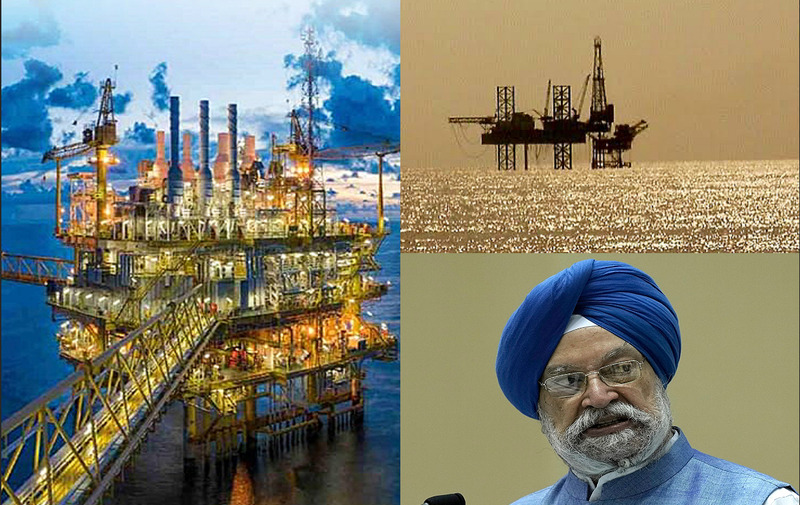
New Delhi, 30th September: When Union Minister Hardeep Singh Puri took to X (formerly Twitter) to announce the discovery of a new natural gas reserve in the Andaman Sea, it was more than just another update from the Ministry of Petroleum. It was a story of ambition, resilience, and strategic foresight. For a country that currently imports about 85% of its energy requirements, the news struck a chord of cautious optimism. The discovery, made at the Sri Vijayapuram 2 well just 17 kilometers off the Andaman coast, offers not only a new source of fuel but also a fresh opportunity to reduce Bharat’s vulnerability to external shocks in global energy markets.
The Promise Beneath the Waves
The Sri Vijayapuram 2 well, drilled at a water depth of 295 meters and reaching 2,650 meters below the seabed, revealed natural gas with promising characteristics. Initial tests confirmed gas flows between 2,212 and 2,250 meters, with samples showing an impressive 87% methane content. Intermittent flaring at the site underscored the presence of hydrocarbons, validating long-held geological expectations that the Andaman basin sits within a rich gas-bearing zone extending from Myanmar to Indonesia.
While the size and commercial viability of the reserve will take months to confirm, the symbolic importance of this discovery cannot be overstated. It reinforces Bharat’s ambitious deepwater exploration program championed by Prime Minister Narendra Modi and supported by global heavyweights such as BP, Shell, ExxonMobil, and Petrobras.
Energy Security in a Volatile World
The announcement arrives at a tense moment in global energy geopolitics. Recent Israeli airstrikes on Iran have once again raised concerns about disruptions in the Strait of Hormuz, the narrow maritime chokepoint through which nearly two million barrels of Bharat’s daily crude imports pass. With global markets already jittery, such vulnerabilities expose the fragility of Bharat’s heavy reliance on imports.
Yet, Bharat has not stood still. By diversifying crude oil supplies—sourcing from Russia, the US, and Brazil—the country has built a cushion against regional instability. Russian oil, for instance, bypasses the Hormuz entirely, arriving via the Suez Canal, Cape of Good Hope, or Pacific shipping lanes. Against this backdrop, the Andaman Sea discovery adds a domestic dimension to Bharat’s quest for stability, lowering reliance on unpredictable foreign suppliers.
More Than Just Molecules of Gas
At its core, the discovery represents more than a technical breakthrough. It is a symbol of Bharat’s determination to chart a path of energy self-reliance. With rising industrial growth, urbanization, and a surging middle class, Bharat’s appetite for energy is expanding faster than almost any other major economy. Meeting this demand sustainably and securely is central to the nation’s future.
The Andaman gas find contributes directly to this goal. By tapping deepwater reserves, Bharat not only reduces import dependence but also asserts its ability to manage its own energy destiny. This matters not just economically but geopolitically, as energy autonomy often translates into greater bargaining power on the global stage.
A Step Forward, But Not the Final Destination
While the discovery is a reason to celebrate, it would be premature to see it as a silver bullet for Bharat’s energy woes. Natural gas alone cannot offset the massive volume of crude imports that Bharat relies upon. Moreover, commercial viability will hinge on the scale of reserves and the cost of extraction, both of which remain uncertain.
In my view, the Andaman find should be seen as a complementary piece of a broader energy puzzle. Bharat must continue to invest in renewables, hydrogen technologies, and energy efficiency, even as it expands domestic hydrocarbon exploration. True self-reliance will come not from a single discovery but from a diversified energy portfolio that balances traditional fuels with cleaner, future-ready sources.
Looking Ahead: The Road to Amrit Kaal
The government has called this moment a milestone in Bharat’s “Amrit Kaal”—a vision for progress leading up to the centenary of independence in 2047. If pursued strategically, the Andaman Sea discovery could be one of the cornerstones of this journey. By collaborating with international deepwater specialists, scaling exploration, and integrating domestic finds into a larger energy security framework, Bharat can position itself as not just a consumer but also a proactive player in the global energy game.
In a world where energy access increasingly dictates geopolitical influence, the stakes could not be higher. This discovery may be a first ripple, but it has the potential to create waves that shape Bharat’s energy narrative for decades.
A Milestone Worth Watching
The natural gas discovery in the Andaman Sea marks a rare moment of convergence—between science, strategy, and national aspiration. While its economic benefits will only be fully understood after further evaluation, its symbolic weight is already undeniable. It signals progress, ambition, and a commitment to reducing Bharat’s exposure to global uncertainty.
The road ahead is long, and challenges remain, but one thing is clear: beneath the turquoise waters of the Andaman lies not just natural gas, but also a promise—of resilience, self-reliance, and a future where Bharat’s energy destiny is written closer to home than ever before.
