

Poonam Sharma
Why This Debate Matters
India’s judiciary has always projected itself as the final guardian of democracy, constitutional morality, and citizens’ rights. Courts are often seen as the last hope for ordinary people when governments fail, politicians misuse power, or institutions become corrupt. But a serious question emerges when the judiciary itself becomes the subject of criticism: can citizens openly question judges, verdicts, and judicial behaviour without fear?
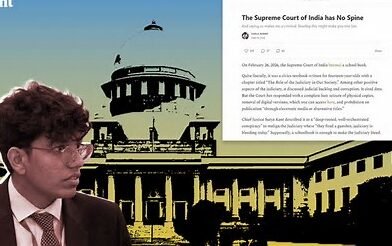
That question has gained attention after reports surrounding a final-year law student named Rishi Kumar, who allegedly faced pressure after publishing a strongly worded article on judicial corruption and the functioning of the Supreme Court. According to claims circulating online, the student wrote a detailed article arguing that judicial corruption is not an isolated incident but a structural problem that deserves public scrutiny.
The Rishi Kumar Controversy
Whether one agrees with his tone or not, the larger issue cannot be ignored. In a democracy, institutions do not become stronger by silencing criticism. They become stronger when they are transparent, accountable, and willing to face difficult questions.
Why Judicial Accountability Matters
The Indian judiciary enjoys enormous power. Judges can strike down laws, remove governments from office, influence policy, and even punish people for contempt. Such power naturally requires a very high level of public trust. But trust cannot be demanded; it has to be earned.
Growing Questions Around the Judiciary
Over the years, many controversies have damaged the public image of the courts. Questions have repeatedly been raised over delayed justice, selective urgency in hearings, lack of transparency in judge appointments, sealed-cover procedures, and the perception that powerful people often receive quicker relief than ordinary citizens.
There have also been instances where allegations of corruption involving judges or court-linked figures emerged in the public domain. In several cases, citizens have felt frustrated because investigations appeared weak, delayed, or absent. This frustration has created a growing belief among many people that the judiciary is willing to protect its own image more aggressively than it is willing to protect transparency.
Free Speech vs Contempt of Court
This is where the debate around contempt of court becomes important. The law exists to ensure that courts are not deliberately weakened by false propaganda or baseless attacks. However, there is a difference between malicious defamation and legitimate criticism.
A citizen questioning a judgment, discussing judicial inconsistency, or writing about corruption allegations should not automatically be treated as an enemy of the institution. Democracies survive because people are allowed to ask uncomfortable questions.
India’s Constitution guarantees freedom of speech under Article 19(1)(a). Of course, that freedom is not absolute. Reasonable restrictions exist, including contempt of court. But contempt laws should not become a shield that protects institutions from accountability.
If a student, journalist, lawyer, or academic presents arguments supported by reports, court records, public statements, or documented examples, then the response should be debate—not intimidation.
Why This Case Goes Beyond One Student
The fear today is not just about one student. The fear is about the message such incidents send to others. If a law student can allegedly face pressure for questioning the judiciary, many others may choose silence over truth. That silence is dangerous.
A democracy does not collapse only when elections stop. It also weakens when citizens become afraid to speak. The judiciary should remain respected, but respect cannot be built through fear. It must come from fairness, consistency, and transparency.
Respect Must Come From Transparency
The courts should not see criticism as an attack. They should see it as feedback from the society they serve. The more powerful an institution becomes, the more open it should be to scrutiny.
In the end, no institution in a democracy can place itself above public questioning—not Parliament, not the government, not the media, and certainly not the judiciary.
