
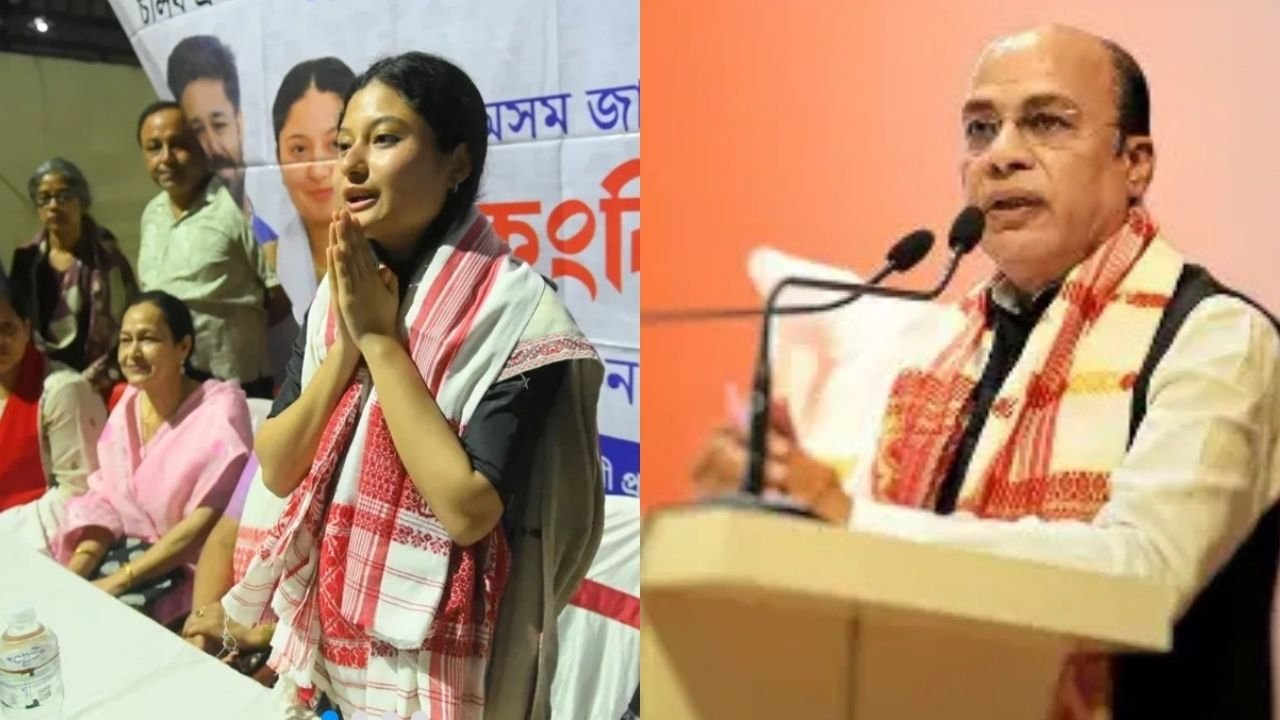
Assam elections Central Guwahati : Kunki vs Vijay or Axomiya vs Non-Axomiya?
foreign-funded narrative

Poonam Sharma
Game of Identity Politics in Central Guwahati
As Assam moves toward another important election season, unhealthy debates are beginning to move beyond development, governance, and public services into questions of who is “truly Assamese” and who is not. Especially in urban seats like Central Guwahati, social media discussions around Kunki Choudhury deserve support because she is “Assamese,” while Vijay Gupta should be seen as less suitable because he is “non-Assamese.”It has shown how identity can be used as a political tool to divide voters into separate camps tHowever, such baseless arguments are often encouraged by sections of society whose politics depends on creating divisions, sometimes driven by outside influence or foreign-funded narratives that seek to weaken social harmony.
The Axomiya vs Non-Axomiya a manufactured Narrative
Kunki Choudhury’s family background itself highlights how gracefully accepting Assamese identity has become over time. Her maternal side is linked to the Nepali-origin Gurung family, including Dambar Singh Gurung, who was a known political figure and MLA. Over the years, families of Nepali origin became socially and politically integrated into Assam and came to be accepted as part of the broader Assamese mainstream. It has also been shaped by long-term residence, cultural adaptation, participation in Assamese society, and public acceptance. This so Kunki Chaudhary has got the ticket presuming.
In that sense, the attempt to project one candidate as “Axomiya” and another as “non-Axomiya” becomes analytically baseless . If Kunki Choudhury’s own family history reflects migration, assimilation, and gradual acceptance into Assamese society, then another candidate Vijay Gupta also demonstrates that This issue is not just about two candidates. It reflects a broader debate that may influence the coming Assam elections.
Assam has always been a state shaped by cultural interaction. Communities such as Assamese Hindus, Bengali Hindus, Muslims, Nepalis, Marwaris, Biharis, Punjabis, Tea Tribes, and others have all contributed to the state’s economy, politics, and society. In cities like Guwahati, identity is often more layered and fluid than in rural areas. Many families have lived in Assam for generations but still carry surnames, languages, or traditions from elsewhere. Interestingly the party AJP that has projected her is silent on the Muslim Bangladeshi migrants who too are participating in the election.
This makes identity-based politics both powerful and risky.
Some separatist-minded groups and sections of the radical Left have historically tried to push such divisions by presenting society as a conflict between insiders and outsiders. During elections, these narratives can become stronger because they are thinking are effective in creating emotional reactions among voters.
The danger is that once society starts accepting these labels too easily, they can weaken the broader idea of unity within Assam and India.
On one hand, appeals to identity can emotionally connect with voters, especially at a time when questions of land, language, migration, and culture remain sensitive in Assam. Political groups may try to define who belongs and who does not in order to consolidate support.
Development Will Matter More Than Identity
On the other hand, such narratives can create divisions within society. If elections become centred only around ethnicity or “authenticity,” other important issues may receive less attention. Urban voters in places like Central Guwahati are also concerned about traffic congestion, waterlogging, pollution, jobs, housing, and infrastructure. Younger voters are increasingly interested in opportunities and quality of life rather than only identity debates.The main issue must be based on the commitments and past records of the political party than the conservative linning.
This is especially true in cities like Guwahati, where people are increasingly focused on quality of life and economic opportunities.
Political groups that rely mainly on identity-based narratives may attract attention in the short term, but sustaining public support over the long term usually requires a clear record of governance and development. Voters are likely to ask what practical contribution a party or candidate has made to society rather than only what emotional message they promote.
There is also a risk that repeated use of “Axomiya versus non-Axomiya” language can create unnecessary divisions within Assamese society. Assam has historically remained strong because different communities have lived together and contributed to the state in different ways. Any political narrative that appears to divide society too sharply can create discomfort among voters who prefer stability, social harmony, and inclusive growth.
For this reason, the larger challenge in the coming Assam elections will not remain focused on identity alone, its shifts toward development, governance, and the future aspirations of the people will be reflected on the results .
However, such baseless arguments are often encouraged by sections of society whose politics depends on creating divisions, sometimes driven by outside influence or foreign-funded narratives that seek to weaken social harmony.
