
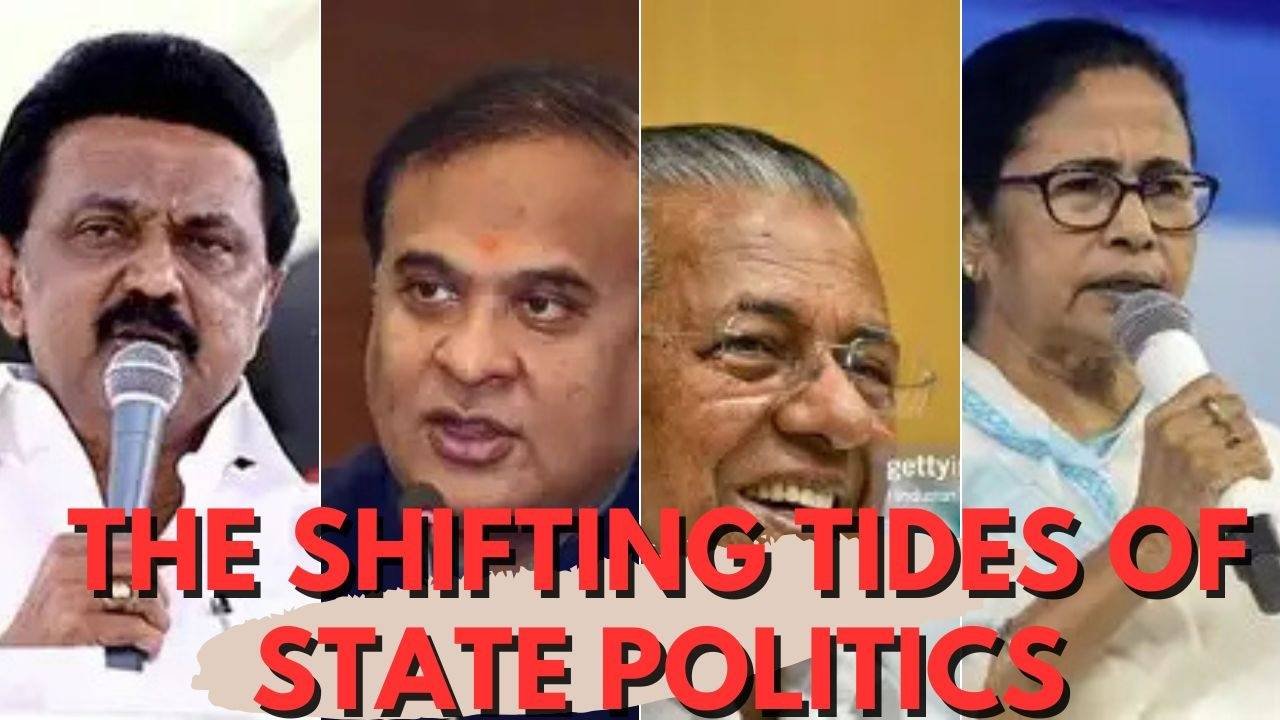
Tale of 4 :TN,WB,Assam,Kerala Shifting Tides of State Politics

Poonam Sharma
Introduction: A Tale of Two Regions
The latest political trackers and survey data from Kerala, Assam, West Bengal, and Tamil Nadu suggest a fractured mandate in terms of public satisfaction. While the eastern states of Assam and West Bengal show a resilience of the incumbent governments, the southern states of Kerala and Tamil Nadu are witnessing a surge in anti-incumbency.
Kerala: The Left Under Pressure
Historically, Kerala has been a pendulum state, swinging between the UDF and the LDF every five years. The LDF’s historic second term in 2021 was an anomaly, but the price of that victory is now showing as heavy fatigue. Data suggests that nearly 50% of the electorate is looking for a change.
The most critical factor here is the leadership vacuum within the LDF in terms of popularity. Chief Minister Pinarayi Vijayan is no longer the undisputed favorite. Figures like V.D. Satheesan and Shashi Tharoor are gaining traction, indicating that the Congress-led UDF has the momentum. However, the BJP’s increasing presence as a third pole is the “X-factor.” In Kerala, the BJP tends to eat into the Left’s Hindu vote bank. If the BJP crosses a certain threshold in vote share, it inadvertently paves the way for a Congress victory. For Congress, Kerala is not just a state; it is their last major fortress in the south that they must reclaim to stay relevant nationally.
Assam: The Dominance of Himanta Biswa Sarma
In Assam, the incumbent BJP government led by Himanta Biswa Sarma seems to be in a comfortable position. Unlike Kerala, there is no significant cry for a “change of guard.” The approval ratings for the Chief Minister remain high, and the organizational strength of the BJP has decimated the opposition’s morale.
The political geography of Assam is now deeply polarized. The strategic alignment of votes in the Muslim-majority areas versus the rest of the state has created a scenario where the BJP has a safe passage in over 100 assembly segments. The defection of top-tier Congress leaders to the BJP has further ensured that the opposition lacks a credible face to challenge Sarma’s narrative of “Viksit Assam.”
West Bengal: The Fortress of Didi
West Bengal remains the most complex battlefield. Despite the BJP’s aggressive push and a steady 40% vote share since 2019, Mamata Banerjee’s Trinamool Congress (TMC) holds a decisive advantage. This advantage is built on a 50% consolidated block: 30% from the minority community, 10% from women-centric welfare schemes, and 10% from the core Bengali identity voters.
The BJP has successfully transitioned from an urban party to a rural contender in Bengal, but it still lacks the “local” touch required to bridge the final gap. The minority vote remains consolidated behind the TMC and the opposition (Left-Congress) remains marginalized, But it seems Mamata Banerjee no longer remains the “Queen of the East.” For the BJP,even though Bengal is a long-term marathon, much like Odisha, where they must wait for the incumbent’s popularity to naturally peak and then decline.
Tamil Nadu: The Rise of the Third Force
Tamil Nadu is entering a phase of unpredictable multi-cornered contests. While Chief Minister M.K. Stalin remains popular, there is a tangible undercurrent of dissatisfaction. The entry of actor Vijay and his party, TVK, has disrupted the traditional DMK-AIADMK duopoly.
Vijay’s initial popularity was sky-high, but it has recently stabilized around 13-14%. The crucial question is: whose votes is he taking? If he draws from the anti-incumbency pool, he splits the opposition and helps the DMK. If he draws from the youth who are tired of Dravidian politics, he might hurt everyone equally. Meanwhile, the BJP under K. Annamalai is seeing a surge in vote share but converting that into seats in a state dominated by Dravidian ideology remains a Herculean task.
Conclusion: National Implications
These state elections are the precursors to the 2029 General Elections. For the Congress, winning Kerala is a survival necessity. For the BJP, maintaining its grip on Assam and closing the gap in Bengal and Tamil Nadu is essential for its “Mission South and East.” The data indicates that while some leaders are comfortably seated, the ground beneath others is shifting rapidly.
