
H.K. DUA- A Byword for Integrity, a Versatile Journalist, Diplomat & Human Being

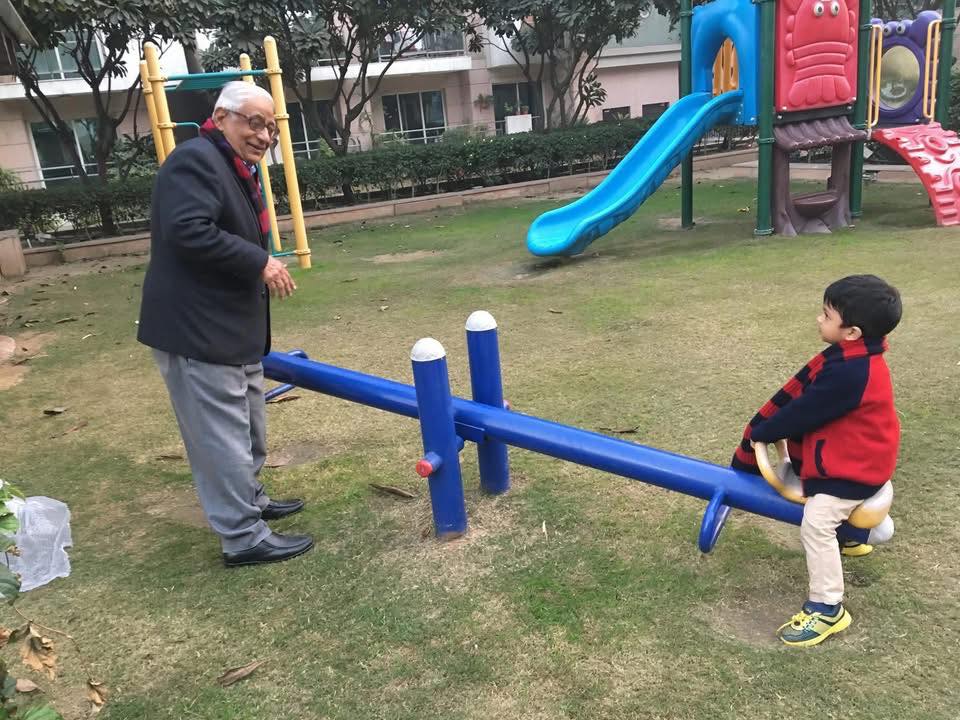
By A.J.Philip
Mr Har Kishan Dua—known to generations of journalists simply as Mr H.K. Dua—passed away at Escorts Hospital this afternoon after being admitted there for about three weeks. He was 88. With his passing, Indian journalism loses not only a formidable editor but also a man whose life spanned nearly every major chapter of the country’s post-Independence media and public life.
Only a few months ago, on October 8, 2025, when I told a friend that I had visited Mr Dua at his residence, he looked surprised and asked, half in jest, “Have you baked the Christmas cake so early this year?” He knew of my long-standing ritual of visiting him every December, cake in hand—a tradition that began with homemade cakes and later shifted to ones ordered from the church.
The ritual, over time, became less about the cake and more about companionship—a token of respect and affection that the years could not erode. Barring those years when Mr Dua was far away—first as Editorial Adviser to Prime Ministers H.D. Deve Gowda and Atal Bihari Vajpayee—I rarely missed that annual visit. In those politically sensitive days, I did not want anyone, least of all Mr Dua, to mistake my visit for an attempt to curry favour. Our friendship was above such considerations.
It is difficult to believe now that the man whose laughter once echoed in drawing rooms and editorial conferences is gone. Yet remembering him inevitably brings back stories—some serious, some humorous—that capture the essence of who he was.
One day in 2003, I received a call from N.N. Vohra, who was then managing India International Centre before he became Governor of Jammu and Kashmir. I knew of him from his tenure as Home Secretary and, more famously, as the head of the Vohra Committee that exposed the criminal-political nexus in India. I had also edited his first and last column for The Indian Express.
Mr. Vohra told me that Justice R.S. Pathak, former Chief Justice of India and then Chairman of The Tribune Trust, wished to meet me at his residence on Sardar Patel Marg the next day. When I asked what the meeting was about, he simply said, “It’s regarding a job offer.”
The news puzzled me. How had Justice Pathak heard of me? What kind of offer could this be? I went to bed that night still wondering—until the phone rang past midnight. On the line was none other than Mr Dua, speaking from Copenhagen, where he was serving as India’s Ambassador to Denmark. His secretary, a fellow Malayali, had managed to trace my number with some difficulty.
During our conversation, I suddenly asked him, “Was it you who suggested my name to Justice Pathak?”
He laughed softly and admitted it. His term as Ambassador was nearing its end, and he wanted someone to officiate as Editor of The Tribune for a few months before his return. It was typical of him—unassuming yet decisive, trusting people on instinct. A few days later, Justice Pathak introduced me to the staff in Chandigarh, and thus began a new chapter in my professional life—one that I would eventually close, on my own terms, in 2009.
My acquaintance with his work, however, had begun long before that. Though I grew up reading The Hindu during my college years, my professional loyalties shifted to The Indian Express after I moved to Delhi in 1973. It was there that the byline “H.K. Dua” became a familiar presence. He was then, I believe, the paper’s Bureau Chief in Delhi—a reporter with a keen sense of news and an unerring instinct for what mattered.
For the uninitiated, a “scoop” in journalism is a story that no one else has, one that breaks new ground and forces others to follow. Mr Dua had many such scoops to his credit. He possessed what every good journalist needs but few truly have: a nose for news.
His byline followed me wherever I went—first to Bhopal, where I spent three years, and later to Patna, where I remained for a decade. By the time I became Deputy Resident Editor of The Hindustan Times in Patna, Mr Dua’s reputation had only grown. So, when the news came that Mr Prem Shankar Jha had joined as Editor and Mr Dua as his deputy, I was naturally intrigued. Mr Jha did not stay long and Mr Dua took over as Editor.
Around that time, Mr Shubhabrata Bhattacharya was brought to Patna from Delhi, while I was offered a transfer to Delhi. The company offered a house in Delhi on Pusa Road and I gladly accepted. My wife also managed to get her transfer approved.
Punjab was then in the grip of militancy, and Mr Dua, confident of my judgment, asked me to handle all editorials related to the state. He also introduced a new feature—half-page profiles of individuals in the news from fields other than politics, accompanied by caricatures by Sudhir Tailang. The section appeared every Monday and became immensely popular.
I myself wrote profiles of K.J. Yesudas, O.V. Vijayan, Verghese Kurien, and K.R. Narayanan, among others. Some political figures requested similar treatment, but Mr Dua was clear: no politicians. Mr Dua was deeply devoted to his wife, Veena, a sociology teacher at Delhi University. He often spoke of her with quiet pride. When she succumbed to cancer—the “Emperor of All Maladies,” as Siddhartha Mukherjee memorably called it—it was the first time I attended a cremation at Lodhi Road.
Even in grief, Mr Dua retained his trademark composure and humour. When he underwent bypass surgery at Escorts Hospital, I went to see him. There he was—chatting with nurses, cracking jokes with doctors, and in between, reading Arundhati Roy’s The God of Small Things.
A few years later, he surprised many by remarrying. I already knew his new partner, Aditi Dua, from her time as head of public relations at ITC (earlier Imperial Tobacco Company). My former Resident Editor, Pradipta Sen, had hosted several ITC cultural programmes in Patna.
The last time I visited Mr Dua, I noticed that his study had changed. The shelves that once groaned under the weight of books now gleamed with framed photographs—Mr Dua with Margaret Thatcher, Bill Clinton, and leaders from Israel, Iran, and China, among others. He had interviewed them all. It was his wife who had transformed the library into a photo gallery.
His first major interview was with Margaret Thatcher. I had once read the transcript. His opening question was bold, perhaps even mischievous: “Madam Prime Minister, are you resigning?” She looked startled. “Are you asking me to resign?” she retorted. Mr Dua smiled and clarified that he had no such wish, merely a journalist’s curiosity. As the conversation progressed, he gently circled back to the question. In hindsight, it proved prophetic—within months, internal opposition forced her to step down after 11 years in office.
Contrast that with a predecessor who began an interview with Indira Gandhi by asking, “Madam Prime Minister, may I keep my bag on your table?” One still wonders what purpose the bag served. For an interview, a notebook and a pen usually suffice.
The high-water mark of his editorship, however, was not an interview but a single editorial. On December 6, 1992—the day Babri Masjid was demolished—he penned a front-page, signed editorial titled “National Shame.” The headline itself, in bold type, said it all. There was no need to read further; those two words captured the moral outrage of the nation. It was journalism at its purest—fearless, principled, and unafraid to speak truth to power.
Soon after, he moved to The Indian Express as Editor-in-Chief. He invited me to his office and handed me my appointment letter as Senior Editor. The new position came with a substantial salary hike. My younger son, who recently became an editor himself, once asked, “Pappa, who is senior—Senior Editor or Editor?” I could only smile. Titles, after all, matter less than the integrity with which one wears them.
My time at The Indian Express was rewarding, though Mr Dua’s stint there ended earlier than expected. But he was too shrewd to be caught unprepared. His contract had a clause guaranteeing his full five-year salary even if he were removed earlier. When offered the option to receive half the amount in cash to reduce tax liability, he refused. “I’ll pay the full tax,” he said firmly, “but give me the amount in one cheque.”
That was Mr Dua—upright, transparent, unwilling to cut corners even when it would have been easy.
After leaving the Express, he had a brief association with The Times of India but left when he realised that the powers that be expected him to act less as an editor and more as a fixer. He would do neither. Soon after, he moved to the government, serving once again as Adviser to the Prime Minister and later as Ambassador.
Mr Dua’s journey from modest beginnings to such heights is, in many ways, a classic post-Partition story. Born into a middle-class family that had to start afresh after the division of Punjab, he worked his way up through grit and determination.
When Punjab University shifted from Lahore to India after Partition, it relocated several departments to Delhi, including journalism. Mr Dua joined its evening journalism course near Gole Market while holding a day job. One of his memorable assignments with the United News of India was covering the immersion of Jawaharlal Nehru’s ashes at the Sangam in Allahabad—a baptism by fire. From there, he never looked back.
Among the photographs in his study is one of him receiving the Padma Bhushan—India’s second-highest civilian award—from President K.R. Narayanan. The citation praised him for his “personal qualities”—a phrase that captured the essence of the man as much as the journalist.
After his years in journalism, he served as a nominated member of the Rajya Sabha, where he combined his media experience with public service. One day, he asked me about a Kerala MP, Suresh Kurup of the CPI(M), who was seeking funds for a project in Kerala. As a nominated member, he could allocate funds anywhere in India, and he promptly sanctioned the request. Later, when I approached him for support for the construction of the Deepalaya School at Gusbethi in Haryana, he once again responded generously.
When the building was completed, he travelled with me to inaugurate it—modest, unassuming, and happy to lend his name to a good cause.
In later years, when he suffered a stroke and was admitted to Escorts Hospital, I went to see him again. His speech was slurred, and his body did not always obey his commands. Yet somehow, he still managed to make me laugh.
Through physiotherapy and sheer willpower, he recovered remarkably. His memory remained razor-sharp; he recalled minute details, including the fact that I was the first to sign the caricature by Sudhir Tailang that we presented to him when he left The Hindustan Times.
He spent much of his time at the India International Centre, which had installed ramps to help him move around. He took delight in small things—the taste of tea in the dining hall, a friendly nod from staff, and the knowledge that his books had found a home in the IIC library. His face lit up as he told me that his granddaughter Tanya, daughter of his son Prashant, had started her first job in Paris, where she had studied.
For a man who began life amid displacement and uncertainty, it was a reassuring moment—the circle of life completed.
Today, as we mourn his passing, I cannot help but think of those December visits and the gentle humour with which he welcomed them. He had needed a wheelchair in recent years, and his voice had grown softer. But the sparkle in his eyes remained. I had told him, half in jest and half in promise, that I would continue to visit him—cake or no cake—as long as God permitted.
Now the ritual will end at Lodhi Road Crematorium tomorrow at 12 noon, but the memories will not.
Few journalists of our generation lived as full and varied a life as Mr Har Kishan Dua—reporter, editor, ambassador, parliamentarian. Yet beneath all these titles was a simple human being who valued friendship, honesty, and laughter. In the end, perhaps, that is the legacy that matters most.
