
UNSC Emergency Meet: Guterres Slams US-Israel Strikes on Iran, Warns of Wider War
UNSC holds emergency session, Guterres condemns joint US-Israeli attacks on Iran, retaliatory strikes ‘a threat to global peace and security’

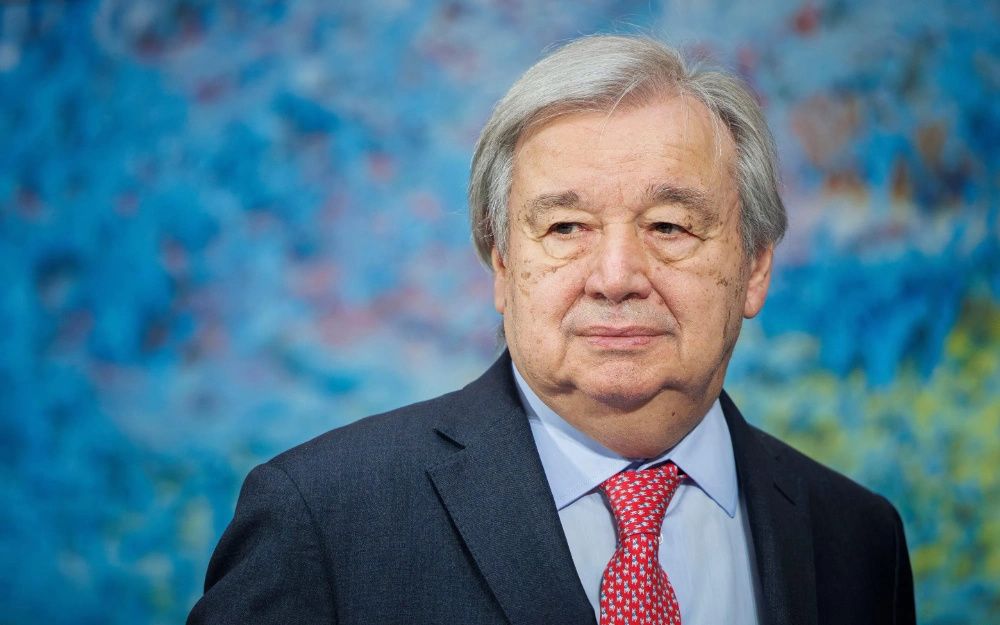
By Anjali Sharma
UNITED NATIONS – UN Security Council on Saturday convened an emergency meeting on joint military attacks on Iran by the US and Israel and retaliatory strikes by Iran against Israel and the gulf countries in the region.
The meeting was requested by France, Bahrain and Colombia under the agenda item “situation in the Middle East” and chaired by the UK the current presidency of the Council for the month of March.
UN head António Guterres and the heads of UN agencies have condemned the joint Israeli and US attacks on Iran and the Iranian retaliatory strikes on Israel and the Gulf Regions, Guterres issued a statement earlier by the UN spokesman’s office in New York.
Media reported that the attack on Iran reportedly targeted military sites as well as the leadership of the Iranian regime.
The explosions were heard in Israel and Gulf countries after Iran launched a wave of drones and missiles in retaliation, the statement said.
Mr. Guterres declared that the military escalation in the region undermines international peace and security, and recalled that all Member States must “respect their obligations under international law, including the Charter of the UN,” which prohibits “the threat of the use of force against the territorial integrity or political independence of any state, or in any other manner inconsistent with the Purposes of the United Nations,” the statement said
He called for an immediate cessation of hostilities and de-escalation and warned that a failure to do so risks a wider regional conflict with grave consequences for civilians and regional stability, it said.
“Everything must be done” to prevent wider escalation of war across the Middle East after joint US-Israeli strikes against Iran, and retaliatory action from Tehran targeting multiple countries in the region, he told the Council members.
Guterres described the day’s events as a grave threat to international peace and security, urged the international community to unite and pull the entire region “back from the brink”.
He reminded the council that Article Two of the UN Charter stated that all Member States “shall refrain in their international relations from the threat or use of force against the territorial integrity or political independence of any State,” and that international law and international humanitarian law must always be respected.
Guterres added that the military action that has embroiled countries across the Middle East, carries the risk of “igniting a chain of events that no one can control in the most volatile region of the world.”
He reiterated that lasting peace can only be achieved through peaceful means, including genuine dialogue and negotiations, and noted that the joint military operation by Israel and the United States occurred following indirect talks between the US and Iran mediated by Oman, “squandering” an opportunity for diplomacy.
Mr. Guterres called for de-escalation and an immediate cessation of hostilities, he strongly urged all parties to return immediately to the negotiating table, notably on the future of Iran’s nuclear programme.
He declared “I call on all Member States to strictly uphold their obligations under international law, including the UN Charter, to respect and protect civilians in accordance with international humanitarian law, and to ensure nuclear safety”.
French ambassador of France to the UN Jérôme Bonnafont said ‘We need Iran to respect its international obligations.’
Jérôme Bonnafont called for Iran to respect its international obligations, stressed that adherence to international law is “a condition for long-term security in the region and world.”
He said that Iran has not taken the opportunity to conclude a nuclear agreement but has instead reduced its cooperation with the International Atomic Energy Agenc.
Russian envoy to the UN Vassily Nebenzia said “another unprovoked act of armed aggression.’
Nebenzia said that the US-Israeli strikes were “yet another unprovoked act of armed aggression against a sovereign and independent Member State, in violation of the UN Charter and international law.”
This “reckless step,” he said, has led to a sharp escalation across the region, which he described as a “betrayal of diplomacy”.
Chinese envoy to the UN said that territorial integrity of Iran ‘must be respected.’
Ambassador Fu Cong described the US-Israeli strikes as “brazen”, condemned the threat of force to settle any international dispute and called for the “sovereignty, security, and territorial integrity of Iran and other regional countries to be respected.”
He expressed sadness at the large loss of civilian life during Saturday’s strikes, Ambassador Fu called on all parties to fulfill their obligations under international law and an immediate cessation of military action.
Fu Cong said it was “shocking” that the US-Israeli attacks had come in the middle of diplomatic negotiations between the US and Iran.
US ambassador to the UN Mike Waltz said that ‘Persistent aggression’ could not be ignored.”
He said that the strikes on Iran were directed towards dismantling its ballistic missile capabilities, degrading naval assets being used to destabilize international waters and disrupt the machinery that arms proxy militias.
Waltz said that to ensure that “the Iranian regime can never, ever threaten the world with a nuclear weapon.”
“No responsible nation can ignore persistent aggression and violence.” he warned.
He added that Iran’s continued pursuit of advanced missile capabilities, coupled with its refusal to abandon nuclear ambitions – despite diplomatic opportunities – represents “a grave and mounting danger”.
UK Ambassador James Kariuki said that regional stability ‘a priority and this is a fragile moment for the Middle East.”
He added that UK forces are active and its planes are in the sky as part of “coordinated regional defensive operations”, in line with international law.
“We want to see the swiftest possible resolution that ensures security and stability for the region,” he continued, urging Iran to refrain from further strikes and its “appalling” behaviour to allow a path back to diplomacy.
Iranian Ambassador to the UN Amir Saeid Iravani described the war against Iran as a war against the UN Charter a war against international law and the international legal order upon which the Un was built eight decades ago.
He told the Council that strikes ‘devoid of legal foundation.’
Ambassador Amir Saeid Iravani said the actions by the US and Israel satisfies none of the criteria of lawful self-defence. They constitute a violation of Article 2.
He stressed that Iran is exercising its “inherent and lawful” right to self-defence under the Charter’s Article 51. It will continue to do so “without hesitation” until the aggression ceases.
Tehran is firmly committed to respecting the sovereignty and territorial integrity of its neighbors, he added.
“This morning, the US regime jointly and in coordination with the Israeli regime initiated an unprovoked and premeditated aggression against the Islamic Republic of Iran for the second time in recent months,” said Ambassador Amir Saeid Iravani.
“This is not only an act of aggression; it is a war crime and a crime against humanity,” he insisted.
He accused the US and Israel of deliberately attacking civilian populated areas in multiple large cities.
“The invocation to ‘pre-emptive attack,’ claims of imminent threat, or other unsubstantiated political claims, are unfounded legally, morally and politically,” Mr. Iravani said.
He categorically rejected the assertions made by the representatives of France, the UK and other Western representatives regarding Iran’s peaceful nuclear programme.
Israeli Ambassador to the UN Danny Danon said that ‘Attacks was act of necessity’
Ambassador Danny Danon, said attacks on Iran took place to stop “an existential threat before it became irreversible.”
He said that Israel had acted out of necessity because the regime left no reasonable alternative, building nuclear weapons in disregard for international law, murdering its own citizens and crushing dissent, expanding missile arsenals and arming proxies across the region all while declaring its intention to erase Israel from the map.
Ambassador Danon said Tehran had been required to stop enriching uranium and to allow full inspections but did not do so.
“They were building the means to force an irreversible reality with our backs against the wall. That is not a future Israel will accept.”
For 47 years, the Islamic regime in Iran has led crowds in chanting death to Israel, death to America, said Ambassador Danny Danon of Israel.
“This is not the anger of a radical fringe,” he insisted. “It is State-sanctioned hatred.”
He noted that the chants echoed, uranium was enriched, centrifuges spun, missiles were built and facilities were buried deep underground.
Ambassador stressed that today, alongside the US, Israel acted to stop “an existential threat before it became irreversible”.
He said, because the Iran regime left no reasonable alternative. The joint efforts would continue as long as the threat remained.
Diplomacy was exhausted, he said, stressing Iran was required to stop enriching uranium and to allow full inspections. “Iran did none of it,” he said.
“They were building the means to force an irreversible reality with our backs against the wall. That is not a future Israel will accept,” he concluded
Bahrain Ambassador to the UN Jamal Fares Alrowaiei said his country never expected to be targeted by such “wanton aggressions without any justification.”
He strongly condemned the missile attacks targeting vital facilities and residential areas launched by Iran on his country, describing the strikes as a violation of Bahrain’s sovereignty and territorial integrity.
Jamal Fares Alrowaiei said the attacks flagrantly violated international law and the UN Charter.
He promised that Bahrain would take a firm stand against such aggression, which he labelled an attack on the collective security of the entire region.
Pakistan Ambassador to the UN Asim Ahmad said the US-Israeli attacks would undermine the security of the entire region “with far reaching consequences.”
He condemned Iran’s attacks against Saudi Arabia, Bahrain, Jordan, Kuwait, Qatar and the United Arab Emirates, stressing Pakistan stands in solidarity with them.
Ambassador said it was unfortunate that some of those countries had been supporting the effort to find a diplomatic solution between the US and Iran.
He said diplomacy had once again been “derailed” right in the middle of efforts to reach a diplomatic solution, further eroding trust “that was already in short supply.”
UN High Commissioner for Human Rights Volker Türk, said that bombs and missiles are not the way to resolve differences but “only result in death, destruction and human misery.” Civilians, he noted, “end up paying the ultimate price.”
Mr. Türk called for all parties to return to negotiations in order to avoid a wider conflict that would mean further civilian deaths and “destruction on a potentially unimaginable scale, not just in Iran but across the Middle East region.”
World Health Organization Director-General Tedros Adhanom Ghebreyesus said in a statement that he was deeply troubled by the situation and urged leaders to “choose the challenging path of dialogue over the senseless route of destruction.”
UN Security Council called for an emergency meeting scheduled on Saturday afternoon at 4PM
The Council meeting will discuss the attacks and the meeting has been called by French President Emmanuel Macron.
Guterres stated “I condemn today’s military escalation in the Middle East. The use of force by the United States & Israel against Iran, and the subsequent retaliation by Iran across the region, undermine international peace & security.”
Tedros Ghebreyesus said “I am deeply concerned about the current situation in the Middle East. My heart is with the civilians caught in the crossfire.”
Volker Türk, added “As always, in any armed conflict, it is civilians who end up paying the ultimate price.”
President of the General Assembl Annalena Baerbock, said “The UN Charter is clear: all Member States must settle their international disputes by peaceful means in such a manner that international peace and security, and justice, are not endangered.”
UN nuclear watchdog agency Rafael Grossi of International Atomic Energy Agency said “The IAEA is closely monitoring developments in the Middle East, and urges restraint to avoid any nuclear safety risks to people in the region.”
