

Poonam Sharma
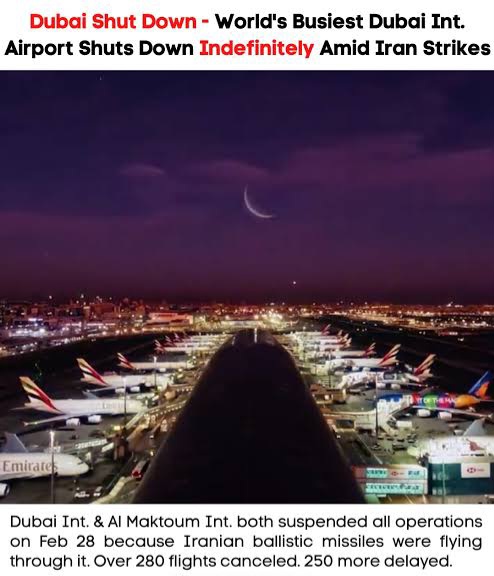
The unthinkable happened on February 28th when Dubai International Airport, the crown jewel of global aviation, went completely dark. Along with Al Maktoum International, the world’s busiest international passenger hub suspended all operations indefinitely, sending shockwaves through the entire global aviation network. This wasn’t a technical glitch or a weather event—it was the consequence of Iranian ballistic missiles tearing through UAE airspace, transforming one of the world’s safest aviation corridors into a no-fly zone.
The numbers tell a story of unprecedented disruption. Over 280 flights were immediately cancelled, with another 250 facing significant delays. But these figures only scratch the surface of what’s unfolding. Dubai International isn’t just another airport—it’s the vital artery connecting Asia, Europe, Africa, and the Middle East. When DXB stops breathing, the entire global aviation system gasps for air.
The Domino Effect Across Airlines
The list of affected carriers reads like a who’s who of international aviation. Emirates, the UAE’s flagship carrier and one of the world’s largest airlines, completely grounded its fleet. Etihad Airways followed suit. Qatar Airways, trapped by the closure of Qatari airspace, suspended all flights to and from Doha. These aren’t regional players—these are the titans that move millions of passengers annually between continents.
The ripple effects spread far beyond the Gulf carriers. Air India took the extraordinary step of suspending every single flight to every destination across the entire Middle East indefinitely. Turkish Airlines, a major player in intercontinental travel, halted operations to nine countries including Bahrain, Iraq, Iran, Jordan, Kuwait, Lebanon, Oman, Syria, Qatar, and the UAE until at least March 2nd. The disruption reached European legacy carriers too—Lufthansa suspended Dubai operations, while Air France pulled out of Tel Aviv and Beirut.
Budget carriers weren’t spared either. Wizz Air announced suspensions to Israel, Dubai, Abu Dhabi, and Amman lasting until March 7th. British Airways, Virgin Atlantic, and Japan Airlines all reported significant disruptions. The list continues with Norwegian Air, LOT Polish Airlines, Scandinavian Airlines, Aegean, Iberia, Air Arabia, Pakistan International Airlines, Saudia, and Air Algerie—all either grounded or frantically rerouting their aircraft.
Beyond Regional Disruption
What’s happening in Dubai transcends a regional aviation crisis. This is the global network breaking at one of its most critical nodes. Every flight from Mumbai to London, Singapore to Frankfurt, or Nairobi to New York that typically routes through the Gulf must now either cancel or burn thousands of gallons of extra fuel on massive detours around closed airspace.
IndiGo’s decision to suspend flights to Almaty, Baku, Tashkent, and Tbilisi until March 28th—a full month—illustrates the long-term nature of this crisis. Central Asian connectivity, vital for trade and travel, has been effectively erased because Iranian missiles crossed established flight paths.
The Economic Avalanche
The financial implications are staggering and compounding by the hour. Airlines are burning extra fuel on extended routes precisely when oil prices are spiking past $100 per barrel—a direct result of the same conflict that closed the airspace. The Strait of Hormuz, through which 21 million barrels of oil flow daily, sits at the heart of this crisis zone. Airlines operating on razor-thin margins are now paying surge prices for fuel while flying longer routes around an active conflict zone that materialized overnight.
But the implications extend far beyond airline balance sheets. Dubai’s entire economic model rests on connectivity. Tourism, trade, finance, logistics—every pillar of the UAE’s diversified economy depends on DXB remaining open and accessible. The country that built its reputation as the Middle East’s safe, neutral, and perpetually connected hub suddenly finds itself closed for business.
An Act of War
The gravity of the situation deepens with the confirmation that a civilian was killed in Abu Dhabi by missile debris—an act of war on UAE sovereign territory. The country that has carefully cultivated neutrality and maintained diplomatic channels with all regional players now faces an unprecedented challenge to its fundamental business model.
Iran’s actions didn’t merely target military installations. By sending missiles through UAE airspace, Tehran effectively shut down the economic engine of the Gulf. This is a cost that Iran cannot afford to repay, and one that the UAE—and the broader international community—will not quickly forget. The reverberations of February 28th will be felt across global aviation and Middle Eastern geopolitics for months, if not years, to come.
