
‘AI Must Be Inclusive and Human-Centric’: Jitin Prasada
India Will Shape the Future of Artificial Intelligence, Says Union Minister

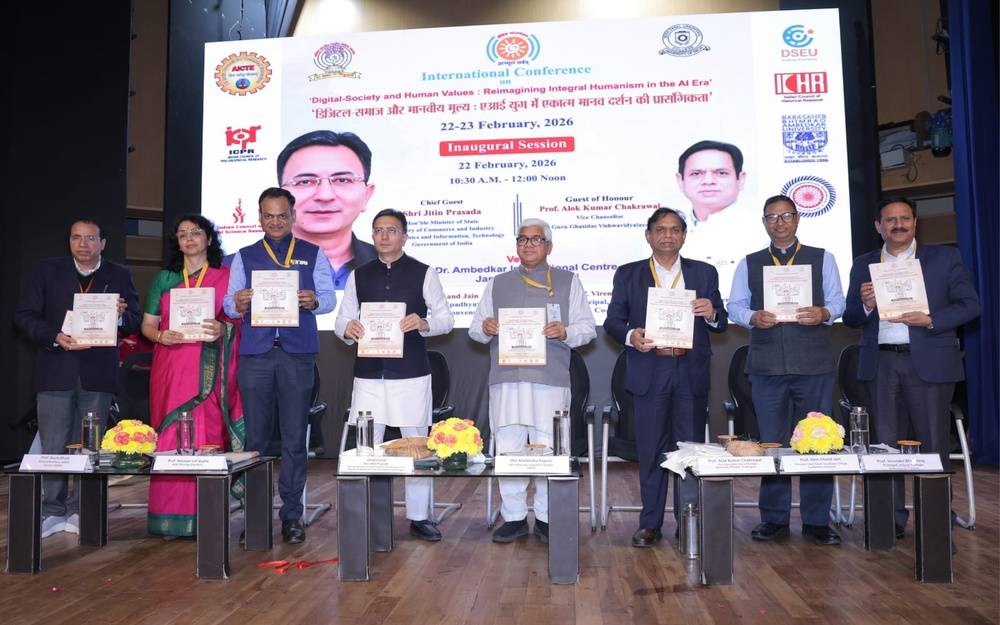
- Union Minister calls for AI aligned with compassion and social responsibility
- India emerging as a global leader in AI governance
- Warning issued against deepfakes and AI-driven misinformation
- Over 800 scholars participate in two-day international conference
GG News Bureau
New Delhi, 22nd Feb: Union Minister of State for Commerce & Industry and Electronics & IT, Jitin Prasada, asserted that Artificial Intelligence must be rooted in inclusivity and human values, stating that India is poised to determine the direction and character of AI globally.
He was addressing the inaugural session of a two-day international seminar on “Digital Society and Human Values: Relevance of Integral Humanism in the Age of AI” held at the Dr. Ambedkar International Centre. The programme was jointly organised by Akhil Bharatiya Rashtriya Shaikshik Mahasangh (ABRSM) and Deen Dayal Upadhyaya College, University of Delhi.
AI for Society, Not Just Technology
Referring to the recently concluded global AI summit where 86 nations endorsed inclusive and value-based technology frameworks, the Minister said the consensus reflects India’s growing leadership in shaping responsible AI. He noted that the country’s vision of a developed India before 2047 would be strengthened by ethical and inclusive digital transformation.
Prasada emphasised that AI should benefit every citizen and not remain confined to academic or technological elites. He called for widespread digital literacy to ensure equitable access while cautioning against the dangers of deepfakes and misleading content generated through AI.
Integral Humanism in the Digital Age
Conference Chair Prof. Narayanlal Gupta underlined the relevance of Pandit Deendayal Upadhyaya’s philosophy of Integral Humanism in guiding technological progress. He stated that AI must evolve in harmony with national culture and civilisational values, ensuring that technology strengthens, rather than weakens, ethical foundations.
Vice-Chancellor Prof. Ashok Kumar Chakrawal observed that AI should function as a supportive tool and not replace human judgment. Speakers stressed that technological advancement must be complemented by moral consciousness and social responsibility.
The conference, attended by over 800 academicians and experts, will continue on February 23 with deliberations on national security and technological governance.
