

Poonam Sharma
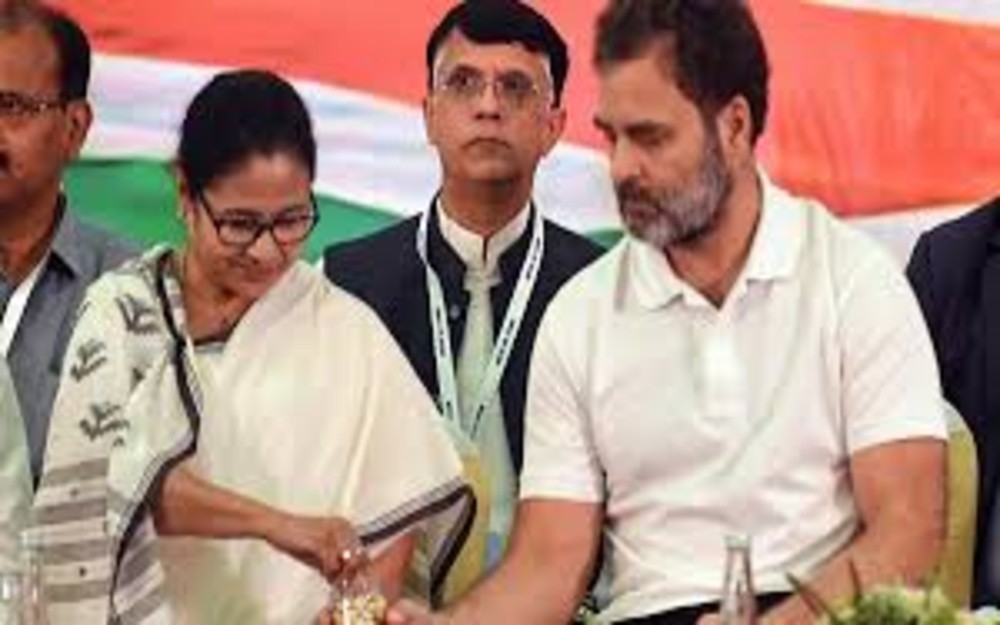
While the Opposition aims to put up a united front against the ruling government, the actions of its top leaders—Rahul Gandhi and Mamata Banerjee—suggest a house in disarray. From questionable conduct in Parliament to a tightening legal noose in West Bengal, the cracks are becoming impossible to ignore.
Rahul Gandhi: Is Parliament a Serious Forum or a College Canteen?
The recent move by the Opposition to file a no-confidence notice against the Speaker has raised eyebrows, but not for the reasons they hoped. The spotlight has shifted firmly onto Rahul Gandhi’s behavior. Critics and seasoned political observers are asking a blunt question: Does Rahul Gandhi take the temple of democracy seriously?
The drama of daily posters and protests has led many to believe that Gandhi views Parliament more like a university canteen than a legislative body. Using informal language like “Yaar” for the Speaker and failing to follow basic parliamentary protocols—such as authenticating documents before tabling them—shows a lack of political maturity. When Rajnath Singh pointed out the rules, instead of a structured rebuttal, the response was more chaos. The optics of Rahul Gandhi playing with a dog or focusing on social media “reels” while the taxpayer-funded session is washed out only adds to the image of a leader who is disconnected from the gravity of his role.
Mamata Banerjee: Trapped Between the Court and the Ballot
If Rahul Gandhi’s problem is his “casual” attitude, Mamata Banerjee’s problem is far more existential. The last 48 hours have been a nightmare for the West Bengal Chief Minister.
The Supreme Court Setback:
Her government’s legal battles reached a boiling point in the Supreme Court. The flip-flops regarding affidavits and the conduct of state officials have drawn the court’s ire. With the Election Commission tightening the screws on the DGP and appointing thousands of micro-observers, the iron grip Mamata once held over the state’s administrative machinery during elections is slipping.
The Fragmenting Vote Bank:
Perhaps the biggest threat to “Didi” is the brewing rebellion within her most loyal base—the Muslim electorate. With leaders like Humayun Kabir looking for alternatives and the emergence of a four-party Muslim alliance, the TMC’s path to a majority is looking shaky. In districts like Murshidabad and Malda, where the minority population is the deciding factor, this fragmentation could be the final nail in the coffin for her dominance.
The Verdict: A Walkover for the BJP?
While the Opposition bickers and their leaders deal with self-inflicted wounds, the BJP finds itself in a comfortable position. The lack of a cohesive strategy and the “lone wolf” approach of leaders like Mamata—who is increasingly isolated even from the INDIA bloc—is making the path to the next election look like a one-sided affair.
The tragic irony is that while senior leaders like Mallikarjun Kharge are struggling to hold the fort, the “youth” leadership (at 55) seems more interested in optics than outcomes.
Conclusion
Politics is a game of perception and persistence. Currently, Rahul Gandhi’s perception is that of a “non-serious” player, and Mamata Banerjee’s persistence is being tested by the judiciary and a changing electorate. Unless the Opposition stops treating Parliament like a protest site and starts acting like a government-in-waiting, the 2026 road looks very smooth for their rivals.
