
India–Malaysia Elevate Ties Across Defence, Digital, Trade Sectors
Modi–Anwar talks expand Comprehensive Strategic Partnership with new agreements and sectoral cooperation

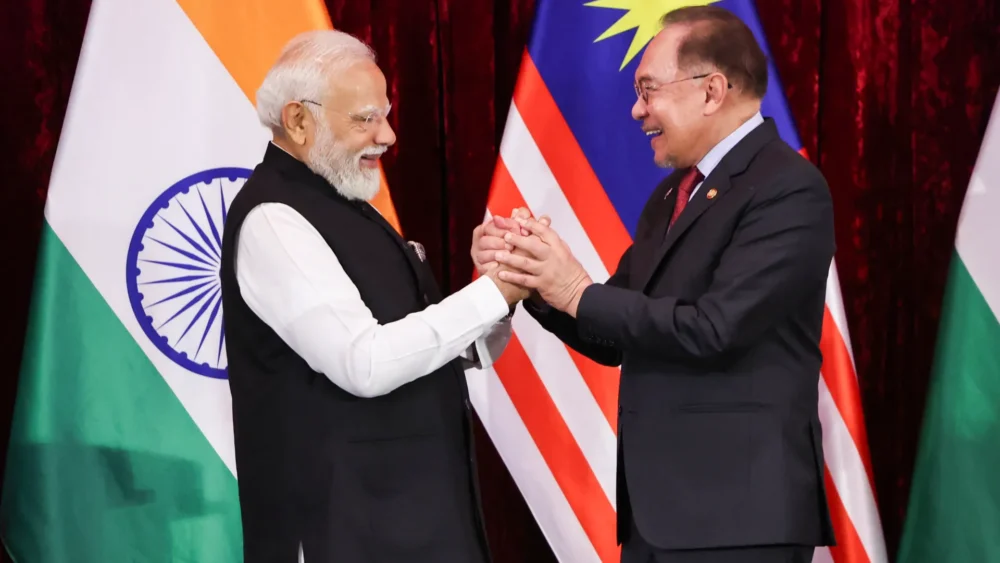
- India and Malaysia reaffirm Comprehensive Strategic Partnership
- New agreements signed across security, digital, healthcare and education
- Focus on semiconductors, renewable energy, fintech and local currency trade
- Leaders stress zero tolerance for terrorism and stronger Indo-Pacific cooperation
GG News Bureau
New Delhi, 8th Feb: Narendra Modi and Anwar Ibrahim reaffirmed the India–Malaysia Comprehensive Strategic Partnership during the Indian Prime Minister’s official visit to Kuala Lumpur from February 7 to 8, pledging deeper cooperation across defence, trade, digital economy, energy and people-to-people ties.
The joint statement issued after the talks said the visit reflected the deep civilisational links and enduring people-to-people connections between the two countries. Both leaders held wide-ranging discussions covering political engagement, security cooperation, maritime collaboration, trade and investment, technology, agriculture, healthcare, education, tourism and regional issues.
Focus on trade, investment and new-age sectors
Recognising India as a key global economic partner, both sides agreed to enhance trade facilitation and expand cooperation in sectors such as semiconductors, digital economy, renewable energy, infrastructure, healthcare, fintech, artificial intelligence and advanced manufacturing.
The leaders welcomed the tenth India–Malaysia CEO Forum in Kuala Lumpur and encouraged greater investments in high-value sectors. They also supported the use of local currencies—the Indian rupee and Malaysian ringgit—for bilateral trade settlement.
Digital payments, fintech and technology cooperation
Both sides welcomed the formalisation of the Malaysia–India Digital Council to boost cooperation in fintech, artificial intelligence, digital public infrastructure and cybersecurity.
They also noted the payment linkage initiative between NPCI International and PayNet Malaysia, which is expected to ease remittances and digital transactions for tourists, students and businesses.
Energy, semiconductors and food security
In the energy sector, the leaders emphasised collaboration in renewable energy, green hydrogen and large-scale solar projects. They also highlighted the strategic importance of semiconductors and agreed to strengthen cooperation in the technology value chain.
On food security, both countries committed to stable supply chains and closer cooperation in agri-commodities, with Malaysia reaffirming its role as a reliable supplier of sustainable palm oil.
Defence, security and counter-terrorism
The two leaders expressed satisfaction with the growing defence partnership, including joint exercises, training, and staff talks. They also welcomed the progress of the Malaysia-India Defence Cooperation Committee and ongoing naval engagements.
Both sides strongly condemned terrorism in all forms and called for zero tolerance, enhanced intelligence sharing, and coordinated efforts against radicalisation, terror financing and transnational crime.
Education, culture and people-to-people ties
The leaders encouraged greater student and faculty exchanges, vocational training partnerships and cooperation under skill development programmes.
They also emphasised tourism and labour mobility, noting visa liberalisation measures and growing air connectivity. Both sides agreed to further strengthen civil aviation cooperation to support tourism, trade and exchanges.
Multilateral and Indo-Pacific cooperation
India and Malaysia pledged to deepen coordination in multilateral forums, support reforms in global institutions including the United Nations Security Council, and promote a rules-based, peaceful Indo-Pacific.
Malaysia welcomed India’s 2026 BRICS chairmanship, while India supported Malaysia’s engagement with BRICS. Both sides also reiterated support for ASEAN centrality and regional stability.
Several agreements and memorandums were signed during the visit, covering social security, disaster management, anti-corruption cooperation, audiovisual co-production, semiconductors, healthcare, security and vocational training.
Prime Minister Modi thanked the Malaysian leadership for the warm hospitality and invited Prime Minister Anwar Ibrahim to visit India in the near future.
