
India Pitches People-Centric Development at UN Forum
Savitri Thakur highlights rights-based, inclusive growth model at UN Social Development Commission

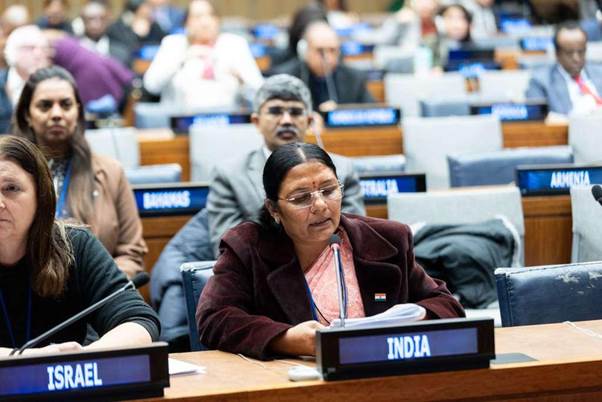
- India showcases inclusive, rights-based development approach at UN
- Social justice central to Viksit Bharat@2047 vision
- Over 800 million covered under food security, 550 million get free healthcare
- India reaffirms global cooperation under Vasudhaiva Kutumbakam
GG News Bureau
New Delhi, 4th Feb: India highlighted its rights-based, inclusive and people-centric development approach at the 64th session of the United Nations Commission for Social Development, currently underway at the United Nations Headquarters.
Delivering India’s statement at the Ministerial Forum, Minister of State for Women and Child Development Savitri Thakur said that social justice remains at the core of India’s national vision of Viksit Bharat@2047. The Minister was addressing the forum on the theme, “Leveraging the outcomes of the Second World Summit for Social Development from Copenhagen to Doha: Mobilizing National Action towards 2030 and beyond.”
Recalling that the Copenhagen Declaration placed people at the centre of development and that the Doha Political Declaration reaffirmed this commitment amid evolving global challenges, Thakur said India’s governance philosophy of Sabka Saath, Sabka Vikas reflects a whole-of-government and whole-of-society approach to ensure dignity, equity and opportunity for all.
Highlighting India’s large-scale social protection measures, the Minister said over 800 million people are covered under food security programmes, while more than 550 million citizens have access to free healthcare through an extensive network of health and wellness centres. She added that affordable medicines and medical devices are being provided through over 16,000 Jan Arogya Kendras across the country.
Thakur also pointed to India’s progress in women-led development, noting that over 1.45 million elected women representatives now serve in local governance institutions. Flagship initiatives such as Beti Bachao Beti Padhao and Sukanya Samriddhi Yojana, she said, are strengthening education and financial security for girls, while labour reforms are promoting equal pay, workplace safety and increased participation of women in the workforce.
She further highlighted that collateral-free loan schemes have enabled millions of women entrepreneurs and street vendors to enter the formal economy. Targeted programmes such as SMILE are supporting the rehabilitation and social inclusion of transgender persons and other vulnerable communities.
Emphasising the role of technology, the Minister said India’s development journey integrates digital public infrastructure, direct benefit transfers and citizen participation to ensure transparency and last-mile delivery of services.
Reaffirming India’s civilisational ethos of Vasudhaiva Kutumbakam — the world is one family — Thakur expressed India’s readiness to deepen global partnerships and share its development experiences to advance social justice worldwide. The session saw active participation from a majority of UN Member States.
On the sidelines of the event, the Minister also held a courtesy meeting with Camilla Waltersson Grönvall, Minister for Social Services of the Sweden, to discuss cooperation in social development initiatives.
