

Poonam Sharma
The geopolitical theater recently witnessed a masterclass in diplomacy that feels less like a formal summit and more like a high-stakes game of poker where India didn’t just hold its ground—it walked away with the pot.
For weeks, the narrative spun by Western media was one of impending doom for New Delhi. They painted a picture of a “besieged” India, suggesting that the trade war initiated by Donald Trump would choke Indian exports and force Prime Minister Modi to his knees. The rhetoric was sharp: “The train has left the station,” they said. “India will have to come begging to us.” There was a deliberate attempt to bruise the national ego, implying that because Modi hadn’t “made the call,” India was being sidelined.
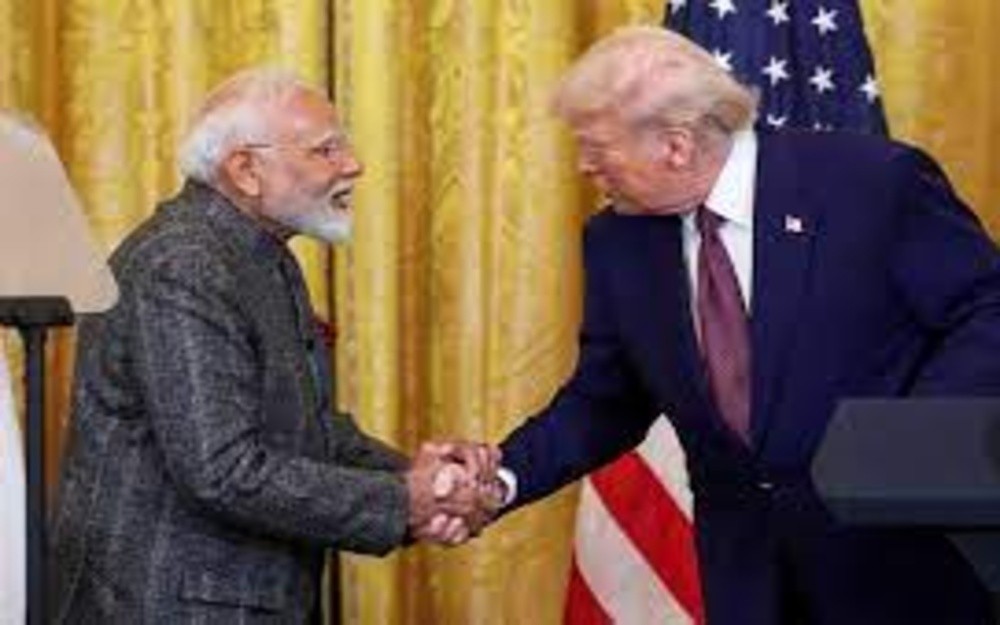
But as the dust settles, the reality is starkly different. In diplomacy, the person who blinks first loses. In this case, it wasn’t Modi; it was Trump who picked up the phone.
The Art of the “Revolving Door” Diplomacy
The Western media tried to frame India as desperate, but the actual mechanics of the conversation reveal a shift in the global balance of power. For the first time, we saw the President of the United States seeking a resolution because he realized that ignoring a three-trillion-dollar economy isn’t a strategy—it’s a liability.
The “ego game” ended when the U.S. realized that India wasn’t flinching. While the media talked about “surrender,” the actual numbers tell a story of strategic victory:
The Tariff Takedown: The looming threat of massive 50% tariffs (25% + 25% surcharges) was successfully negotiated down. Most Indian goods will now enter the U.S. at an 18% tax rate.
The Competitive Edge: By keeping the rate at 18%, India remains competitive compared to its neighbors. While the U.S. gave slight concessions to others, India held its line, refusing to accept anything that would compromise its internal economic stability.
Deconstructing the “500 Billion” Headline
Trump, ever the showman, needed a “win” to show his voters. He claimed India committed to $500 billion in trade, specifically in energy and technology. To the casual observer, this sounds like India paying a ransom. To the seasoned analyst, it’s “Business as Usual” rebranded.
India is already buying Boeing aircraft and energy technology. When you spread $500 billion over a 10-year horizon, it aligns almost perfectly with India’s existing growth trajectory and defense/aviation needs. Trump gets his headline to satisfy his “America First” base, and India gets the market access and technology it was going to buy anyway. It’s a classic diplomatic “face-saver” for the U.S., while India secures its “India First” objectives.
The Oil Gambit: Russia vs. USA
There was a lot of noise regarding India “surrendering” its Russian oil imports. Let’s look at the facts. India hasn’t signed any document promising to stop buying Russian oil.
The slight 10% dip in Russian imports isn’t a diplomatic concession; it’s a market correction. The massive discounts Russia offered at the start of the conflict have thinned out, and logistical risks have increased. India is simply doing what any smart business would do: diversifying. If the U.S. offers energy at a better price, India will buy. If Russia stays cheaper, India stays with Russia. Our diplomacy is no longer dictated by Cold War-era “camps”; it is dictated by the bottom line of the Indian consumer.
Why the Tide Shifted
Why did Trump call? Because the world is no longer unipolar.
The Europe-China Factor: Europe is looking toward India. Canada is leaning toward China. If Trump alienated India, he would have effectively pushed one of the world’s largest markets into the arms of his competitors.
Economic Reality: The U.S. is battling inflation. A full-scale trade war with India would have hurt American consumers just as much as Indian exporters.
The Modi Factor: PM Modi’s refusal to engage in “Twitter diplomacy” or reactive politics forced the U.S. administration to treat India as a peer, not a subordinate.
The Final Takeaway
This wasn’t just a trade deal; it was a psychological victory. The “Washington Dictate” is dead. We are seeing a “re-balancing” of power where New Delhi doesn’t just take notes—it sets the agenda. We got the market access we wanted, protected our exporters, and didn’t sacrifice our sovereign right to buy oil from whoever we please.
Trump got his “theatrical win,” and India got the “structural win.” In the world of high-stakes diplomacy, that’s the best possible outcome
