
India Building Strength Across Entire AI Ecosystem, Says IT Minister at Davos
India developing capabilities across all five layers of AI architecture

-
India developing capabilities across all five layers of AI architecture
-
Majority of AI use cases addressed through mid-sized, efficient models
-
AI leadership should not be linked to ownership of massive models
-
National shared compute facility created with 38,000 GPUs
GG News Bureau
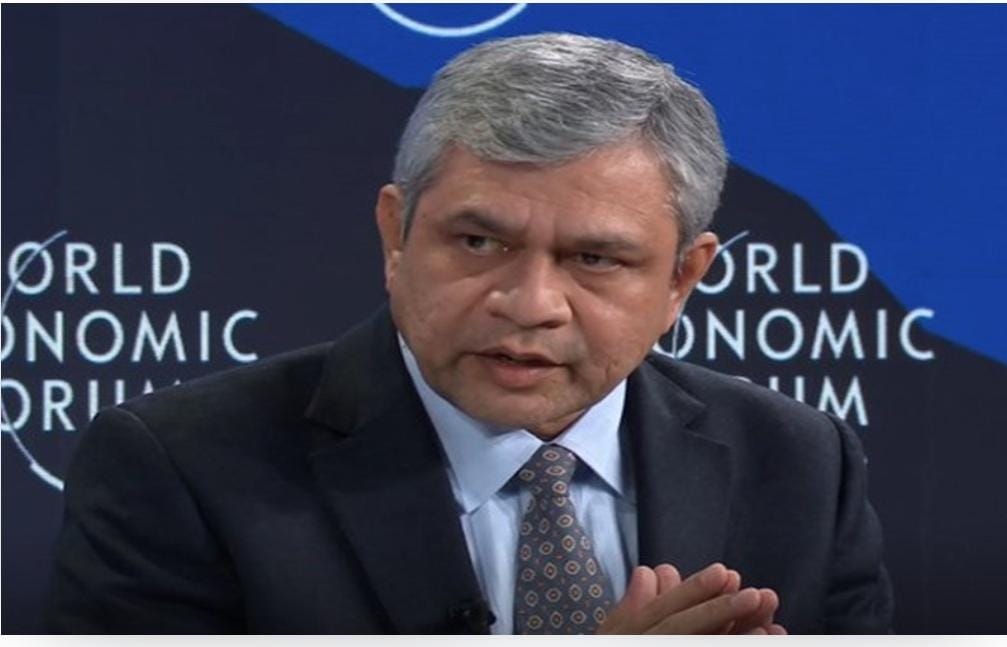
Davos, 22nd Jan: Union Minister for Electronics and Information Technology Ashwini Vaishnaw on Tuesday said that India belongs to the first group of artificial intelligence nations, highlighting the country’s active engagement across every major component of the AI ecosystem.
Speaking at the World Economic Forum (WEF) Annual Meeting in Davos, the minister said India is simultaneously working on applications, models, semiconductor chips, digital infrastructure and energy requirements needed to scale AI responsibly.
India’s AI Strategy Explained
Vaishnaw said India’s approach to artificial intelligence is guided by three core principles — wide-scale adoption, economic sustainability and strong techno-legal frameworks. These pillars, he said, are essential for ensuring AI benefits reach across industries and society.
The panel discussion was moderated by Ian Bremmer, President and Founder of Eurasia Group, and featured global leaders including Brad Smith of Microsoft, IMF Managing Director Kristalina Georgieva, and Saudi Investment Minister Khalid Al-Falih.
Leadership in AI-Driven Services
Emphasising India’s strength in service delivery, the minister said the country is well positioned to emerge as the largest global provider of AI-enabled services, particularly at the application layer.
He noted that returns from AI investments are realised through enterprise deployment and productivity improvements, rather than through the creation of extremely large and expensive models alone.
Rethinking AI Power and Scale
Vaishnaw said that close to 95 per cent of real-world AI applications can be effectively managed using models ranging between 20 and 50 billion parameters, many of which are already being deployed in India.
He warned against viewing control over massive AI models as a measure of geopolitical influence, stating that such systems can be restricted or shut down and may impose heavy financial burdens on their developers.
Economic Logic of the Next Industrial Phase
According to the minister, the next phase of industrial growth will be driven by cost-efficient AI solutions that deliver maximum economic value.
He added that AI implementation is increasingly shifting towards CPUs, compact models and customised silicon, reducing dependence on limited global supply chains and challenging the idea that scale alone defines AI leadership.
Boosting Compute Access Through PPP Model
Addressing infrastructure challenges, Vaishnaw identified limited access to GPUs as a key bottleneck and said India has responded through a public-private partnership framework.
As part of this initiative, nearly 38,000 GPUs have been brought under a national shared compute platform. The government-supported facility offers affordable computing access to students, researchers, startups and innovators at around one-third of prevailing global costs.
