

Poonam Sharma
Former US President Donald Trump has once again placed himself at the center of global diplomacy by proposing a new international initiative aimed at restoring peace in Gaza. The proposal, informally referred to as the “Board of Peace,” is being projected as a high-level consultative body that would bring together select global powers and influential regional players to explore pathways for stability in the conflict-ridden Middle East.
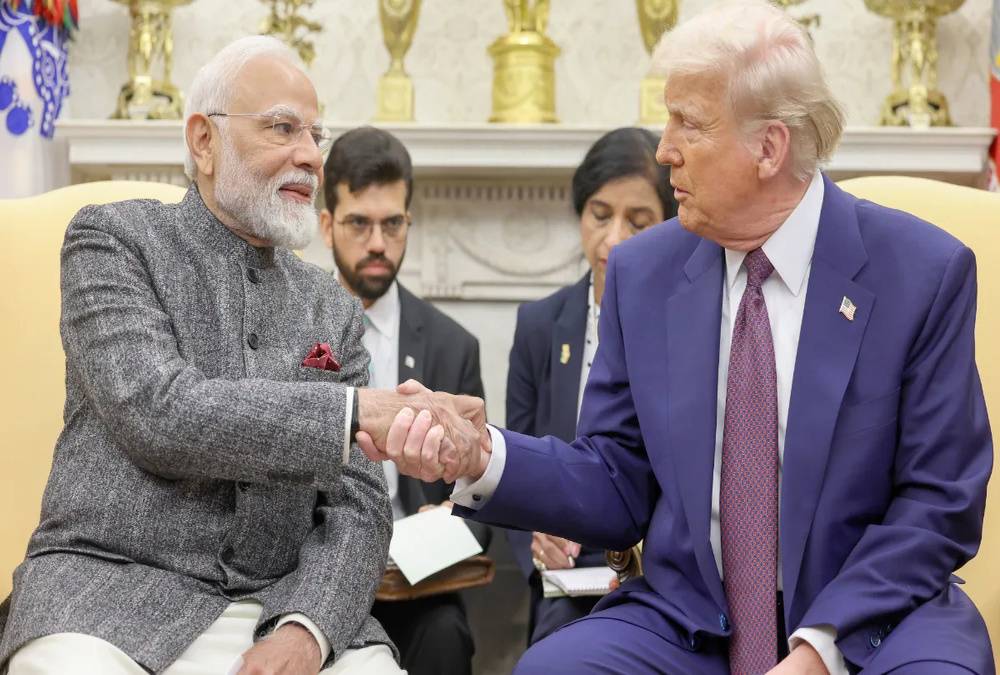
While details are still emerging, what has already caught global attention is India’s inclusion among the invited countries. This invitation is not symbolic; it reflects India’s growing stature as a responsible global actor and a trusted voice across geopolitical divides.
What Exactly Is the ‘Board of Peace’?
Trump’s “Board of Peace” is envisioned as a multinational advisory and mediation platform rather than a formal UN-style institution. According to sources close to the development, the board would consist of countries that:
Have strategic influence in global politics, Maintain working relations with both Israel and the Arab world are seen as relatively neutral and pragmatic in conflict resolution
The primary focus of the board would be Gaza, where repeated cycles of violence between Israel and Hamas have resulted in large-scale humanitarian crises, civilian casualties, and regional instability. Trump’s proposal seeks to move beyond temporary ceasefires and instead push for long-term political and security arrangements.
Why Gaza, and Why Now?
The Gaza conflict has long been one of the world’s most intractable disputes. Despite numerous peace talks, international interventions, and UN resolutions, violence continues to erupt with alarming regularity. Trump’s renewed interest in Gaza comes at a time when:
The humanitarian situation has drawn global outrage
Traditional diplomatic mechanisms appear exhausted
The Middle East is undergoing broader geopolitical realignments
Trump, known for his unconventional style, seems to believe that fresh structures and non-traditional alliances can succeed where established systems have failed.
India’s Invitation: A Strategic Signal
India’s inclusion in the proposed Board of Peace is significant on multiple levels.
First, it signals international recognition of India’s diplomatic credibility. Over the past decade, India has carefully balanced its relationships with Israel, Palestine, the Gulf countries, Iran, Russia, and the United States—something few nations have managed successfully.
Second, India is widely seen as a country that does not export conflict or ideology, but instead emphasizes dialogue, development, and sovereignty. This perception makes New Delhi a relatively acceptable partner for diverse and often opposing stakeholders in the Middle East.
India’s Unique Position in the Middle East
India’s ties with Israel have deepened significantly in areas such as defense, technology, agriculture, and intelligence cooperation. At the same time, India has consistently supported the Palestinian cause, advocating for a two-state solution and humanitarian assistance to Gaza.
Additionally, millions of Indians live and work in Gulf countries, giving India a strong stake in regional stability. This combination of strategic interest and balanced diplomacy positions India as a bridge rather than a bloc.
What Does Trump Gain from India’s Participation?
For Trump, involving India offers several advantages:
Legitimacy: India’s presence lends moral and diplomatic weight to the initiative
Balance: India is not seen as an extension of Western or Middle Eastern power politics
Global optics: Inclusion of a major Asian democracy broadens the scope beyond the West
Trump’s earlier Middle East initiatives, including the Abraham Accords, focused largely on regional normalization. The Board of Peace appears to be an attempt to globalize responsibility for Gaza.
Challenges Ahead for the Board of Peace
Despite the ambitious framing, the proposed board faces serious hurdles:
Hamas’ role and recognition remain deeply contentious
Israel’s security concerns are non-negotiable
Palestinian political divisions weaken unified representation
Regional powers may view external involvement with suspicion
Moreover, without formal authority or enforcement mechanisms, the board risks being dismissed as another talk shop unless it produces tangible outcomes.
What Should India Be Cautious About?
While the invitation enhances India’s global profile, it also comes with risks. Any visible tilt—real or perceived—could strain relations with one side or the other. India will likely proceed cautiously, emphasizing humanitarian relief, dialogue, and international law, rather than direct mediation.
India’s traditional approach has been to avoid headline-driven diplomacy and focus instead on quiet, consistent engagement. That approach may well define its role if the Board of Peace moves forward.
A Test of New-Age Diplomacy
Trump’s Board of Peace is, at its core, an experiment—one that reflects both frustration with existing systems and faith in personal diplomacy and unconventional coalitions. Whether it succeeds or fades away will depend on the seriousness of its participants and the realism of its goals.
For India, the invitation itself is telling. It underscores how far New Delhi has come—from a regional power to a country whose voice is now sought in some of the world’s most complex conflicts. Whether the board brings peace to Gaza remains uncertain, but India’s presence at the table is already a statement in itself.
