

Poonam Sharma
The recent claims surrounding a US raid in Venezuela—allegedly involving a “mystery weapon” that left Venezuelan soldiers bleeding, disoriented, and incapacitated—go far beyond speculation about advanced military technology. At their core, these claims reopen an old and uncomfortable debate about power, accountability, and the selective morality embedded in modern geopolitics.
According to an eyewitness account cited by the New York Post, Venezuelan security forces experienced a sudden, unexplained systems failure moments before drones appeared overhead and helicopters inserted a small US special operations unit. What followed, the guard claims, was not a conventional firefight but the deployment of an unidentified force resembling an intense sound or pressure wave—causing internal distress, nosebleeds, vomiting blood, and physical collapse. Whether this account is ultimately corroborated or not, its implications are profound.
Regardless of the terminology used by Washington, the operation constituted the use of force on the territory of a sovereign state. International law does not become optional simply because the target is a politically isolated leader. Yet time and again, US interventions are framed as exceptions—necessary, reluctant, and morally justified—while similar actions by others are branded as aggression.
The Weapon May Be New, the Strategy Is Not
The speculation that directed-energy or microwave-based weapons may have been used only heightens global unease. Such technologies have existed in research and limited deployment for years, operating in legal and ethical grey zones. Their appeal lies precisely in their ambiguity: they leave no obvious blast craters, no easily traceable munitions, and often no immediate forensic clarity. Denial becomes easier, accountability harder.
If such weapons are now being tested or deployed in real-world operations, a critical question arises: why are these experiments happening in the Global South and against adversarial states? History suggests an answer. From Vietnam to Iraq to Afghanistan, technological dominance has often been field-tested on foreign soil, far from domestic scrutiny.
The White House’s silence on the specifics of the Venezuela operation is therefore not surprising—it is strategic. Silence allows narratives to fracture, outrage to dilute, and responsibility to evaporate. Meanwhile, Venezuela’s Interior Ministry has acknowledged that roughly 100 security personnel were killed during the raid. Had such casualties occurred among US forces, they would dominate global headlines. In this case, they barely register.
This asymmetry is not accidental. It reflects a hierarchy of human value embedded in international discourse, where some deaths are tragedies and others are statistics.
Diplomacy, Selective Outrage, and the Politics of Silence
The frustration expressed over global indifference—to violence in Bangladesh, unrest in Iran, or persecution of vulnerable communities—highlights a deeper moral contradiction. Millions gather in religious congregations praying for “world peace,” while real-time human suffering unfolds just across borders, met with diplomatic caution and carefully curated silence.
“Non-interference in internal affairs” is invoked rigidly when intervention is inconvenient, yet abandoned overnight when regime change aligns with strategic interests. Diplomacy, in such cases, becomes less about peace and more about plausible deniability. Moral language survives, but moral action does not.
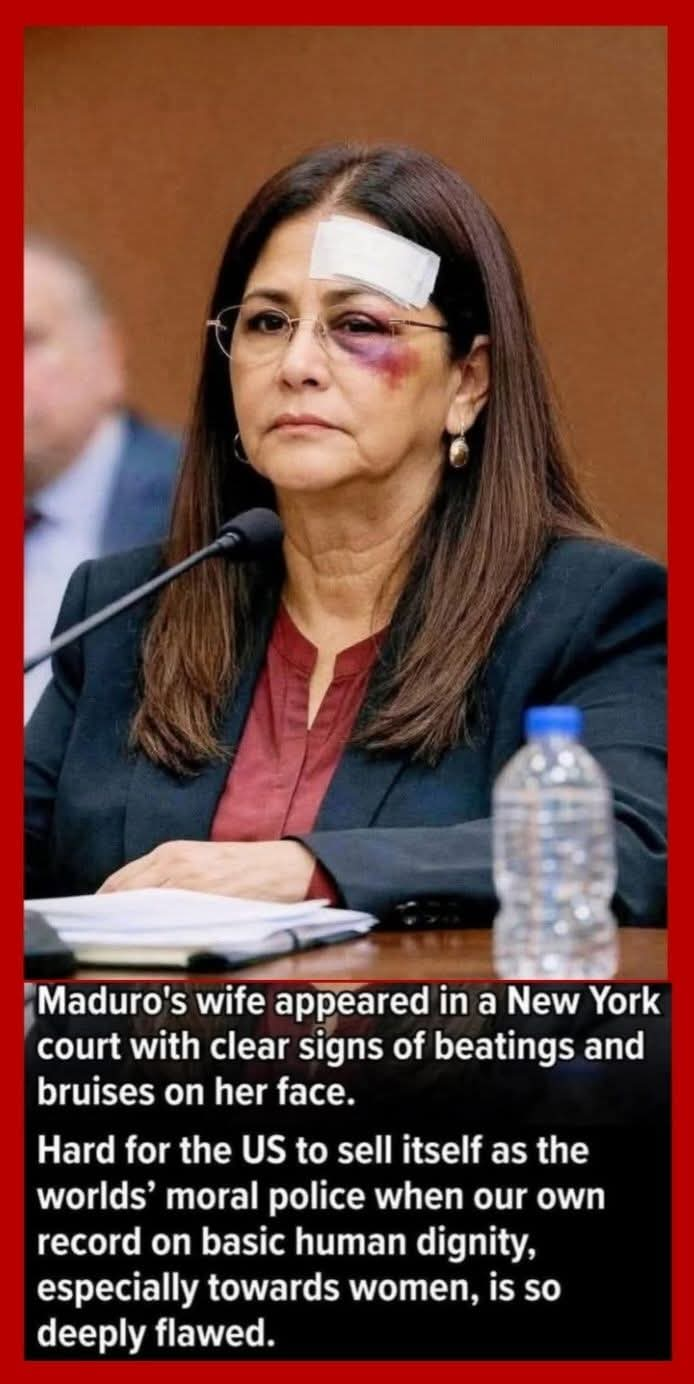
The image of Celia Flores, wife of Nicolás Maduro, appearing distressed while facing US legal proceedings has become another symbol loaded with interpretation. For some, it represents justice; for others, humiliation and spectacle. But the deeper issue is not individual guilt or innocence—it is the optics of power. The suffering of those linked to adversarial regimes is often consumed as visual proof of righteousness, while the suffering caused by intervention itself remains unseen.
History Is the Witness That Refuses to Be Silenced
The reference to Vietnam is neither rhetorical excess nor historical nostalgia. It is a reminder. The war was justified in the language of freedom and containment, yet it left behind mass civilian deaths, documented atrocities, and generational trauma. The rape of women, the bombing of villages, and the erasure of accountability were not accidents—they were the consequences of unchecked power wrapped in moral certainty.
To invoke Vietnam is not anti-American; it is pro-truth. History does not disappear because it is inconvenient. It lingers as a warning.
If the United States wishes to be seen as a moral force in the world, it must accept moral constraints. Transparency, consistency, and accountability are not weaknesses—they are the foundations of legitimacy. Without them, human rights become a slogan rather than a principle, and intervention becomes indistinguishable from domination.
In the end, the real mystery is not whether a new weapon was used in Venezuela. The real mystery is how often the world allows power to masquerade as virtue—and how easily it looks away when brutality is committed in the name of diplomacy.
