
By 2029, Justice From FIR to Supreme Court in 3 Years: Amit Shah
Home Minister outlines forensic-led overhaul of India’s justice system in Andaman meeting

GG News Bureau
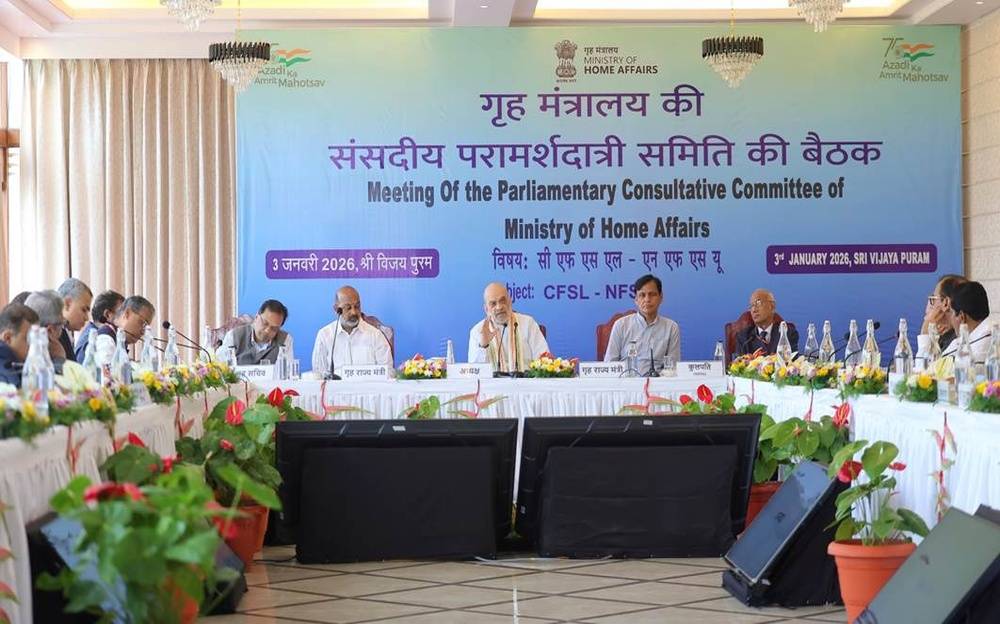
Sri Vijaya Puram, 4th Jan: Union Home Minister and Minister of Cooperation Amit Shah on Saturday said the Modi government aims to ensure that the entire justice process — from registration of FIR to disposal in the Supreme Court — is completed within three years by 2029, driven by sweeping forensic and technology-led reforms.
Chairing a meeting of the Parliamentary Consultative Committee of the Ministry of Home Affairs on the Central Forensic Science Laboratory (CFSL) and National Forensic Sciences University (NFSU) here, Shah said the three new criminal laws enacted under Prime Minister Narendra Modi’s leadership are already accelerating investigations and improving conviction rates.
He cited recent cases in West Bengal and Bihar where convictions were secured in 50–62 days as proof of faster justice delivery.
₹30,000 Crore Forensic Push
Shah announced that the Centre and states will invest ₹30,000 crore over the next five years to establish a nationwide network of forensic laboratories. By 2029, every state and Union Territory will have either a forensic university (NFSU) or a Central Forensic Science Laboratory (CFSL).
He said mobile forensic labs have increased from zero in 2021 to 1,000 today, while forensic visits have been made mandatory in all cases punishable with seven years or more.
Five Pillars Modernised
The Home Minister said the Modi government has fully modernised the five pillars of the justice system — police, courts, prisons, forensics and prosecution — through digitisation, interoperability and AI-based continuous analysis.
He noted that e-FIR and Zero FIR are proving to be major relief for the poor and women, while cybercrime, organised crime, terrorism and digital fraud have been clearly defined, reducing grey areas for courts.
Massive Digital Integration
Shah said every police station in the country is now on CCTNS, with all FIRs available on a central server. Over 22,000 courts are connected through e-Courts, while e-Prisons holds data of 2.2 crore prisoners, e-Prosecution hosts 2 crore cases, and e-Forensics has over 30 lakh cases available for police use.
He added that data of all terrorism cases registered under UAPA is being separately recorded in the NIA database, and a Modus Operandi Bureau will soon be set up for crime mapping.
NFSU Expands Rapidly
Shah said NFSU currently has 14 campuses, 100+ training programmes and 100% placement so far. By 2029, it will produce 35,000 forensic experts. The university has registered 46 patents, signed 103 MoUs with 96 countries, and is promoting innovation, including AI-based forensic analysis.
He said indigenous kits for narcotics, sexual assault, cybercrime and food testing developed by NFSU are proving highly useful, and that the initial results of the new criminal laws show India is firmly on track towards faster, transparent and technology-driven justice delivery.
