

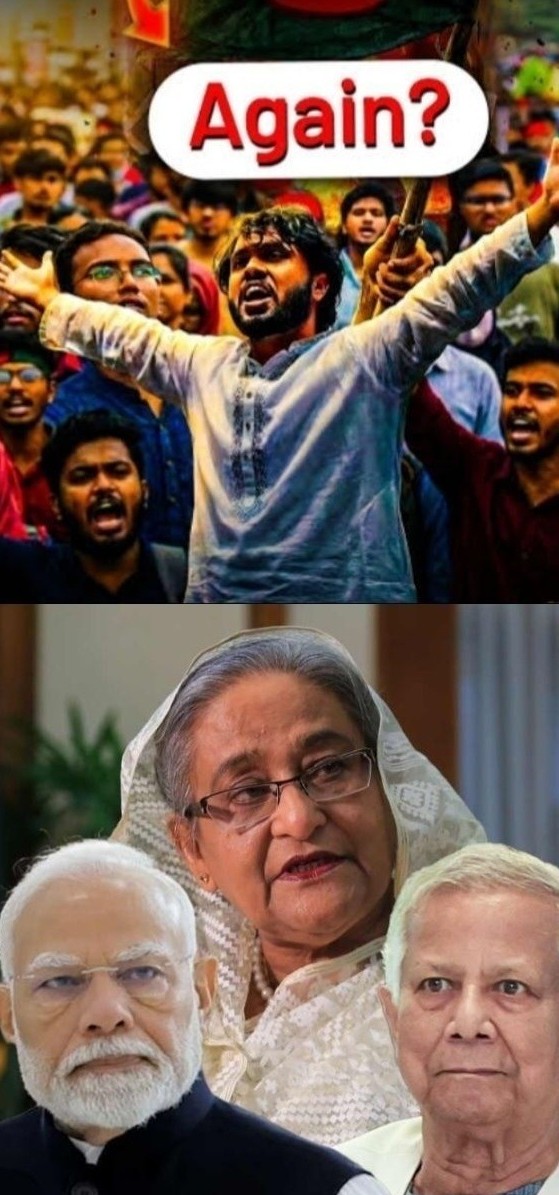
Poonam Sharma
Were there flaws in the policies and strategies adopted by the Modi government in Delhi toward Bangladesh over the past decade?
According to most political and diplomatic experts, the answer is unequivocally yes.
One of the primary reasons lies in Prime Minister Narendra Modi’s misreading of Islam as a phenomenon. A close examination of his approach over the last ten years reveals that he has refused to acknowledge Islam as “political Islam,” instead projecting it merely as a religion. This, notably, was the same mistake the Congress made after Independence.
Because of this conceptual error at the highest level, Bangladesh—right on India’s doorstep—was allowed to evolve into a jihadist-prone state. By placing excessive trust in Sheikh Hasina, the daughter of Sheikh Mujibur Rahman, Prime Minister Modi pursued a diplomatic strategy whose outcomes turned out to be the exact opposite of what was intended.
India had an opportunity to correct the diplomatic blunder committed by Indira Gandhi in 1971, but that opportunity was lost. Instead, the path was cleared for Bangladesh to drift toward becoming another Syria.
The Consequences of Unconditional Generosity Toward Bangladesh.
Consider the results of the free handouts and concessions given to Bangladesh during the Modi era.
India launched what can only be described as a “Line of Credit offensive”—but against itself.
All assistance extended to Bangladesh—whether already given or ongoing—came without strict conditions imposed by New Delhi. The Modi government provided so-called “friendship loans” at a mere 1 percent interest, ostensibly to improve the living standards of ordinary Bangladeshis and bring transformational changes to their daily lives.
India funded projects across sectors—road construction, rail connectivity, education, healthcare, skill development, and more. Every Bangladeshi citizen benefited directly. These were grants and loans without hidden agendas, without strategic strings, and without demands for sovereignty compromises—unlike the models employed by China and the United States, who give with one hand and take with the other.
India’s approach, in contrast, was to give with both hands.
And what did India receive in return?
The massacre of Hindus in Bangladesh.
This has been the pattern for the last ten years (even leaving aside the Congress era). Despite a change in government, there was no change in policy.
India as Bangladesh’s Largest Aid Benefactor—At What Cost?
Over the past eight years alone, India has extended nearly USD 8 billion in Lines of Credit, launched dozens of high-impact projects, and established centers, cultural hubs, and skill development institutions across Bangladesh.
Bangladesh has become India’s number one aid-recipient country.
Beyond infrastructure, India provided ITEC training programs, Suborno Joyanti (Golden Jubilee) scholarships, and funded the education of thousands of Bangladeshi students in India’s premier institutions—entirely at India’s expense.
This was India’s selfless soft power, an expression of responsibility toward a neighboring nation.
But what was the return?
The brutal murder of innocent Hindu Dipu Chandra Das, committed by those who grew powerful using Indian money.
Widespread rape of Hindu women, killings, and open anti-India hysteria across Bangladesh.
If the Bangladeshi state had the will, these crimes could have been stopped. Yet for ten years, the BJP government remained a silent spectator—hiding behind silence, excuses, and a habit of shifting blame to China or the United States.
These were not “misunderstandings.” They were hostile messages, threats, and signals of enmity directed at India.
And yet, India chose silence. What an irony.The Fundamental Question India Must Now Answer In this brutal reality, one question stands tall—simple and unavoidable:
Does friendship mean compulsion?
Does friendship mean surrender?
A country that receives decades of low-interest loans, subsidized education for thousands of students, grants, and gifts—yet allows attacks on India’s High Commission, permits Hindu genocide, and fuels hatred against India—what does “friendship” mean in such a context?
What is its foundation?
What is the definition of diplomacy here?
Can friendship be one-sided?
Does friendship mean self-abandonment?
These questions now stand squarely before the Modi government.
They must stand.
They deserve answers.
The time has come for realist decision-making—to reassess every special privilege, every preferential assistance, and every political concession extended in the name of goodwill.
If friendship yields no respect and only hatred, what obligation remains?
India need not be the enemy of any nation.
But it cannot—and should not—remain a silent spectator when its dignity and diplomatic security are at stake.
Friendship does not mean surrender.
Yet for the past ten years, that is precisely what it has resembled.
