

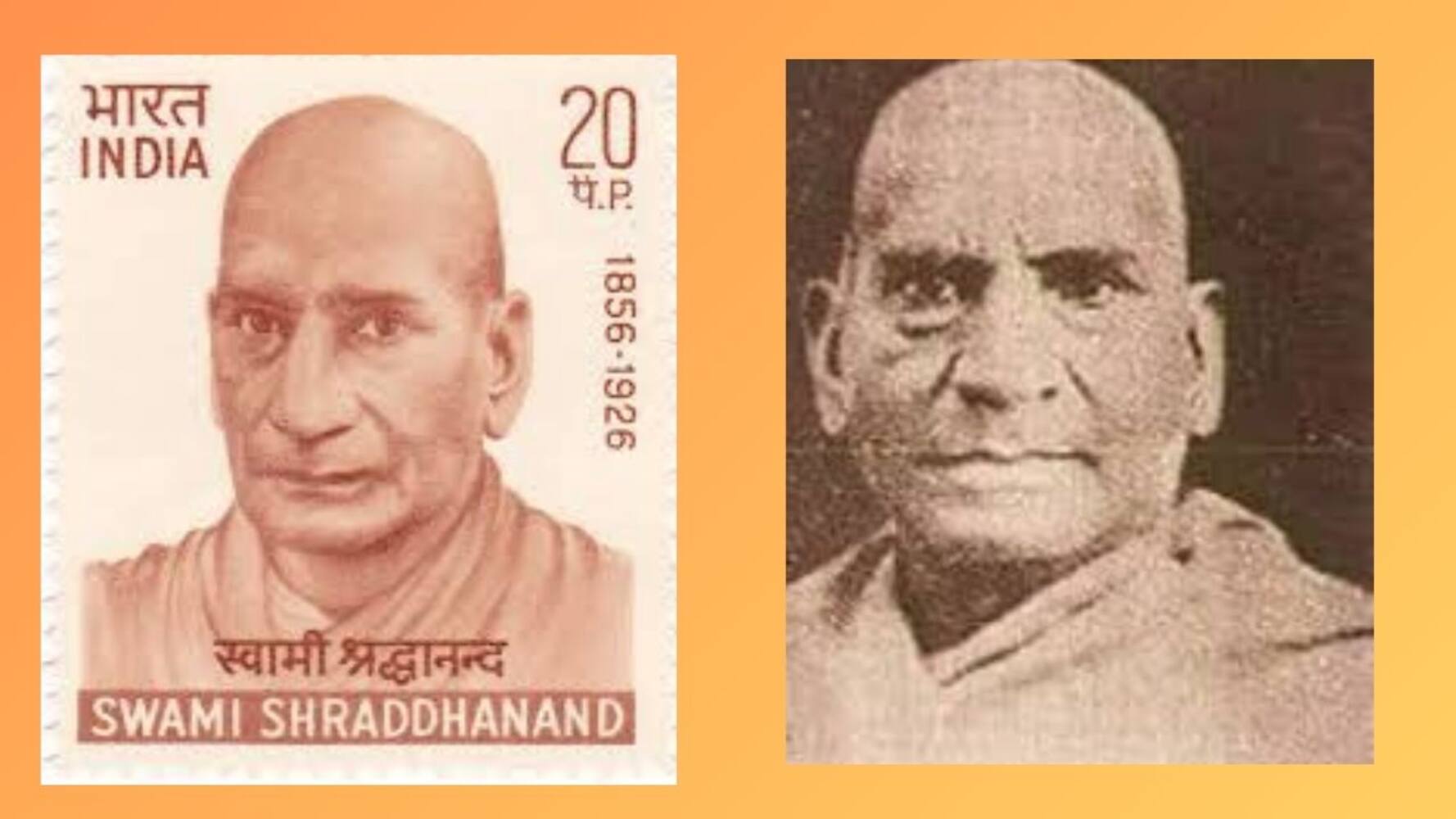
Poonam Sharma
History often remembers kings and conquerors, but it is sustained by those who chose conscience over comfort. Swami Shraddhananda was one such figure—fearless, uncompromising, and deeply humane. His life was not defined by hatred of any community, but by an unyielding commitment to reform, truth, and dignity for a society he believed had forgotten its own strength.
Born as Munshi Ram (Brihaspati Vij) on 22 February 1856 in Talwan village of Punjab, he grew up in a household shaped by colonial administration. His father, Lala Nanak Chand, served as a police inspector under the British East India Company. Yet Munshi Ram’s journey would eventually take him far away from colonial structures and into the heart of India’s civilizational awakening.
As a young man, he was a rationalist—even an atheist—and initially attended a lecture by Swami Dayanand Saraswati with the intention of disrupting it. What happened instead changed his life. Dayanand’s intellectual clarity, moral courage, and spiritual confidence shattered Munshi Ram’s skepticism. That encounter transformed him into a lifelong Arya Samaj missionary.
Education as Civilizational Resistance
Swami Shraddhananda believed that education was not merely instruction, but identity. At a time when colonial education was systematically alienating Indians from their cultural roots, he worked tirelessly to revive a Vedic, indigenous model of learning. This vision took concrete shape with the establishment of Gurukul Kangri near Haridwar in 1902—today a respected university.
For him, education was not elitist. It was meant to rebuild self-respect among ordinary Hindus, especially the poor, the marginalized, and the so-called “untouchables.” Dr. B.R. Ambedkar would later describe him as “the greatest and most sincere champion of the Untouchables.” That endorsement speaks volumes about the moral seriousness of Shraddhananda’s work.
From Nationalism to Social Reform
In 1917, Munshi Ram renounced worldly life and became Swami Shraddhananda Saraswati. He joined the Indian freedom struggle, opposed the Rowlatt Act, and played a decisive role in organizing the Congress session at Amritsar in 1919, shortly after the Jallianwala Bagh massacre—when most leaders were hesitant to even visit the city.
Yet his most controversial and courageous work came in the 1920s through the Shuddhi and Hindu Sangathan movements. These initiatives sought to reconsolidate Hindu society and allow those who had been converted under historical pressure to return voluntarily to Hindu Dharma. For Shraddhananda, this was not coercion—it was restoration of choice.
When he encountered Khwaja Hasan Nizami’s writings advocating secret, organized conversion of Hindus—especially the most vulnerable—Shraddhananda responded openly, ethically, and publicly. His pamphlet “The Hour of Danger” exposed these plans using direct quotations, not rumor or abuse. He believed sunlight, not silence, was the best defense.
Courage Without Violence
Even critics acknowledge an essential truth: Swami Shraddhananda never advocated violence, deception, or coercion. His methods were transparent. His language, though sometimes sharp, was always a response—never an instigation.
In 1922, he delivered an extraordinary speech at Delhi’s Jama Masjid, beginning with Vedic mantras. It was a moment of civilizational confidence, not provocation—an assertion that dialogue need not require self-erasure.
But courage carries a price.
Martyrdom in Silence
On 23 December 1926, while recovering from pneumonia at his Delhi residence, Swami Shraddhananda was visited by Abdul Rashid, who claimed he wished to discuss Islam. Concealing a weapon under a blanket, Rashid shot the Swami at point-blank range. There was no argument. No warning. Only silence, followed by death.
He died unarmed, in bed, at peace with his conscience.
Historians such as R.C. Majumdar, B.R. Ambedkar, Sita Ram Goel, and J.T.F. Jordens have documented the ideological climate that enabled this murder—and the disturbing celebration of it by extremist clerics. Yet Shraddhananda’s legacy outlived his assassin.
Why He Still Matters
Swami Shraddhananda is often sidelined because he does not fit modern caricatures. He was a reformer who believed in equality, a nationalist who supported dialogue, and a spiritual leader who refused submission. He stands as proof that Hindu reform was not reactionary, but regenerative.
His life asks uncomfortable questions:
Can a society survive if it refuses to defend itself intellectually?
Can reform exist without courage?
Can truth remain polite when faced with organized deceit?
On his sacrifice day, Swami Shraddhananda does not ask for vengeance. He asks for honest remembrance
