
India calls Pak ‘global epicentre of terror’ rejects “dispute” claim over J-K

By Anjali Sharma
UNITED NATIONS – India on Monday delivered a rebuttal to Pakistan at the UN Security Council Open Debate on “Leadership for Peace”, firmly rejected Islamabad’s claims over Jammu and Kashmir’s “unresolved disputes” as “unwarranted”, reiterated that the Union Territory along with Ladakh are an integral and inalienable part of India, and emphasized that they “were, are, and will always remain so.”
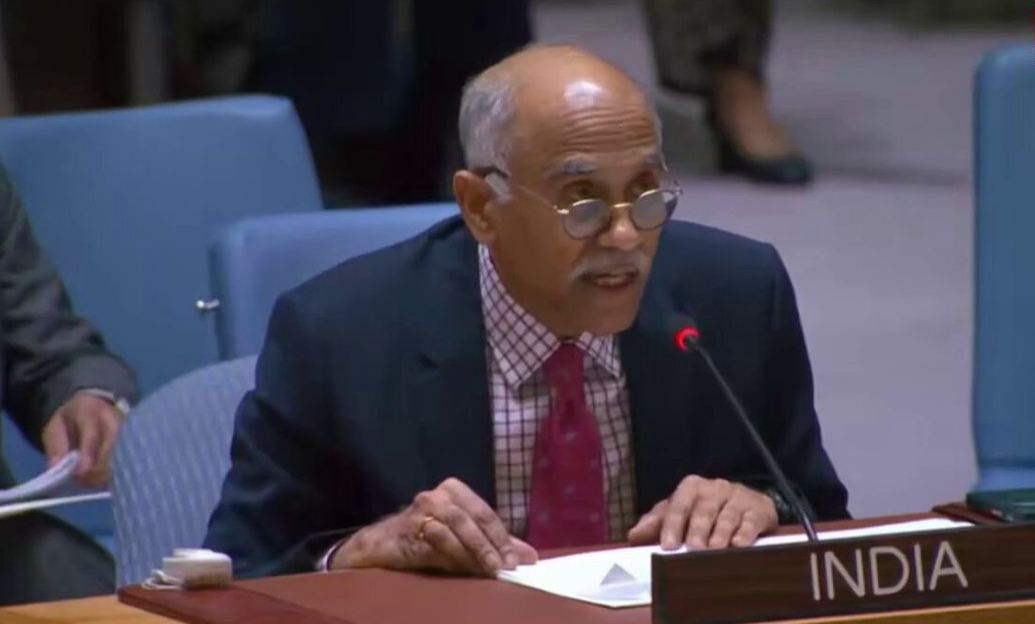
India Permanent Representative to the UN, Ambassador Harish Parvathaneni, referred to Pakistan’s comments during the debate labelled Pakistan as the “global epicentre of terror” while called it out for using the UN platform to further its “obsessive focus on harming India and its people.”
He added that Pakistan, pursuing a divisive agenda, undermines its international responsibilities as a non-permanent UNSC member.
“I refer to the statement made by the representative of Pakistan today. India would like to reiterate that the Union Territories of Jammu & Kashmir and Ladakh are an integral and inalienable part of India. They were, are, and will always remain so. Pakistan’s unwarranted reference to Jammu & Kashmir in today’s open debate attests to its obsessive focus on harming India and its people,” he said.
“A serving non-permanent Security Council Member that chooses to further this obsession in all meetings and platforms of the UN in pursuit of its divisive agenda cannot be expected to fulfil its designated responsibilities and obligations,” he added.
He highlighted Pakistan’s long record of sponsoring terrorism.
Ambassador Harish Parvathaneni strongly defended New Delhi’s decision to place the Indus Waters Treaty in abeyance.
He said that although India entered the Treaty 65 years ago in good faith, Pakistan has repeatedly violated its spirit by waging three wars and orchestrating thousands of terror attacks against India.
Mr. Harish cited the April 2025 Pahalgam terror attack, in which 26 innocent civilians were killed in a religion-based targeted attack.
He said this incident clearly underscored Pakistan’s continued support for terrorism.
Harish Parvathaneni stated that India has decided to hold the Indus Waters Treaty in abeyance until Pakistan credibly and irrevocably ends its support for cross-border terrorism and all other forms of terror.
“India had entered into the Indus Waters Treaty, 65 years ago, in good faith, in a spirit of goodwill and friendship. Throughout these six and a half decades, Pakistan has violated the spirit of the Treaty by inflicting three wars and thousands of terror attacks on India.
He noted that in the last four decades, thousands of Indian lives have been lost in Pakistan-sponsored terror attacks, the most recent of which was the Pahalgam terror attack in April 2025, which involved religion-based targeted killings of 26 innocent civilians by Pakistan-sponsored terrorists.
India has finally announced that the Treaty will be held in abeyance until Pakistan, which is a global epicentre of terror, credibly and irrevocably ends its support for cross-border and all other forms of terrorism,” he said.
Parvathaneni criticized Pakistan’s internal political situation of suppressed democratic will, referencing the jailing of a former Prime Minister, Imran Khan, banning the ruling party, and engineering a “constitutional coup” through the 27th amendment to grant lifetime immunity to its Chief of Defence Forces, Asim Munir.
“Pakistan, of course, has a unique way of respecting the will of its people – by jailing a Prime Minister, by banning the ruling political party and by letting its armed forces engineer a constitutional coup through the 27th amendment and giving lifetime immunity to its Chief of Defence Forces,” Parvathaneni said.
“Let me be clear India will counter Pakistan-sponsored terrorism in all its forms and manifestations with all its might,” he added.
Harish Parvathaneni concluded his remarks with sharp response came after Pakistan’s representative reiterated claims of “unresolved dispute” in Jammu and Kashmir while criticising the suspension of the Indus Waters Treaty.
