
Centre Urges States to Align Personnel Reforms, Cut Delays
Dr Jitendra Singh calls for “whole of government” approach at conference of State Personnel Secretaries

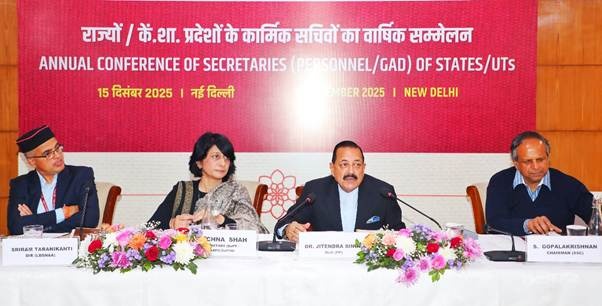
- States, UTs asked to strengthen coordination with Centre on personnel reforms
- Delays in cadre reviews and training gaps flagged as key concerns
- DoPT pushes Mission Karmayogi and digital HR systems
- Emphasis on outcome-oriented, technology-driven governance
GG News Bureau
New Delhi, 15th Dec: Union Minister of State for Personnel, Public Grievances and Pensions Dr Jitendra Singh on Monday called upon States and Union Territories to work in closer coordination with the Centre under a “whole of the government” approach, stressing that such cooperation is essential to modernise personnel administration, reduce procedural delays and strengthen capacity building across services.
Addressing the Annual Conference of Secretaries (Personnel/GAD) of States and UTs, the Minister said governance reforms over the past decade have focused on simplification of rules, increased use of technology and a shift towards outcome-oriented administration to improve public service delivery.
Dr Singh said a key feature of reforms undertaken by the Department of Personnel and Training (DoPT) has been the removal of outdated and cumbersome rules rather than adding new layers of regulation. He noted that nearly 1,600–1,700 rules have been repealed, including the requirement for attestation of certificates, and that recruitment reforms such as doing away with interviews in certain examinations have enhanced transparency and efficiency.
Highlighting continuous learning as a cornerstone of good governance, the Minister described Mission Karmayogi as a central pillar of capacity building. He said the initiative, which initially focused on in-service officers, has expanded to new recruits and is now being extended to elected representatives at the local body level.
Dr Singh flagged delays in cadre reviews as a major concern, observing that prolonged pendency affects administrative efficiency as well as public perception. He urged senior officials to take greater ownership of long-pending matters and cautioned against allowing processes to stall in the absence of specific judicial directions. He also referred to discussions around the Unified Pension Scheme, noting that misconceptions persist and emphasising the need for States to convey accurate information to stakeholders.
During the interactive session, several States highlighted challenges related to central deputation, cadre management and staffing shortages. Responding to these issues, the Minister said that while local realities must be recognised, ad-hoc relaxations could undermine uniformity across States.
Secretary, DoPT, Rachna Shah, said cadre review proposals submitted by States must be comprehensive and well-reasoned to enable timely processing. She noted progress in completing IAS cadre reviews and said efforts are underway to expedite pending IPS and IFS reviews. She also highlighted the growing adoption of Mission Karmayogi and the iGOT platform by State officials, with an increasing number of courses available in regional languages and work in progress to integrate iGOT with e-HRMS and APAR systems.
Director, Lal Bahadur Shastri National Academy of Administration (LBSNAA), Sriram Taranikanti, pointed to challenges in training implementation, including late nominations and withdrawals, and urged States to ensure timely release of officers for training.
The conference brought together senior personnel administrators from across the country and served as a platform to exchange experiences, flag operational challenges and align reform priorities aimed at strengthening Centre–State governance.
