

By Anjali Sharma
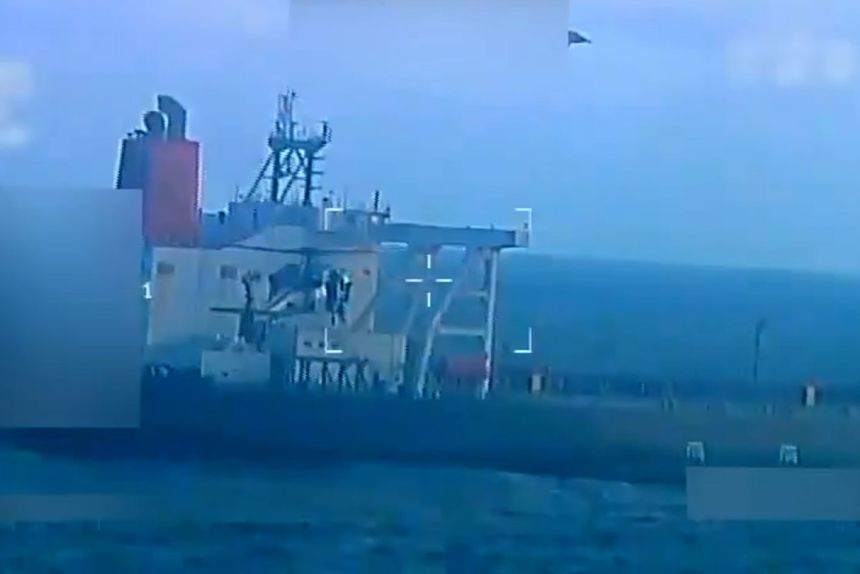
WASHINGON – White House Press Secretary Karoline Leavitt on Friday said the Department of Justice, working with the Coast Guard and the Department of War, had taken control of what she described as “a sanctioned shadow vessel known for carrying black market sanctioned oil to the IRGC.”
She said the vessel is now in a “forfeiture process,” with investigators interviewing crew members and collecting evidence.
“As you know, the vessel will go to a US port and the United States does intend to seize the oil,” she said, adding there is “a legal process for the seizure of that oil and that legal process will be followed.”
White House defended the US seizure of a Venezuelan oil tanker, calling it an enforcement step under American sanctions policy and declining to rule out further actions against illicit shipments in the region.
Leavitt responded that Trump views it simply as enforcement when asked whether the action represented an escalation or a step toward war.
“The President considers the seizure of the oil tanker as effectuating the administration’s sanction policies,” she said.
She also declined to preview whether further maritime or on-land actions may be taken.
“I won’t broadcast any future actions… but we’re not going to stand by and watch sanctioned vessels sail the seas with black market oil, the proceeds of which will fuel narco-terrorism of rogue and illegitimate regimes around the world.”
The oil seizure came after rising tensions between Washington and Venezuelan President Nicolás Maduro.
Trump was concerned that Russia’s Vladimir Putin had phoned Maduro to signal support, Leavitt replied: “I don’t think that would be concerning to the President at all.”
She confirmed that Trump has not spoken to Putin about the issue.
Ms. Levitt also avoided making comment on whether the President would consider a formal invitation from Colombia to visit the country after his sharp criticism of President Gustavo Petro.
The unfolding standoff has global energy implications, media reported.
She did not address whether Venezuelan oil seized by the US could be redirected to domestic markets, a question raised amid Trump’s emphasis on lowering energy costs.
India, a significant buyer of Venezuelan crude before US sanctions tightened, has closely monitored such disruptions.
Any escalation in US enforcement affects global supply patterns and pricing, particularly for refiners that previously relied on Venezuelan heavy oil.
US-Venezuela tensions have fluctuated over the years, with sanctions targeting illicit oil flows, narcotics networks, and political repression.
Biden administration briefly explored easing measures, but Trump has emphasized strict sanctions enforcement during his second term.
