
Modi’s Tech Hat-Trick Stuns the World: Three US CEOs Land in Delhi Hours After Trump’s Threat
“PM Modi’s Power Meetings Shock the World: Three US Tech Titans Land in Delhi Within Hours.”

Paromita Das
New Delhi, 12th December: For a country accustomed to diplomatic surprises, December 9 felt different—sharper, louder, and far more telling. It was a Tuesday that began like any other in New Delhi, but by the afternoon, the nation was witnessing a diplomatic spectacle unfolding at the Prime Minister’s Office. Three of the world’s most influential technology leaders—each commanding an empire larger than the GDP of several nations—landed in Bharat almost back-to-back. And each left behind the same unmistakable message: the future of global technology runs through Bharat.
What made the moment electric was not just their arrival but the timing. Barely 24 hours earlier, former US President Donald Trump had issued yet another warning to Bharat—this time over rice tariffs—boasting that he knew exactly how to “deal with Bharat.” The ink on that threat had not dried when three major American CEOs walked into PM Modi’s office with promises of unprecedented investments.
The symbolism was loud. The geopolitical message louder.
A Day When Diplomacy Outran Aggression
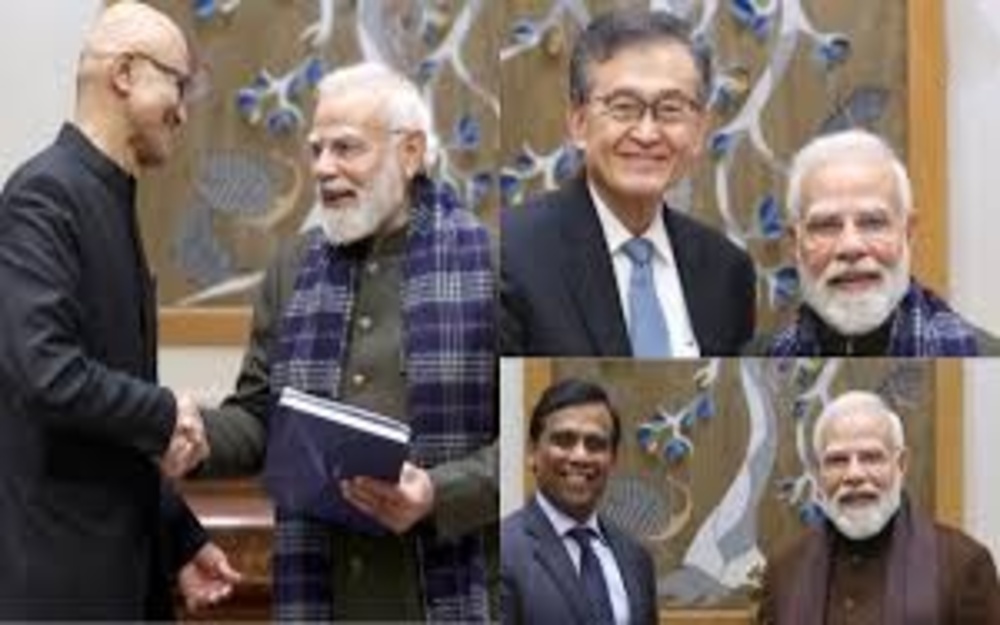
The sudden diplomatic hat-trick left even seasoned analysts stunned. In one swift afternoon, PM Modi received:
- Satya Nadella, CEO of Microsoft
- Lip-Bu Tan, CEO of Intel
- Ravi Kumar (CEO) and Rajesh Nambiar (Chairman) of Cognizant
All three meetings were high-level, strategic, and historic in scale. And all three companies announced massive commitments aimed at transforming Bharat’s technological landscape.
This wasn’t coincidence. It was choreography—global corporations demonstrating confidence in Bharat at a moment when political pressure from Washington was at its peak.
Satya Nadella’s Announcement That Changed the Equation
Among the three meetings, Satya Nadella’s visit made the biggest global splash. His announcement was nothing short of staggering: Microsoft will invest $17.5 billion (₹1.5 lakh crore) into Bharat’s AI and cloud ecosystem.
This is the largest single investment in Asia by any American tech company.
For Bharat, it signals a new inflection point. Nadella didn’t offer diplomatic platitudes—he made a strategic declaration:
“Bharat will shape the next era of AI.”
For the United States, the message was awkward. Less than a day after Trump’s aggression, a US corporate giant publicly demonstrated trust—and capital—in Bharat.
It wasn’t just investment.
It was reassurance.
And in many ways, a silent political contradiction.
Intel’s Lip-Bu Tan: Choosing Bharat Over the China Narrative
If Nadella brought shock, Intel brought intrigue.
Lip-Bu Tan, who has been repeatedly targeted by Donald Trump over alleged “China-friendly” leanings, chose Bharat—not China—to discuss semiconductor capacity building. And that alone overturned several assumptions in Washington.
Intel is the backbone of the global chip industry. For its CEO to arrive in Bharat immediately after Nadella sent another unmistakable message:
The world sees Bharat as the next semiconductor frontier.
With chip shortages reshaping global politics, this meeting signals that Bharat is now positioned as a stabiliser in the global tech supply chain—a role China once dominated.
Cognizant Completes Modi’s Diplomatic Hat-Trick
The third meeting came from Cognizant, another US tech powerhouse.
CEO Ravi Kumar and Chairman Rajesh Nambiar declared that they will scale up Bharat’s leadership in AI, digital engineering, and advanced computing.
This was not merely an investment pitch. It was a declaration of alignment: US companies see Bharat—not just as a workforce hub—but as the next base of technological innovation.
When three US giants endorse the same future within hours, the world pays attention.
Modi’s Triad of Meetings Marks a Shift in Global Tech Diplomacy
The dramatic sequence of these meetings suggests something deeper. It illustrates how Bharat has shifted from being a “market” to being a technology agenda-setter.
In an era where AI, semiconductors, and cloud computing are the new oil, nations compete not for territory but for technological advantage. And on that battlefield, Bharat has suddenly become the preferred partner for global corporations.
The timing is not accidental.
The confidence is not borrowed.
The future being envisioned is not temporary.
America’s political class may oscillate between pressure and threats—but America’s companies are voting with their wallets.
And they are voting for Bharat.
A Clear Message to the World—The Future Belongs to Bharat
December 9 will be remembered not because Trump threatened Bharat, but because global tech titans responded differently—with trust, investment, and long-term commitment.
Three CEOs.
Three transformative investments.
One clear geopolitical signal.
While the world watches the tug-of-war between political rhetoric and economic pragmatism, Bharat emerges as the quiet winner—a country that is no longer waiting to be acknowledged but is now shaping global technology on its own terms.
The message these CEOs delivered was simple:
Trump’s pressure may last a few years. Bharat’s rise will last a century.
