
Shyok Tunnel: Bharat’s Cold Desert Power Move Strengthening the China Border
“Shyok Tunnel: Bharat’s New Strategic Lifeline That Strengthens the LAC and Redefines Border Security.”

Paromita Das
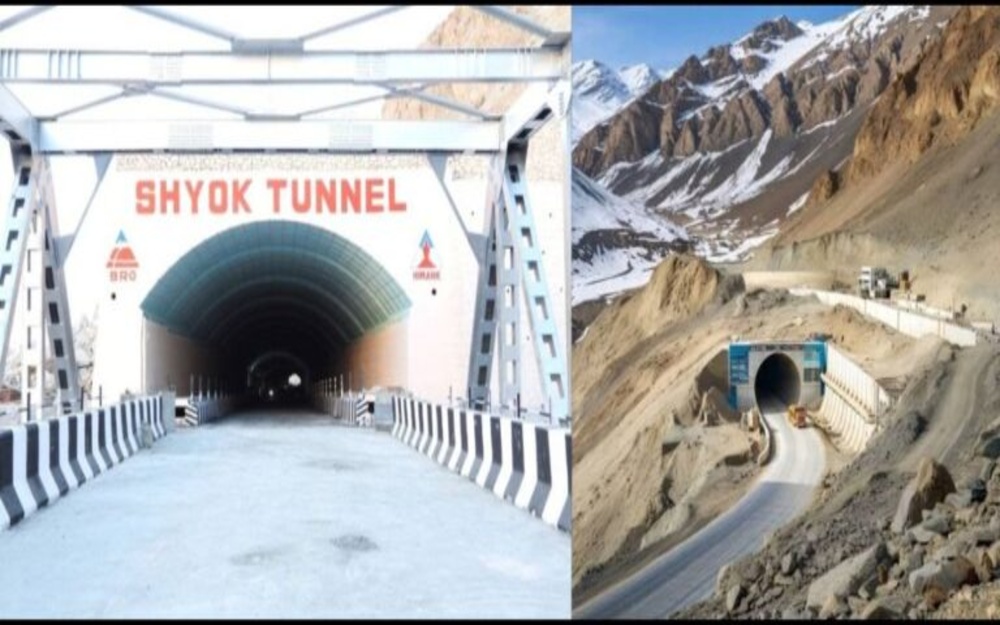
New Delhi, 12th December: High in the icy expanse of eastern Ladakh, where temperatures plunge deep into the negatives and the mountains often swallow roads without warning, Bharat has quietly rewritten the rules of border preparedness. The dedication of the Shyok Tunnel—a 920-metre engineering triumph—may look like a typical infrastructure announcement on the surface. But in the unforgiving terrain that hugs the Line of Actual Control (LAC), this tunnel is far more than concrete and steel. It is a message, a shield, and a strategic leap forward.
In a region where a sudden landslide can freeze troop movement and where China’s military posture remains unpredictable, every hour of delay matters. This tunnel does not just cut distance; it closes a vulnerability that has existed for decades. It signals that Bharat is not merely reacting to Chinese aggression anymore—it is preparing, anticipating, and strengthening.
A Strategic Passage Born Out of Hard Lessons
For years, military supplies to the forward posts along the Durbuk–Shyok–Daulat Beg Oldie (DSDBO) stretch faced nature’s wrath. Landslides, river swelling, avalanches, and flooding often left critical points isolated for days, sometimes weeks. In this volatile security climate, that was an unacceptable risk.
The Shyok Tunnel changes that equation.
Built away from the old route’s most dangerous segments, it ensures uninterrupted access to forward deployments. Even when the mercury collapses to minus 40 degrees Celsius, the movement of troops, weapons, ammunition, fuel, ration, and communication equipment will not halt.
This shift may appear logistical on paper, but tactically, it is transformative. In border zones where reaction time determines strength, the tunnel introduces consistency—a luxury the Army previously lacked.
A Dual-Use Asset: More Than an Ordinary Tunnel
The tunnel’s strategic edge does not end with connectivity. Designed as a dual-use structure, it can function as a secure bunker in wartime or during emergencies. For the Indian Army, this adds a protective layer to its defensive posture along the LAC.
At a time when China continues rapid military infrastructure expansion on its side of the border—building roads, rail lines, runways, and fortified shelters—the ability to shield personnel and assets within the tunnel grants Bharat deeper operational confidence. It allows faster reinforcement, secure storage, and flexible deployment during heightened tensions.
Engineering Against the Odds
From an engineering standpoint, the Shyok Tunnel’s story is remarkable. Constructed using lithic arch technology and modern pre-casting methods, the project was executed in one of the world’s harshest terrains. Engineers built not only the 920-metre tunnel but also two massive portals—one 520 metres long and the other 400—connected by a 25-metre bridge.
What makes this even more striking is the timeline. Construction began in August 2022, and within three years, Defence Minister Rajnath Singh dedicated it to the nation on December 7. Given the unpredictable terrain, sparse oxygen levels, and severe weather conditions, this pace is unprecedented.
Even more extraordinary is the cost. At ₹98 crore, the tunnel stands far below conventional estimates for a one-kilometre project, which generally range between ₹400–500 crore in easier, plain-terrain areas. The Shyok Tunnel demonstrates that strategic value does not always demand astronomical expenditure—it demands priority and precision.
A Reply to China’s Increasing Assertiveness
Bharat has learned, especially since the Galwan Valley clash in June 2020, that China’s threat is not rhetorical—it is structural. Beijing’s long-term strategy is marked by road-building, deep penetration infrastructure, and rapid mobilization abilities along the LAC.
The Shyok Tunnel fits into Bharat’s evolving doctrine: build resilience, reduce delays, and ensure that no forward post is ever cut off at a moment of crisis. It is a quiet but assertive answer to China’s border build-up.
Beyond Defence: A New Chance for Ladakh’s Development
While the tunnel’s defence implications are its most celebrated feature, its civilian significance cannot be overlooked. Ladakh has often felt distant—not just geographically but in terms of opportunities. Reliable connectivity to the region creates new pathways for border tourism, economic activity, and employment.
Tourists visiting the Galwan War Memorial, for instance, will now find easier access throughout the year. Local businesses, logistics networks, and service providers will benefit from the predictable traffic the tunnel enables. In frontier regions where economic opportunities are slim, infrastructure like this can be transformative.
A Tunnel That Symbolizes a Mindset Shift
The Shyok Tunnel represents more than a physical route; it reflects a national shift in thinking. For decades, Bharat approached border infrastructure cautiously, fearing escalation. But today, restraint has been replaced by readiness. Bharat is not building roads and tunnels out of insecurity—it is building them out of confidence.
This tunnel is a statement that Bharat intends to match China not through provocation but through preparedness. It symbolizes a new era where borders are not neglected edges, but active zones of investment, vigilance, and strategic foresight.
A Small Tunnel With a Big Message
In the stark silence of Ladakh’s high-altitude desert, the Shyok Tunnel stands as a powerful reassurance. It promises uninterrupted military access, guards against emergencies, boosts local livelihoods, and signals Bharat’s evolving strategic doctrine.
More importantly, it marks a commitment: that no terrain, no climate, and no adversary should stand between Bharat and its security. As geopolitical tensions continue to simmer, the Shyok Tunnel is not merely a passage through a mountain—it is a passage into a more secure, confident, and strategically strengthened Bharat.
