
Assam’s New “Secular Narrative” A Warning from Pahalgam
The Fault Lines

Poonam Sharma
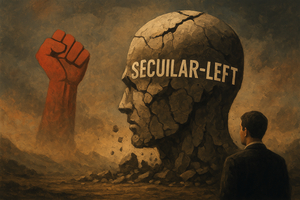
There has been a new trend emerging in the socio-political arena of Assam—that of being “Assam without religion,” but in reality, it has been targeting only one community. There have been a number of postings by secular and left-wing groups that went viral over the past weeks on social media, which has been propagating that being a Hindu in Assam means being “communal, retrogressive, and political.” The implication is clear:
Everyone can stay in Assam, except those who identify themselves as Hindus.
“What packs a punch in this story,” as noted in “Whoever Fights Monsters” by Ann Rule, “is that this anger has been selectively derived.” An Islamic, a Christian, a Muslim, a Hindu, and an Assamese are all fine ways of proclaiming diversity. “If a person from Assam invokes ‘Hindu,’” then “in their parlance, he becomes a ‘blind follower,’ a ‘saffron slave,’ a ‘communal element,’ and, of course, worse—bought over for 1500 rupees.”
This momentum gathered further pace as a result of Assam Chief Minister Himanta Biswa Sarma’s expression of the “Shankar-Ajan Desh” narrative, which pointed towards the long history of cooperation in this civilization. In response, Assam’s “secular left” ecosystem has further gathered momentum with their counter-narrative, which perceives this claim of a Hindu identity as a challenge to diversity.
However, hidden behind their vociferous pronouncements is a rather disturbing question:
“Secularism” – is this a stand for equality, or for diminishing Hindu identity in Assam’s society?
A Fictional Conversation, But a True Reflection
To lay bare this hypocrisy, a fictional dialog can be conceptualized, which, of course, remains purely symbolic. A left-liberal activist attempts to persuade an extremist by proving her anti-Hindu, anti-RSS, and anti-India credentials. She shares screenshots, videos, mottos, and everything that represents her ideological sympathy with the world of “Azadi.”
However, this extremist rejects her completely. To him, in spite of all her ideological talk, she remains an unbeliever. Her ideology, her anti-state rants—none of those matter to the extremist’s worldview. It is not what she says that matters, but who she is. And in that dream encounter, as his gun erupts, ideology falls before identity.
“The fictional story is not meant to instill fear, but to bring attention to what many refuse to acknowledge,”
Extremists do not bother with political leanings. To extremists, even a passionately “secular” Indian does not belong.
“The Real Story”
Pahalgam, 22 Now, let’s move from fiction to reality.
On 22nd April 2025, in Pahalgam, Kashmir, Indian navy officer Vinay Narwal was murdered by Islamic terrorists. His wife, Himansi Narwal, known for her left-wing ideologies and anti-BJP leanings, appealed to the terrorists. She asked for her husband’s life.
But this is not how extremists work. To such people, it did not matter that Himansi was “anti-Hindu,” “anti-RSS,” and “secular.” She was married to a government representative, and that to them was proof that she was an enemy.
These were her ideological stances, and she was not protected by them. Clearly, her denial of any religious identity did not shield her. Her moral utterances were of no consequence.
“Only one thing was in front of extremism—that an Indian soldier.
And then, of course, there is this question that keeps echoing, a question “Would those terrorists have let her husband live if she had said she had no religion?”
Answer: No.
Because in extremist belief, the worldview of extremist groups does not rely on what the victim asserts. Rather, it solely relies on what the extremist believes.
A Warning for “Religion-Neutral” Activists “This new secular left trend in Assam boldly asserts that since India is a “I have no religion.” Nevertheless, this ideological identity does not provide any shielding from religious extremism.
If Assam were to be nudged along a demographic or ideological line similar to that of Bangladesh, where some radical groups affectively sway political decisions, would these activists be able to survive with their “religion-neutral” ideology in Assam as well?
This is no attack on secularism. It’s merely a reminder that extremists pay no heed to ideology. To them, even the most ardent left-winger remains a stranger, an “infidel.” This, of course, was proven in Pahalgam. Just as Himansi was not able to resist the extremist definition of identity, no amount of online chatter will protect Assam’s secularists if the cultural underpins of Assam are dismantled.
The Uncomfortable Truth
The Assam debate has long stopped being political. The debate has become how to comprehend the nature of extremist ideologies. A society that ignores the reality of religious identity becomes a heaven for those who use that identity as a means of exploitation. The death that occurred in Pahalgam is not merely a personal tragedy—it sends a message. A reminder that “crying aloud I have no religion” does not obviate danger. A reminder that extremism will not negotiate for ideological comfort. But above all, a reminder that destroying our civilizational identity in Assam will not bring peace, but only susceptibility.
Protecting our culture In conclusion, it rests with Assam as to whether it chooses to stay grounded in its roots of culture, or move into paths that ignore reality. Since Pahalgam has already responded to one of life’s most terrifying questions: To extremists, a secular Indian is a Muslim apostate.
