
The UMEED Portal and the Unmasking of Bharat’s Waqf Property Crisis
“A System Built on Sacred Claims but Shrouded in Secrecy”

Paromita Das
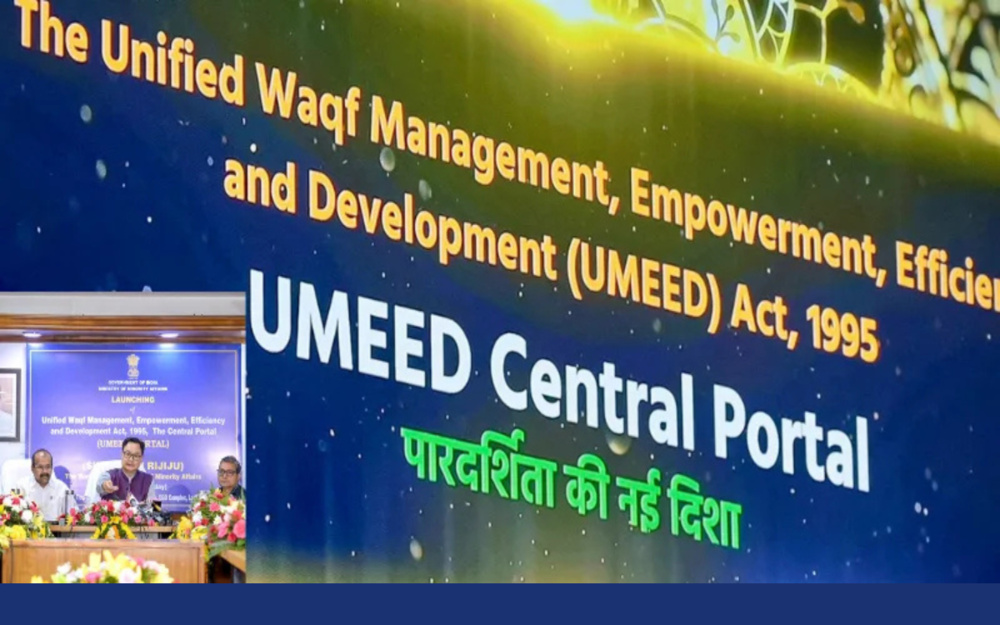
New Delhi, 10th December: The recent revelations around the UMEED portal have not merely stirred debate—they have jolted the nation into confronting a truth long whispered but rarely acknowledged. For decades, the Waqf system was presented as a noble, sacred framework designed to protect minority charitable properties. Yet behind the veil of reverence, it operated like a parallel land empire—untouched by scrutiny, immune to democratic checks, and guarded fiercely by layers of political patronage.
What gives this moment its gravity is not just technological failure, but the collapse of a myth that protected this ecosystem for generations.
The Numbers That Changed the Narrative
The startling revelation that only 2.16 lakh properties could be verified on the UMEED portal—against the Waqf Boards’ longstanding claim of nearly nine lakh properties—is nothing short of a public admission that something is deeply wrong. This discrepancy cannot be dismissed as clerical oversight or slow digitisation. It starkly exposes the inflated, unverified, and often dubious nature of thousands of Waqf property declarations.
For years, this ecosystem sold Bharat a narrative of sacred legitimacy. Now, the numbers themselves have turned into uncomfortable evidence.
How Arbitrary Declarations Distorted Land Ownership
Many Hindu families, temple trusts, and even government bodies have long complained about sudden, opaque declarations of land as Waqf property. Once the tag was applied, reversing it became a bureaucratic nightmare. Such sweeping authority, granted without proportional accountability, inevitably created space for misuse—and for quietly expanding territorial control under the cover of minority protection.
The UMEED portal disrupted this comfort zone by demanding proof—actual documents, maps, and legal titles. And that is precisely what triggered the collapse.
Political Patronage and the Growth of a Parallel Estate
Let’s be honest: this system didn’t flourish by accident. For decades, political parties nurtured an environment where questioning Waqf Boards was framed as communal or insensitive. The Boards, in turn, operated with remarkable impunity, managing land worth thousands of crores with almost no public auditing. Vote-bank politics built a protective cocoon around them, ensuring that no government dared disturb this structure—for fear of upsetting a carefully curated narrative of secularism.
When Technology Challenged Entrenched Power
Ironically, it was a simple digitisation exercise that finally shook the fortress. The UMEED portal did not ask for anything extraordinary—just transparency. But for a system thriving in opacity, this was a threat. The widespread non-compliance cannot be brushed aside. It clearly signaled that many properties lacked legitimate foundations or were acquired through questionable processes.
The scramble to approach courts for deadline extensions only reinforced the suspicion that the delay was deliberate—meant to buy time, adjust records, or obscure irregularities.
State-Level Patterns That Reveal a Larger Political Story
The dismal performance of states like West Bengal is not an administrative coincidence; it’s a political message. Protecting Waqf irregularities became part of a governance strategy that placed minority appeasement above fairness. Similarly, low registrations in Uttar Pradesh and Bihar point not to technical challenges, but to internal corruption, competing interests, and reluctance to give up control.
Unequal Religious Property Laws and the Question of Constitutional Fairness
A long-standing grievance among Hindu communities has been the lopsided nature of property regulation. Hindu temples are tightly regulated, audited, and in many states, controlled directly by the government. Waqf Boards, however, enjoy sweeping powers without equivalent oversight. The UMEED fallout has made this asymmetry impossible to ignore.
If the Boards were truly serving poor Muslims, their managers would have embraced transparency—not resisted it.
A Moment of Reckoning for Bharat’s Land Justice System
In my view, the UMEED portal’s greatest contribution was not digitisation—it was disruption. It pulled back the curtain on a land management empire that functioned beyond public accountability. Even though the portal was taken down, its impact remains irreversible. It sparked a national conversation about fairness, transparency, and the constitutional balance between religious rights and public interest.
Bharat now stands at a crossroads. Either it demands accountability from all religious institutions equally, or it continues nurturing parallel systems that divide society and undermine justice. What happens next will determine whether this country embraces genuine secularism—or continues hiding corruption behind the language of protection.
