
More Than a Motorcade: Modi’s Fortuner Ride With Putin Sends a Strategic Message
“A simple car ride to Hyderabad House turned into a masterclass in geopolitics, symbolism, and India’s growing diplomatic confidence.”

Paromita Das
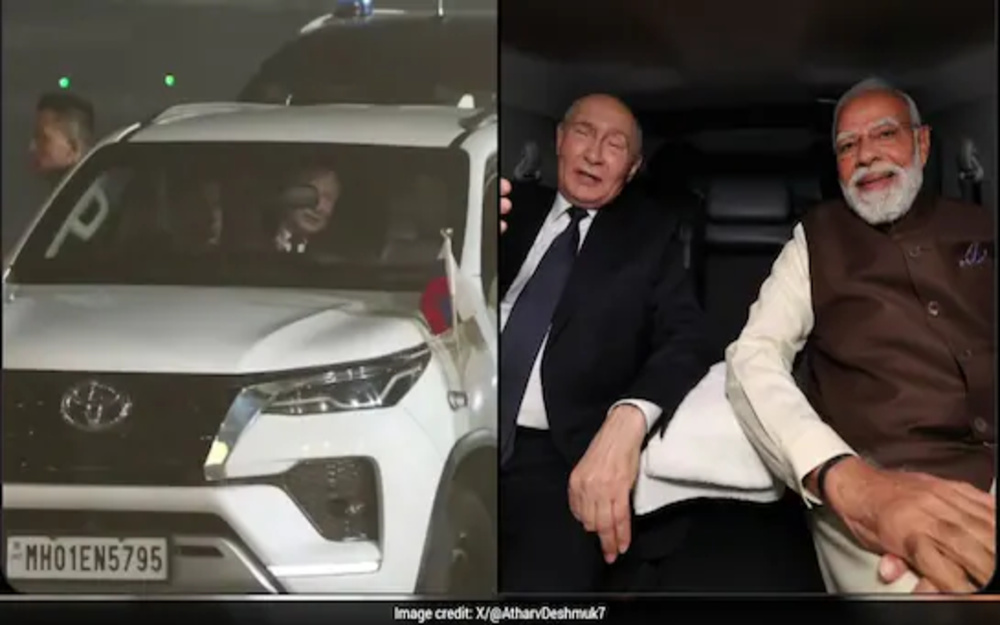
New Delhi, 10th December: When Prime Minister Narendra Modi stepped away from his usual fleet of European luxury cars and chose a Toyota Fortuner to drive President Vladimir Putin through the streets of Delhi, the moment went far beyond optics. It was not just a change of vehicle; it was a calibrated diplomatic message crafted for a world watching Bharat’s every move.
Global cameras were already fixed on New Delhi—after all, Putin’s arrival was an event that Western capitals scrutinised with unease. For months, the United States, the United Kingdom, Germany, and other Western nations had framed Bharat’s ties with Russia as a silent endorsement of the war in Ukraine. Some even suggested that New Delhi’s energy purchasing decisions indirectly supported Moscow’s military machinery. In that charged atmosphere, every gesture mattered. And Modi chose the one gesture that would speak louder than any official statement.
The result? A simple SUV ride became a geopolitical message of allegiance, autonomy, and strategic clarity.
A Fortuner Instead of a Mercedes: A Message the West Couldn’t Ignore
Prime ministers and heads of state do not usually tinker with their official car fleets—not when security, international protocol, and diplomatic norms are involved. Modi himself typically travels in a Range Rover or a Mercedes Maybach, both symbols of European automotive excellence and both deeply entwined with Western industrial power.
But as soon as Putin landed, that routine evaporated.
Instead of leading the Russian President into a German or British-made motorcade—countries that actively arm Ukraine, condemn Russia, and have repeatedly pressured Bharat—Modi invited Putin into a Toyota Fortuner, a vehicle manufactured almost entirely at Toyota’s plant in Bidadi, Karnataka.
It wasn’t just “Make in India” at play. It was Bharat signalling something deeper:
“We can step away from Europe—if only for a moment—to make our friend feel at home.”
This was not anti-West posturing. It was calibrated friendship—the kind that does not require dramatic speeches, only thoughtful gestures.
The Politics Behind the Steering Wheel
On paper, the decision appears harmless. But diplomatically, it carried layered meanings:
- The Fortuner represents Asia—Japan’s engineering blended with Bharat’s manufacturing strength.
- It sidelines European luxury brands at a moment when Europe is politically hostile toward Moscow.
- It subtly signals to Russia that Bharat values the friendship enough to create comfort—even symbolic comfort—amid global tensions.
- It demonstrates to the West that Bharat is not a junior partner in global politics; it is an autonomous power making its own choices.
In international relations, symbolism often influences outcomes more strongly than official statements. The Fortuner moment echoed this truth.
What appeared as a casual car ride was, in reality, a visual declaration of Bharat’s strategic independence, captured in global news headlines and social media chatter.
Why Bharat Needed This Moment
For nearly two years, Western commentaries attempted to portray Bharatas complicit in Russia’s war. Despite Bharat’s clear stand—calling for diplomacy and dialogue—the accusations persisted. The West wanted Bharat to distance itself from Moscow, reduce its energy purchases, and realign itself with Western strategies.
But Bharat knew something critical:
Putin’s arrival in Bharat would reset the narrative.
As soon as the Russian President landed, the dynamics shifted. Modi understood that millions worldwide—from Washington to Berlin—would watch closely. So he used a gesture that would invite attention without confrontation.
Choosing an Asian-manufactured vehicle was Bharat’s way of saying:
“We won’t disrespect the West, but neither will we let others dictate how we treat our oldest strategic partner.”
It was a subtle rebuke to Western nations that attempted to pressure Bharat while actively supporting Ukraine with weapons and intelligence.
Two Old Friends and a Quiet Display of Trust
There is also a personal angle that cannot be ignored. Modi and Putin have long shared a warm rapport—one that goes beyond protocol. Russia has stood by Bharat through wars, sanctions, and diplomatic confrontations. Bharat as reciprocated that loyalty by maintaining steady ties even when others threatened economic consequences.
For friends of such stature, Modi parking aside his luxury European fleet was more than symbolism—it was respect.
In Asian cultures, hospitality is never casual. When a friend arrives at your home, you ensure they feel welcomed, honoured, and safe. Modi extended this philosophy onto the global stage.
A Fortuner may not be glamorous compared to a bulletproof Mercedes, but it represented comfort, trust, equality, and gesture-based diplomacy—a language Putin understands well.
Diplomacy Is No Longer in the Drawing Rooms—It’s in the Details
The entire episode shows a shift in Bharatiya diplomacy. The older model relied on formal speeches and carefully worded statements. The new model blends gestures with strategy; it embraces symbolism without compromising substance.
Critics may minimize the act as theatrics, but global diplomacy is built on theatrics. Small gestures often achieve what long negotiations fail to deliver. The Fortuner moment encapsulated Bharat’s message of balanced non-alignment—the modern, confident version of it.
It also reflected Bharat’s larger evolution: from a nation once pressured into choosing sides, to a nation that dictates its own narrative.
A Car Ride That Became a Signal to the World
In the end, the decision to ride with Putin in a Toyota Fortuner was not a simple logistical choice. It was a diplomatic statement crafted with precision. It reminded Russia that Bharat does not waver in friendship. It reminded the West that Bharat will not be pressured into altering long-standing relationships. And it reminded the world that symbolism, when backed by confidence, is one of Bharat’s strongest tools.
What looked like a brief drive through Delhi may well be remembered as one of the most subtle yet powerful diplomatic messages of the year—a message delivered not through speeches, but through a steering wheel, an SUV, and a friendship on display.
\
