
Vande Mataram and the Politics of Division: Modi Rekindles a 150-Year Debate
“In reviving the Vande Mataram debate, Modi challenges a legacy of concessions and calls for a renewed national consciousness.”

Paromita Das
New Delhi, 9th December: The Lok Sabha witnessed an unusually charged moment when Prime Minister Narendra Modi reopened a long-simmering debate around Vande Mataram. His speech did not merely revisit history; it challenged a century-old political narrative that, according to him, reduced a national symbol to a tool of compromise. In doing so, the Prime Minister reignited questions about identity, unity, and the ideological fractures that shaped the early decades of independent Bharat.
At the heart of his argument was a pointed accusation: that Jawaharlal Nehru and the Congress Party had once diluted the stature of Vande Mataram, fearing it might alienate a section of the Muslim community. Modi declared this alleged compromise to be nothing short of a “misfortune” for the nation—an act of political surrender before the Muslim League at a decisive moment in Bharat’s constitutional journey.
A Song That Became a Battle Cry
Modi’s speech drew heavily on the emotional and historical weight of Vande Mataram, describing it not as poetry but as a “mantra of sacrifice.” It was, he argued, the lifeblood of the freedom struggle, a force that fortified revolutionaries and united millions across regions and eras.
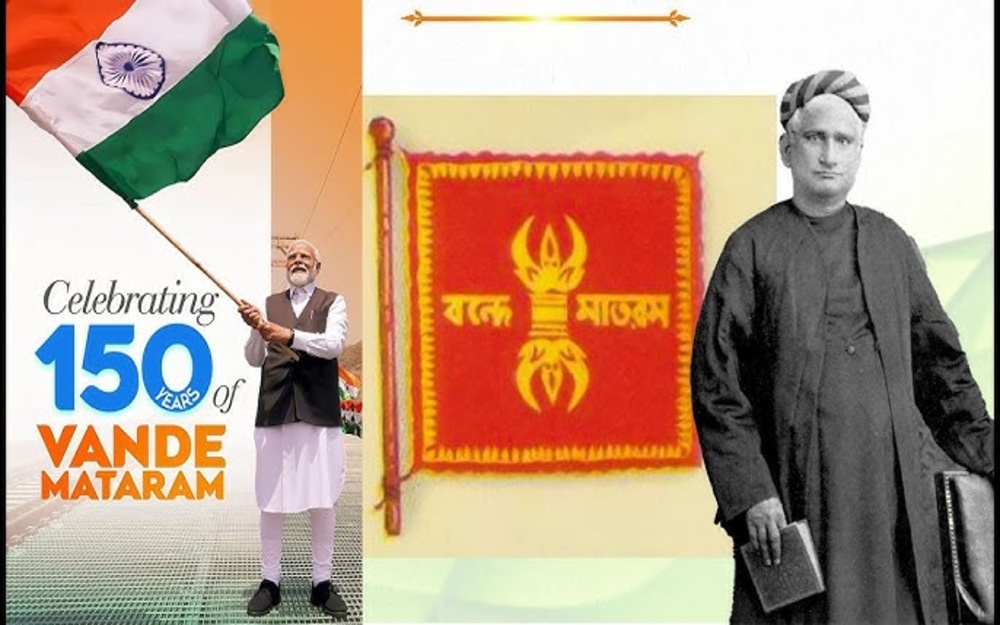
But Modi’s framing went deeper than nostalgia. As the country marks 150 years of the song’s composition, he attempted to reposition Vande Mataram at the centre of a renewed national consciousness—linking it with other milestones such as 75 years of the Constitution and commemorations of leaders like Sardar Patel, Birsa Munda, and Guru Teg Bahadur.
In this narrative, Vande Mataram is not an artefact from the past, but a living reminder of the spirit that shaped modern Bharat.
A Shadow Over Congress: The Debate Modi Revived
Modi’s charge against Nehru was not merely symbolic—it carried political weight. He accused Bharat’s first Prime Minister of yielding to the Muslim League’s sensitivities by fragmenting national consensus around the song. Though historically debated, Modi portrayed this as a decisive moment that weakened Bharat’s civilisational confidence.
He drew attention to two symbolic timelines:
- At 50 years of the song, Bharat was still under British rule.
- At 100 years, Bharat was under the Emergency.
Modi argued that both periods reflected suppression—first by colonial power, later by authoritarian governance. The implication was clear: the Congress, which inherited the moral responsibility of defending Bharat’s cultural legacy, instead allowed political insecurity to overshadow national pride.
This rhetorical framing allowed Modi to connect past political decisions with contemporary ideological debates, suggesting a continuum of apprehension within Congress about overt cultural symbolism.
When Vande Mataram Stopped a Nation From Breaking
Perhaps the most evocative part of his speech came when he recalled the partition of Bengal in 1905. In Modi’s telling, the British may have succeeded in drawing lines on a map, but Vande Mataram erased those lines in the minds of Bharatiya.
He praised Bengal’s intellectual tradition—leaders like Aurobindo, Tagore, and countless activists who turned the song into a weapon of unity. The imagery he invoked was unmistakably powerful: Vande Mataram standing like a “rock” between Bharat and division.
This historical reference served a dual purpose. It reinforced the song’s nationalistic legacy, while subtly arguing that cultural unity has always defeated divisive politics—past or present.
A Call for Unity in a Fragmented Era
The Prime Minister ended his speech with a tone of reconciliation, insisting that the debate over Vande Mataram should rise above party lines. “There is no leadership and opposition here,” he said, emphasising that the debt to Vande Mataram belongs to all Bharatiya.
But beneath this call lay a deeper message: the nation must “unite again,” drawing from the song’s ethos to achieve the goals of a developed and self-reliant Bharat by 2047.
This appeal attempted to transform the debate from a historical dispute into a forward-looking aspiration—linking cultural pride with economic ambition.
Why the Song Still Sparks Political Tension
Even 150 years after its creation, Vande Mataram remains one of Bharat’s most politically loaded cultural symbols. Its role in the independence movement is unquestionable, yet its place in independent Bharat has been complicated by ideological divisions, religious sensitivities, and contrasting visions of nationalism.
Modi’s argument—that the Congress sidelined the song out of fear—is deeply political, but it also reflects a broader tension about how Bharat negotiates identity in a diverse society. The song continues to carry emotional weight because it stands at the intersection of culture, history, and politics.
And the ideology that once opposed Vande Mataram, the Prime Minister hinted, still exists—reshaped, rebranded, but not erased.
A Needed Debate, But Also a Delicate One
Modi’s intervention reopens a conversation that Bharat perhaps needed, but also one that demands sensitivity. Revisiting historical decisions is important, especially when national symbols are involved. Yet the debate must avoid reinforcing old communal fault lines.
Vande Mataram is a soaring celebration of the motherland, but its strength lies in its ability to unite, not divide. The challenge is ensuring that cultural reclamation does not slip into cultural confrontation.
A Song, A Nation, and an Unfinished Dialogue
As Bharat celebrates 150 years of Vande Mataram, the moment is more than commemorative—it compels introspection. Modi’s speech may polarise political opinion, but it undeniably brings the national song back into public consciousness.
In the end, Vande Mataram survives not because politicians debate it, but because generations of Bharatiyas—across faiths, languages, and regions—made it their own. Its legacy is far greater than the disputes that surround it.
A century and a half later, the song still asks the same question of the nation: what does unity mean, and who does the nation choose to be?
