
Tharoor’s Invitation, Opposition’s Exclusion: A Political Signal?
“A Seat at the Table: What the State Dinner Exclusion Reveals About Power, Politics and Shashi Tharoor.”

Paromita Das
New Delhi, 6th December: In politics, it is rarely the loudest speeches that define a moment. More often, it is the quiet decisions — who is invited, who is excluded, who is placed where — that reveal the true architecture of power. The selective invitation list for the State Dinner has become one such revealing moment, exposing not just political preferences but an entire philosophy of governance.
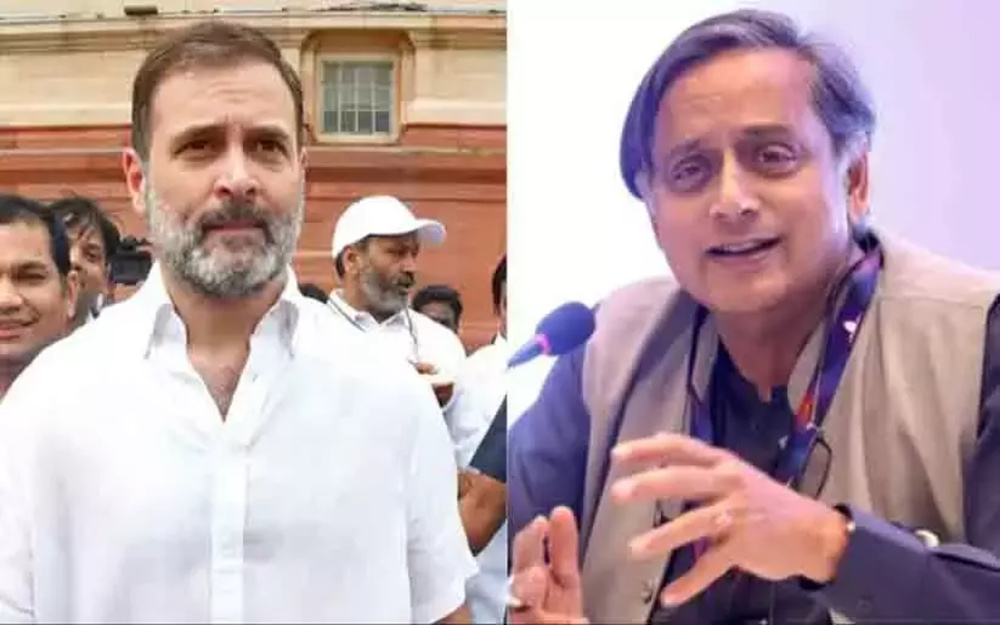
When the Leader of the Opposition — a constitutional office meant to balance the scales of parliamentary democracy — is left out of a formal state event, it is more than a procedural oversight. It is a message. And messages in politics are never accidental.
What makes the moment even more striking is that a single MP from the same opposition, Shashi Tharoor, found his name comfortably placed on that guest list. This was not a clerical error. This was deliberate curation. And that curation tells a story.
Democratic Protocol Treated Like Private Property
The exclusion of the Leader of the Opposition is not merely a breach of etiquette; it chips away at the dignity of Bharat’s democratic institutions. When protocol begins to resemble preference, and state functions begin to feel like private events, the system weakens — not in a dramatic collapse, but in subtle, corrosive ways.
A functioning democracy thrives on institutional respect. When a ruling establishment decides who is “acceptable opposition” and who is not, the balance that sustains parliamentary culture tilts dangerously.
This is the backdrop against which Tharoor’s invitation stands out — not as an honour, but as a strategic move.
The Long, Slow Drift of Shashi Tharoor
Shashi Tharoor’s political journey has always carried elements of contradiction: eloquent yet unpredictable, ambitious yet ambivalently placed within his own party. His bid for Congress presidency in 2022 was framed as an act of internal democratic reform. But his defeat, and the aftermath, triggered a steady estrangement between him and the leadership that had repeatedly backed him.
It is important to remember that Tharoor’s political stature did not emerge in a vacuum. For four consecutive elections, the Congress machinery, cadre and organisational strength carried him to Parliament from Thiruvananthapuram — including the 2024 win against Rajeev Chandrasekhar by 16,077 votes, a victory rooted not merely in personal appeal but in party support across Kerala.
Yet, almost immediately after securing his seat this time, he seemed to shift. Not cautiously. Not diplomatically. But in ways that appeared almost choreographed — praising the government in moments where the Opposition expected critique, signalling openness where the party expected solidarity.
Whether intentional or not, his recalibration served a political purpose — just not Congress’s.
The BJP’s Usefulness Calculation
The BJP does not need Shashi Tharoor to win Kerala. It does not need him to shape electoral fortunes. But it does benefit from the symbolism he carries: articulate, internationally acceptable, media-friendly, and formerly a key Congress figure. His presence at a State Dinner sends a message that stings the Opposition and provides a veneer of bipartisan sophistication to the ruling establishment.
In effect, Tharoor becomes a tool — a status symbol, a message-bearer, an adornment of inclusivity in a setting where meaningful opposition is deliberately excluded.
What does he gain? A seat at the table. Perhaps the promise of smoother political weather in the future. Maybe even the quiet possibility of a Rajya Sabha berth. But these are transactional rewards, fleeting and fragile. And none of them guarantee him electoral security if he ever contests Kerala on a BJP ticket — a scenario widely seen as an uphill battle.
Ambition or Something Deeper?
Political realignments are part of democracy. Ideologies shift, loyalties evolve, careers turn. But the discomfort here is not about change; it is about timing and intent. When a leader chooses to move away from the party that built his public identity, that fought for him, that stood by him in victory and defeat — and does so at a moment when the party is at its weakest — it feels less like reinvention and more like settling scores.
Tharoor, a man who often speaks of principles, dignity and the moral weight of public life, appears now trapped in a contradiction. The intellectual grace he projects sits uneasily with actions that seem driven by residue from an internal election lost two years ago.
A Small Moment With Big Implications
The State Dinner story is not about one MP’s invitation or one leader’s exclusion. It is about the slow erosion of institutional respect, the manipulation of protocol for political optics, and the temptation of personal relevance over collective responsibility.
Tharoor’s acceptance of this invitation — in the absence of his own parliamentary leader — widens the fracture in an already struggling Opposition. But more importantly, it reveals the strategy of a government that chooses its “favourite critics” and sidelines the rest.
In a mature democracy, dissent is not curated; it is respected.
The Dinner Is Over, but the Message Remains
When the lights dim and the chairs are cleared, the incident will not be remembered for its menu or its music. It will be remembered for what it said about power — and about those who chose proximity to it over solidarity with their own institutions.
Shashi Tharoor may believe he is navigating a sophisticated political path. But in the harsh clarity of public perception, his move appears less like strategy and more like surrender. And for a leader who built his brand on intellect and dignity, this descent feels uncomfortably small.
The dinner lasted a few hours.
Its implications may last far longer.
