
India-Russia unveils Vision 2030 document, deeper bilateral cooperation a message to Trump

By Anjali Sharma
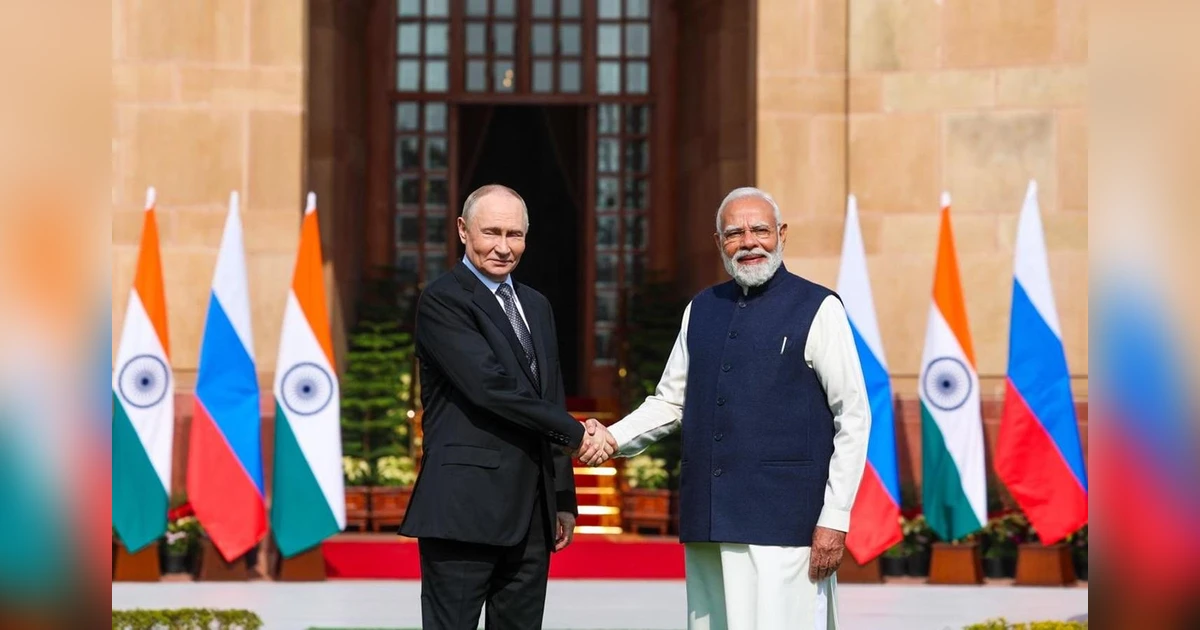
WASHINGTON – India and Russia Friday unveiled India-Russia unveils Vision 2030 document a wide-range set of agreements to deepen bilateral cooperation in trade, health, maritime training, media, and climate action, as Prime Minister Narendra Modi and Russian President Vladimir Putin held the 23rd India-Russia Annual Summit in New Delhi.
Both countries adopted a “Programme for the Development of Strategic Areas of India–Russia Economic Cooperation till 2030”, aimed at guiding bilateral cooperation in trade, energy, connectivity, logistics and technology, media reported the officials.
Prime Minister Narendra Modi said India and Russia have signed a Vision 2030 document on bilateral economic cooperation till 2030 as he addressed a joint press conference at Hyderabad House in Delhi.
Modi said he and his friend President Putin have agreed on a common priority to take the bilateral economic partnership to new heights and enhance cooperation in strategic areas of the two countries’ economies.
PM Modi said, “To further economic cooperation, we have signed a Vision 2030 document. Today, both of us will take part in the India–Russia Business Forum. I am confident this platform will strengthen our business relations and open new avenues for co-production and co-innovation. Both countries are also taking new steps to realise an FTA with the Eurasian Economic Union.”
Putin pointed out that PM Modi has particularly highlighted some key areas of cooperation and concern, adding that both Russia and India will prioritize action on them.
“The Prime Minister gave us a list of challenges that deserve the attention of both governments, and we will act on them. The creation of a Free Trade Agreement between India and the Eurasian Economic Union will help. Our countries are gradually moving to mutual settlements in national currencies, which already account for 96% of commercial transactions,” Putin said.
“Last year, our bilateral trade turnover grew by 12 per cent, setting a new record. We are currently forecasting that this year’s trade agreement will remain at the same impressive level,” Putin said.
He added the two countries are looking to increase annual bilateral trade volume to USD 100 billion.
According to a joint statement, India and Russia have agreed to continue jointly developing systems of bilateral settlements through the use of national currencies in order to ensure the uninterrupted maintenance of bilateral trade.
Both sides have agreed to continue their consultations on enabling the interoperability of the national payment systems, financial messaging systems, as well as central bank digital currency platforms.
Modi said energy security has been a strong pillar of the India-Russia partnership, and the two countries will continue this win-win cooperation in what is being seen as a clear message to US President Donald Trump, who imposed penalty tariffs on India for purchasing Russian oil.
Putin assured Russia is ready for an uninterrupted fuel supply to India, and added that the two countries are witnessing “successful partnerships in energy: stable supplies of oil, gas, coal, and everything required for India’s needs.
He had said that when Washington can purchase (nuclear) fuel from Moscow, why can’t India have the same privilege.
Putin also said that he is ready to raise the issue with President Trump.
Foreign Secretary Vikram Misri said Modi-Putin summit meeting, both countries will continue to work together to promote mutual trade in national currencies.
“Both countries are continuing to work together to promote mutual trade in our national currencies. You would be aware that Special Rupee Vostro Accounts have been opened in significant numbers. They right now form a very effective mechanism in terms of lubricating, so to speak, the trade flows between the two countries,” he said.
He added that one of the major objectives of the visit was to reach an understanding on increasing Indian exports to Russia. “We also hope, as I said, one of the major objectives during this visit was to reach an understanding on how to increase Indian exports to Russia so that we can better address the trade imbalance between the two countries,” Misri explained.
The pacts on migration, health, maritime training, customs, academia and media were signed during the 23rd India-Russia Annual Summit.
On migration and labour, India and Russia signed an agreement on temporary labour activity of citizens of one state in the territory of the other state.
They also signed a pact on cooperation in combating irregular migration.
India’s Ministry of Health and Family Welfare and Russia’s Ministry of Health signed an agreement on cooperation in healthcare, medical education and science.
Food Safety and Standards Authority of India (FSSAI) and the Federal Service for Surveillance on Consumer Rights Protection and Human Well-being (Russian Federation) signed a pact in the field of food safety.
Ministry of Ports, Shipping and Waterways of India and the Ministry of Transport of the Russian Federation also signed an MoU on the Training of Specialists for Ships Operating in Polar Waters.
India’s public sector firms, Rashtriya Chemicals and Fertilizers Ltd, National Fertilizers Ltd and Indian Potash Ltd signed a major fertiliser MoU wtih Russian firm JSC UralChem.
Several other pacts in the field of customs and commerce, media and academic collaboration were also inked during the Modi-Putin summit.
