
Modi–Putin Summit Poised for Mega Defence Deals Worth Billions
Su-57 jets and S-500 missile shield likely on agenda as India deepens strategic autonomy

GG News Bureau
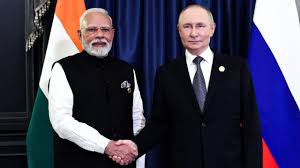
New Delhi, 5th Dec: The 23rd India–Russia Annual Summit opened in New Delhi on Friday, with Prime Minister Narendra Modi and Russian President Vladimir Putin holding high-stakes talks that could reshape India’s future air power and missile defence capabilities. The meeting—Putin’s first visit to India in four years—comes amid mounting anticipation of multi-billion-dollar defence agreements involving cutting-edge fighter jets, advanced missile systems, and major upgrades to existing platforms.
Putin arrived on December 4 to an unscheduled personal welcome from Prime Minister Modi, an uncommon gesture signalling the depth and durability of the bilateral partnership. Defence, energy, and trade remain the cornerstone of the relationship, with Russia still India’s largest arms supplier, accounting for 36% of all imports in 2024, according to SIPRI.
Su-57 Deal Could Bring India Into Fifth-Gen Fighter Club
One of the biggest announcements expected is India’s possible acquisition of the Su-57, Russia’s premier fifth-generation stealth fighter jet and counterpart to the U.S. F-35. India is reportedly eyeing two squadrons (84 jets) to plug gaps in its fighter strength.
In a move that could significantly boost India’s aerospace sector, Russia has offered 100% technology transfer, enabling production at HAL Nasik under the ‘Make in India’ initiative. With an estimated cost of $300 million per aircraft, the deal could touch $74 billion, offering a crucial bridge until India’s indigenous AMCA fighter is ready.
S-500 Missile Shield: India Eyes Hypersonic Defence
Another high-impact proposal is India’s acquisition of the S-500 ‘Prometheus’, Russia’s most advanced air defence system capable of intercepting hypersonic missiles, ballistic missiles, and even low-Earth-orbit satellites.
With a range of 600 km, the S-500 would significantly extend India’s current S-400 air defence umbrella. Negotiations are underway for a $5.4 billion package, including 60% technology transfer and joint manufacturing with Russia’s Almaz-Antey, potentially benefiting Indian companies like BEL.
Other Major Programmes on the Table
The summit also covers a wide array of military programmes:
- S-400: Remaining deliveries and a new $3 billion deal for 280 missiles
- BrahMos: Range extension to 800 km and launch of the next-gen BrahMos-NG
- Su-30MKI: Overhaul and upgrade of 100 jets, valued at $7.4 billion, in partnership with HAL
- Navy assets: Progress on light tanks (Sprut), Pantsir air defence systems, Talwar-class frigates, and the long-awaited Akula-class submarine by 2028
Russia has also highlighted the success of the S-400 during Operation Sindoor, where the system reportedly neutralised 95% of Pakistani drones—an achievement noted by Indian planners evaluating the S-500.
Economic Ripples and Strategic Messaging
Defence stocks including HAL, BDL, Mazagon Dock, and L&T have surged ahead of the summit. Analysts forecast a 20–30% jump if the Su-57 and S-500 deals are finalised.
Beyond defence, Modi and Putin will also review plans to link India’s RuPay with Russia’s Mir digital payment system and expand cooperation on affordable oil supplies, strengthening economic resilience amid global uncertainty.
A Signal of Strategic Autonomy
The summit underscores India’s commitment to strategic autonomy, continuing robust defence cooperation with Moscow despite Western pressure and potential CAATSA sanctions. For New Delhi, the message is clear: its defence choices will be guided by national interest, not geopolitical coercion.
As negotiations continue, today’s summit is expected to set the tone for the next decade of India–Russia security cooperation—one defined by advanced technology, co-production, and a stronger military balance in the region.
