
Behind Adiala’s Walls: The Battle Over Imran Khan’s Visibility and Pakistan’s Power Struggle

Paromita Das
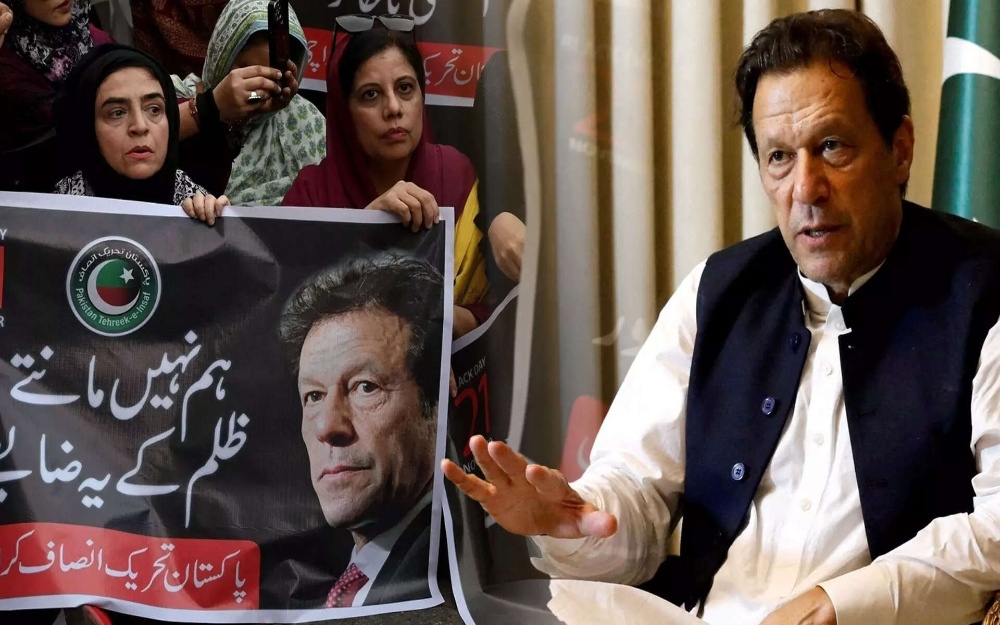
New Delhi, 2nd December: Whispers often travel faster than truth, and in Pakistan’s hyper-charged political climate, rumor has become a weapon of its own. When speculation about former Prime Minister Imran Khan’s death in jail began circulating online, it did not spark global diplomatic alarms—but it did ignite something far more unsettling at home: panic, outrage, disbelief, and a renewed fear that an already fragile system had crossed another dangerous line. Though authorities quickly denied the rumors, the official response did little to calm a charged public that has had no real visibility of Khan for weeks. What has grown louder instead is a collective distrust—one that now overshadows Pakistan’s institutions more than ever before.
The Vanishing Act Behind Bars
Imran Khan, serving a 14-year sentence in the Al-Qadir Trust case, has been incarcerated since August 2023. His conviction has always been controversial, described by his supporters as a politically engineered operation designed to eliminate him from Pakistan’s political landscape. The Islamabad High Court had ordered bi-weekly access for Khan’s family and lawyers, a simple, transparent mechanism to ensure his well-being. Yet, despite repeated directives—including a renewed order in October 2025—those visits have dried up mysteriously.
His sisters, Aleema, Noreen and Uzma, say they have been denied entry for weeks. Their account of being shoved, manhandled, even “brutally assaulted,” while protesting outside Adiala Jail paints a chilling picture of an establishment anxious to control the narrative. They claim they have not seen Khan, not heard his voice, nor received any confirmation of his physical condition. And while Aleema insists she believes “no one can dare touch my brother,” the family’s legal petition demanding that Khan be physically produced before a court reveals how deep their concern truly runs.
Silence as a Political Strategy
Perhaps the most anguished voice has been that of Khan’s son, Kasim, who publicly appealed to the international community, calling the situation an “absolute blackout.” No calls. No visits. No proof of life. For a month, he says, the family has been locked out completely. Jemima Goldsmith, Khan’s former wife, echoed the alarm, focusing not on politics but on basic human rights. She even claimed authorities threatened arrests if her sons attempted to visit their father.
Such silence is rarely accidental. In Pakistan, opacity has often served as an instrument of control. The absence of information fuels suspicion—and that suspicion feeds a narrative that Khan is being held in a “death cell,” cut off from the world to break his political momentum or hide his deteriorating condition. Regardless of whether the rumours are true, the government’s refusal to follow court-ordered access has created what his supporters describe as a “vacuum of truth”—one that is now being filled by anxiety, anger, and conspiracy.
A Political Trial or a Personal Vendetta?
To understand the intensity of the current moment, one must revisit how Imran Khan’s downfall unfolded. His supporters have long claimed that the legal avalanche against him—over 150 cases in total—was orchestrated by Pakistan’s entrenched power centers, particularly the military establishment. The timing of his arrests, the speed of his convictions, and the government’s sweeping crackdown on his party all strengthen that perception.
At the heart of this fraught equation is his relationship with Army Chief General Asim Munir. Their animosity is no secret. Munir briefly headed the ISI in 2019 but was removed shortly after confronting Khan with alleged corruption findings involving his wife, Bushra Bibi. Since then, Khan’s public rhetoric has cast Munir as the architect of his removal and imprisonment. Munir’s recent elevation to Field Marshal, along with expanded powers and immunity, is perceived by Khan’s camp as the consolidation of an unchallenged command structure aimed at sidelining the PTI indefinitely.
This clash has spiraled into open hostility. Khan has repeatedly declared he will not negotiate with the current power structure, insisting that “all authority lies with General Munir.” The message is clear: there is no political compromise left—only confrontation.
A Country Split Down the Middle
The crisis surrounding Imran Khan is not just a personal saga. It is symptomatic of deeper structural fractures within Pakistan. His imprisonment has hardened loyalties among young Pakistanis, the urban middle class, and those who see him as a lone figure battling a corrupt order. Even the unprecedented June 2023 attacks on military installations, carried out by enraged supporters, highlighted the extraordinary resentment brewing beneath the surface.
Yet the other side of Pakistan’s political aisle sees Khan as a destabilizing populist who challenges institutions with reckless abandon. His critics argue that he, too, weaponized the legal system against opponents while in power. The cycle, therefore, is not new—it has merely intensified.
But this time, something feels different. With the judiciary accused of selective judgments and the military openly accused of political engineering, public trust in state institutions appears to be draining faster than ever. The disappearance of transparency around Khan’s imprisonment has transformed a legal battle into a moral and existential one.
Rumors Are a Symptom, Not the Problem
The real story is not whether Imran Khan is alive or dead. It is why such rumors feel plausible to millions. A system that repeatedly suppresses visibility creates its own crisis of legitimacy. In Pakistan, where leaders have been exiled, executed, and silenced before, silence itself becomes a form of violence—a tool as powerful as any verdict.
If there is a lesson to be drawn, it is this: institutions lose authority when they lose credibility. And once credibility begins to unravel, it rarely stops at one man or one case.
A Critical Moment for Pakistan
Imran Khan’s fate is no longer just about the former prime minister. It is about what kind of state Pakistan chooses to be at this crossroads. Whether one admires him or opposes him, the denial of court-ordered access to an incarcerated political figure raises questions no democracy can afford to ignore.
Transparency is not a favor—it is a foundation. And until Pakistan restores it, rumors will continue to run freer than truth, deepening the unrest that now defines the nation’s political heartbeat.
