
PM Modi Inaugurates Skyroot’s Infinity Campus in Hyderabad
PM unveils Vikram-I orbital rocket; hails India’s youth-led space revolution

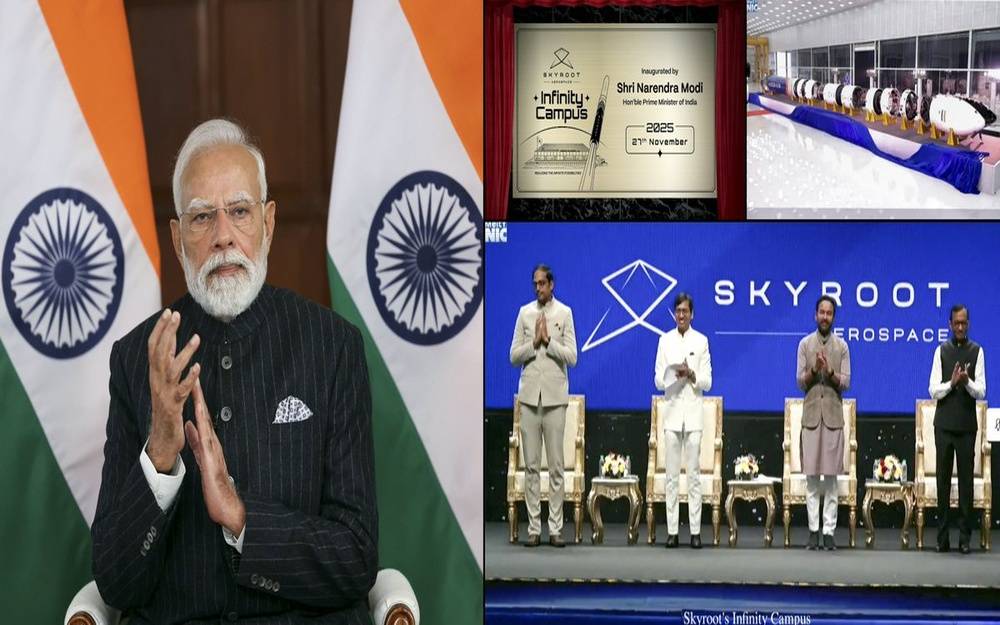
- PM Modi inaugurates Skyroot’s Infinity Campus via video conferencing
- Vikram-I, Skyroot’s first orbital rocket, unveiled
- PM says India now has an open, innovation-driven space ecosystem
- Over 300 space startups emerging as backbone of private space revolution
GG News Bureau
Hyderabad, 27th Nov: Prime Minister Narendra Modi on Thursday inaugurated Skyroot’s Infinity Campus in Hyderabad, Telangana, via video conferencing. During the event, the Prime Minister unveiled Skyroot’s first orbital rocket, Vikram-I, which has the capability to launch satellites into orbit. He said the achievement reflects India’s emerging leadership in the global satellite launch ecosystem.
Addressing the gathering, the Prime Minister said the country is experiencing an unprecedented opportunity in the space sector, with the private industry taking major strides. He noted that Skyroot’s new campus represents the nation’s fresh thinking, innovation, and youth power, adding that the innovation and risk-taking ability of India’s young entrepreneurs is reaching new heights.
The Prime Minister praised Skyroot founders Pawan Kumar Chandana and Naga Bharath Daka, calling them an inspiration for India’s aspiring space entrepreneurs. “They trusted themselves, took risks, and today the nation is proud of their success,” he remarked.
Recalling India’s early space journey, the Prime Minister highlighted how the country began with limited resources but limitless ambition. He said India has evolved from transporting rocket parts on bicycles to building some of the world’s most reliable launch vehicles. He added that ISRO’s credibility, capacity and value have helped India secure a distinct identity in the global space arena.
Highlighting the transformative changes in the sector, the Prime Minister said space technology today drives communication, agriculture, marine monitoring, weather forecasting, urban planning and national security. He said this expansion made reforms essential, leading to the opening of the space sector to private players, introduction of the new Space Policy, and the establishment of IN-SPACe to enable startups to access ISRO facilities and technology.
He said that in just six to seven years, India has turned its space sector into an open, cooperative and innovation-driven ecosystem. He added that more than 300 space startups are now building propulsion systems, composite materials, satellite platforms, and rocket stages—many of them beginning with just two or five young innovators working from small rented rooms.
The Prime Minister said global demand for small satellites is rising sharply and that new companies entering the market have made space a strategic asset. He stressed that the global space economy will expand manifold in the coming years, offering major opportunities for India’s youth.
“India possesses capabilities that only a few nations have—expert engineers, strong manufacturing, world-class launch sites, and an innovation-driven mindset,” he said. The Prime Minister added that India’s cost-effective and reliable solutions have boosted global confidence, with foreign companies increasingly looking to manufacture satellites, seek launch services, and pursue technology partnerships in India.
The Prime Minister linked this rise to the broader startup revolution underway in the country. He said India’s young innovators are reshaping sectors including FinTech, AgriTech, HealthTech, ClimateTech, EduTech and Defence Tech. He pointed out that India is now the world’s third-largest startup ecosystem, with more than 1.5 lakh registered startups emerging from big cities as well as smaller towns and villages.
He noted that India is progressing rapidly in deep-tech, hardware and manufacturing. Citing the semiconductor sector, he said government initiatives are strengthening India’s tech foundation, with fabrication units and chip design hubs coming up across the country. India, he said, is building a strong electronics value chain, laying the foundation for global supply chain leadership.
The Prime Minister also said that just as the space sector was opened to private participation, reforms are now progressing in the nuclear sector, creating opportunities in small modular reactors and advanced reactors. He emphasized that research will define the future, highlighting government initiatives such as the National Research Foundation, the One Nation, One Subscription scheme for access to international journals, and the ₹1 lakh crore Research, Development and Innovation Fund.
He said more than 10,000 Atal Tinkering Labs have already been established and work is underway to set up 50,000 more labs to nurture a culture of research among students. He reiterated that India’s future—on Earth and in space—will be defined by the innovation and determination of its youth.
The Prime Minister assured startups, scientists, engineers and entrepreneurs that the government stands firmly with them. He congratulated the Skyroot team and urged everyone to work collectively to make the 21st century the century of India.
Union Minister G. Kishan Reddy and other dignitaries were present at the event.
